 Taiwanese people participating in the 'Pineapple Eating Challenge' on social networking services (SNS) such as Facebook. [Facebook capture. Resale and DB prohibited] / Photo by Yonhap News
[Asia Economy Reporter Choi Eun-young] Since Tsai Ing-wen, who pursues Taiwan independence, took office in 2016, China's "harassment of Taiwan" has intensified. This time, controversy has arisen as China suddenly imposed an import ban on "pineapples," which account for more than 90% of Taiwan's total exports. In response, a movement has emerged in Taiwan to "directly consume pineapples to support orchard farmers."
Recently, a '#Pineapple Challenge' craze has been sweeping social networking services (SNS) such as Facebook and Instagram in Taiwan.
This challenge, which involves posting photos or videos of eating pineapples online, was started by Taiwan President Tsai Ing-wen on the 27th of last month.
On the 27th of last month, President Tsai visited a pineapple farm in Kaohsiung (高雄), southern Taiwan, and posted a photo holding freshly picked pineapples with her thumb up. On a separate Instagram account, a photo was uploaded of her eating pineapple while wearing a shirt with the word 'TAIWAN' printed on the chest.
The reaction within Taiwan to these photos was enthusiastic. When China completely suspended imports of Taiwanese pineapples citing quarantine issues, angry Taiwanese citizens actively stepped forward to help orchard farmers directly.
Tsai Ing-wen, who is anti-China, encouraged the consumption of Taiwanese pineapples, saying, "Let's stand up against China's unfair trade practices." Subsequently, key Democratic Progressive Party (DPP) politicians including Premier Su Tseng-chang (蘇貞昌), Vice President Lai Ching-te (賴淸德), and Kaohsiung Mayor Chen Chi-mai (陳其邁) also visited pineapple farms to take 'certification shots' and appeal for increased pineapple consumption.
Participation from ordinary citizens also followed. A doctor working in an emergency room joined the challenge by posting a photo wearing a white coat with a pineapple photoshopped above their head. An amateur band created and released a song encouraging people to eat more pineapples, and a temple attracted attention by offering pineapples as offerings to Buddha statues.
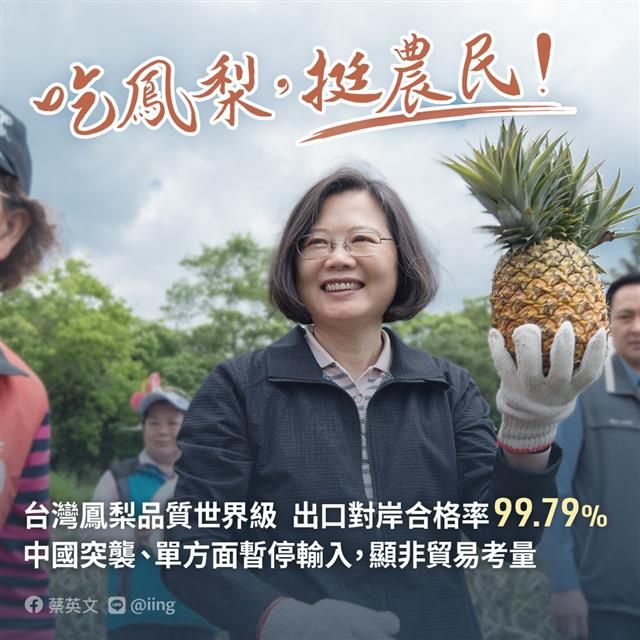 Taiwan President Tsai Ing-wen Holding a Pineapple
 [President Tsai Ing-wen's Facebook Account. Resale and DB Prohibited] / Photo by Yonhap News
Local media such as Taiwan's Liberty Times have speculated that the background of the pineapple challenge is China's harassment of Taiwan.
On the 1st, China banned imports of Taiwanese pineapples, citing the detection of harmful organisms in some pineapples imported from Taiwan since last year. However, according to the South China Morning Post (SCMP) and others, out of 6,200 samples taken between March and May last year, only 13 contained harmful organisms, and since Taiwan strengthened its export quarantine in October last year, no harmful organisms have been found.
Despite this, Taiwan believes that China's belated import ban must have political motives. There are voices suggesting that it targets farmers who form the support base of the ruling Democratic Progressive Party.
Traditionally in Taiwan, the Kuomintang (KMT) has strong support in the northern metropolitan areas such as Taipei, while the DPP has strong support in southern regions including Kaohsiung (高雄). The main pineapple producing areas such as Kaohsiung, Pingtung (屛東), and Tainan (臺南) are regions with many DPP supporters.
Meanwhile, since Tsai Ing-wen, who pursues Taiwan independence, took office in 2016, China has severed official relations with Taiwan and intensified pressure across military, diplomatic, and economic fields. The sudden suspension of pineapple imports is part of ongoing 'economic punishment,' further worsening cross-strait (China and Taiwan) relations.
© The Asia Business Daily(www.asiae.co.kr). All rights reserved.


















