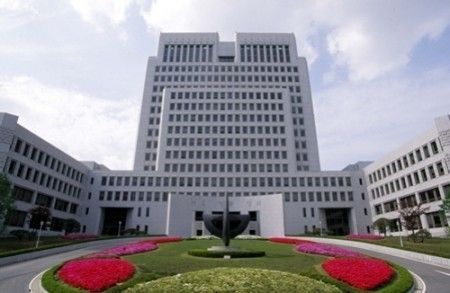
[Asia Economy Reporter Kim Daehyun] The Supreme Court has ruled that if a private investment project (BTO) operator suffers losses due to the government's incorrect demand forecast, the government must compensate for part of the losses.
On the 1st, the Supreme Court's 2nd Division (Presiding Justice Noh Jeonghee) announced that it upheld the appellate court's partial ruling in favor of the plaintiff in the case where Shinbundang Line Co., Ltd. filed a lawsuit against the government requesting adjustment of the implementation agreement.
In 2002, the Ministry of Land, Infrastructure and Transport received a proposal from Shinbundang Line Co., Ltd., composed of Doosan Construction, Daelim Industrial, and Daewoo Construction, to promote the construction and operation project of a section of the Shinbundang Line subway (Sinsa Station to Jeongja Station) using the BTO method, and designated the company as the project operator. BTO (Build-Transfer-Operate) is a method where the government owns the public facility built by a private business, while the business operator operates the facility for a certain period to earn revenue.
At that time, both parties agreed that if Shinbundang Line Co., Ltd. achieved 50% of the expected fare revenue, the government would compensate 80% of the expected fare revenue for the first five years after opening. However, after opening in 2011, actual demand was only about 30-40% of the forecast.
Accordingly, Shinbundang Line Co., Ltd. demanded the government pay 102.1 billion KRW in loss compensation. Their claim was that since the linked railway network project was delayed and the government's forecast failed, the government should share the losses. However, the government rejected the claim, stating that the condition of achieving 50% of the expected fare revenue was not met.
The first trial ruled against the plaintiff, judging that changes in subway operating conditions such as delays in the linked railway network project could not be attributed to the government.
The second trial partially accepted the plaintiff's claim. The court stated, "If the traffic demand expected to increase due to the opening of the linked railway network was not reflected, losses could have been avoided by reducing the total project cost or raising fares," and ordered the government to pay about 28.6 billion KRW to Shinbundang Line Co., Ltd.
The Supreme Court also agreed with this judgment. The court dismissed the appeal, stating, "The appellate court did not err in interpreting the implementation agreement under the Private Investment Act."
© The Asia Business Daily(www.asiae.co.kr). All rights reserved.

















