Notification Texts on Vaccination Day and Third Day for Nursing Hospitals and Facilities
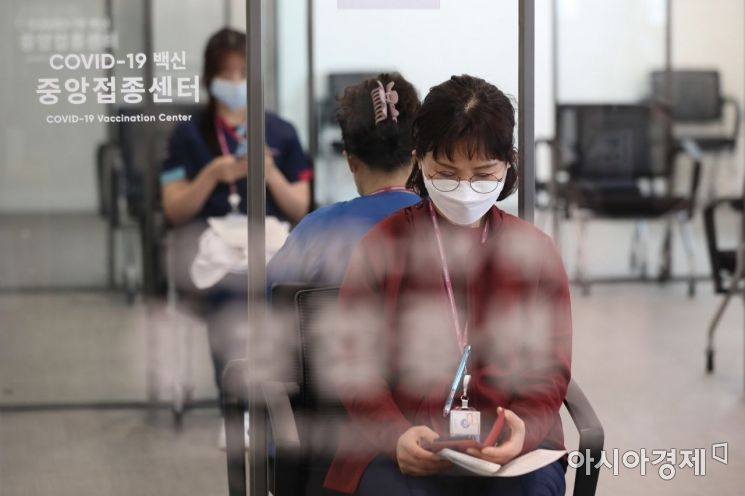 On the morning of the 27th, COVID-19 medical staff who received the Pfizer COVID-19 vaccine are waiting in the observation room at the Central Vaccination Center of the National Medical Center in Euljiro, Jung-gu, Seoul. Photo by Joint Press Corps
[Asia Economy Reporter Kim Ji-hee] Since the COVID-19 vaccination began on the 26th of last month, a total of 21,177 people have completed their first dose of the vaccine as of midnight on the 1st of this month. Health authorities plan to send text messages to COVID-19 vaccination candidates with information on the date, location, and reservation guidance once it is their turn to be vaccinated.
According to the Central Disease Control Headquarters (CDCH), when it is the vaccination candidate's turn, the authorities will send text messages including ▲pre-reservation guidance ▲reservation confirmation ▲vaccination date, time, location, and precautions ▲second dose reservation guidance ▲and reporting of any reactions from the third day after vaccination.
Since vaccinations at nursing hospitals and care facilities are conducted either on-site or through visits, text messages will be sent to candidates on the day of vaccination and on the third day after vaccination. Medical staff at COVID-19 treatment hospitals will receive text messages regarding pre-reservation before vaccination, vaccination details on the day, and second dose reservation dates. COVID-19 treatment hospitals have been administering the Pfizer vaccine since the 27th of last month.
Meanwhile, as of midnight on this day, a total of 152 cases suspected of adverse reactions after COVID-19 vaccination have been reported. All cases were mild. Fever above 38 degrees Celsius accounted for the highest proportion at 76%, followed by muscle pain (25%), headache (14%), nausea (11%), and chills (10%).
The Korea Disease Control and Prevention Agency is monitoring adverse reactions that may occur with the introduction of new vaccines through a surveillance system. To identify potential safety issues related to each vaccine, monitoring is also being conducted by sending text messages to some vaccine recipients from the day of vaccination up to six weeks (including the second dose).
© The Asia Business Daily(www.asiae.co.kr). All rights reserved.
![Clutching a Stolen Dior Bag, Saying "I Hate Being Poor but Real"... The Grotesque Con of a "Human Knockoff" [Slate]](https://cwcontent.asiae.co.kr/asiaresize/183/2026021902243444107_1771435474.jpg)
















