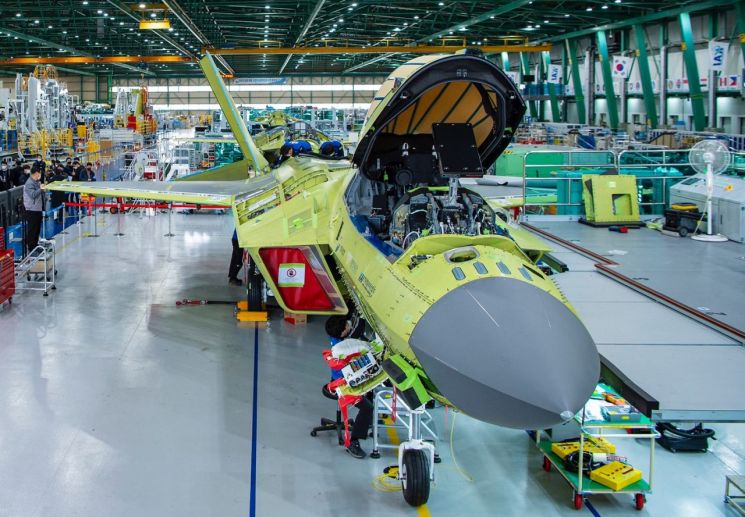
[Asia Economy (Sacheon) = Yang Nak-gyu, Military Specialist Reporter] The first domestically developed Korean fighter jet will be unveiled next month.
According to the Defense Acquisition Program Administration (DAPA) and Korea Aerospace Industries (KAI) on the 1st, the first prototype of the Korean Fighter eXperimental (KF-X) will be publicly revealed through a delivery ceremony next month.
This achievement comes 20 years after then-President Kim Dae-jung declared the development of a domestic fighter jet at the Air Force Academy graduation ceremony in March 2001. It has been over five years since DAPA and KAI began system development in January 2016.
The KF-X prototype delivery ceremony marks the first time the fighter jet, previously only on design blueprints, is physically completed and brought out of the hangar for public viewing. However, this stage only initiates ground testing and verification, so the aircraft will not be able to fly immediately. After the delivery ceremony, the KF-X will undergo about a year of ground tests before its first flight, scheduled around July next year.
Following this, prototypes 1 through 6 must complete a total of approximately 2,200 sorties of flight testing over four years without incident. Only then will the system development of the KF-X 'Block I', equipped with basic flight performance and air-to-air combat capabilities, conclude in June 2026.
Lee Sang-jae, Executive Director of KAI’s Fixed-Wing Production Division, said, "The paint scheme for prototype 1 will be a dark gray similar to the F-15K. After painting, the engine will be reinstalled, and various functions such as the landing gear and wings will be inspected to complete the assembly of prototype 1."
Lee explained that the single-seat (one cockpit) prototype 1 was assembled using over 220,000 parts, including about 7,000 bolts, nuts, and rivets, and approximately 1,200 types of tubes and pipes.
Prototypes 2 and 3 will be produced by the end of this year, and prototypes 4 through 6 will be completed by the first half of next year. Among these, prototypes 4 and 6 will be made as two-seat (dual cockpit) versions.
The KF-X measures 16.9 meters in length, 4.7 meters in height, and 11.2 meters in wingspan, making it slightly larger than the American F-16 fighter and similar in size to the F-18. It has a maximum thrust of 44,000 pounds, a maximum takeoff weight of 25,600 kilograms, and a maximum payload of 7,700 kilograms. Its top speed is Mach 1.81 (approximately 2,200 km/h), with a range of 2,900 kilometers.
It can be equipped with European-made METEOR air-to-air missiles, German Diehl’s AIM-2000 air-to-air missiles, and domestically developed long-range air-to-ground guided missiles currently under development.
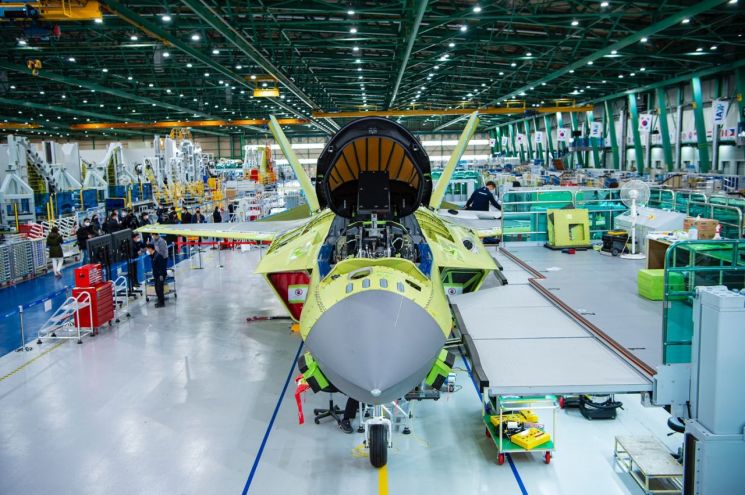
The KF-X’s exterior is a 4.5-generation fighter jet similar to the American F-35A stealth fighter, which is considered a 5th-generation aircraft. Jeong Gwang-seon, head of DAPA’s KF-X project team, said, "Although the KF-X is not being developed specifically for stealth capabilities, it has stealth shaping and will secure an independent platform, allowing continuous research into various derivative models."
As the first domestically produced fighter jet, the KF-X aims for a 65% localization rate of parts during mass production. The AESA (Active Electronically Scanned Array) radar and Infrared Search and Track (IRST) systems, which serve as the "eyes" of the KF-X, are prototypes developed with domestic technology and will be installed on prototype 1 for ground and flight testing.
Other key avionics such as the Electro-Optical Target Acquisition and Tracking Pod (EO TGP) and the Integrated Electronic Warfare Suite (EW Suite) are also being developed domestically. However, since the EO TGP is an air-to-ground system, it will be incorporated into the KF-X 'Block II' additional armament tests for air-to-ground combat capabilities, scheduled from July 2026 to 2028, according to DAPA.
Engine partial localization is being pursued through technical cooperation with General Electric (GE). Jeong said, "Engines will be directly purchased from GE and installed on some prototypes, but some will be assembled and produced by Hanwha Aerospace. In the final mass production phase, engines with some domestically produced parts will be installed."
The 'Iron Bird', an electronic flight control verification device whose technology transfer was refused by Lockheed Martin in the U.S., has also been developed purely with domestic technology and is being used for testing.
The KF-X project also has significant economic ripple effects. The system development (Block I) jointly pursued with Indonesia from 2015 to 2026 is valued at 8.1 trillion won, and the additional armament tests (Block II) conducted solely by Korea from 2026 to 2028 amount to 700 billion won, making the total project scale approximately 8.8 trillion won. Jeong said, "Since the project started in 2016, it has created over 10,000 jobs up to last year. More employment effects are expected during the mass production phase."
However, concerns have been raised that the project might face setbacks as Indonesia has recently failed to pay its 604.4 billion won share due to economic difficulties. According to DAPA, Indonesia agreed to cover about 20% of the KF-X project cost, totaling 1.7338 trillion won, in stages during the development phase. However, as of February, only 227.2 billion won out of the 831.6 billion won due has been paid. Jeong dismissed concerns, saying, "Both countries are negotiating in good faith. Even if joint development fails, the project can proceed according to procedures."
On-site voices also pointed out that the 52-hour workweek system is a major challenge facing the KF-X project, even more so than Indonesia’s unpaid contributions. Ryu Kwang-soo, Executive Director of KAI’s Fixed-Wing Business Division, emphasized, "Normal project progress requires no disruptions in ground and flight testing. For this, favorable weather and thorough internal preparation are essential."
He added, "The biggest difficulty during internal preparations is the limitation of the 52-hour workweek. I hope the 52-hour workweek regulation could be relaxed even for research and development fields."
© The Asia Business Daily(www.asiae.co.kr). All rights reserved.


















