Personal Information Commission "Concerns Over Privacy and Personal Data Infringement"
Eun Seong-su "Personal Data Can Be Fixed... Will Supplement Inadequate Parts"
Conflict Expected to Continue Over Supervisory Authority
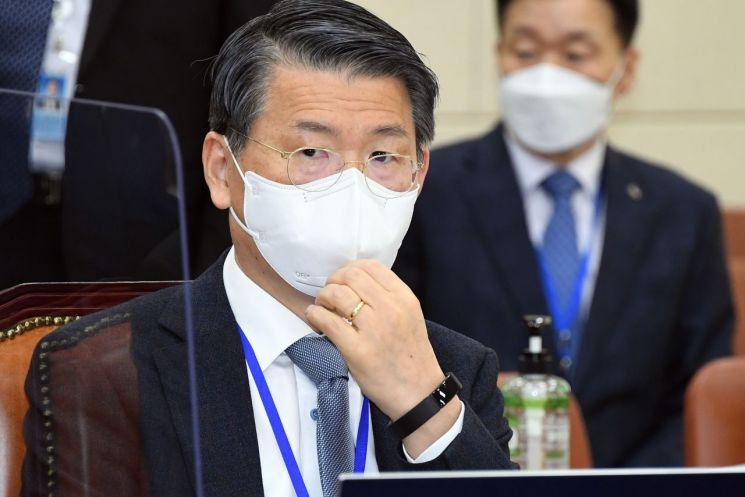
[Asia Economy Reporter Wondara] Financial industry attention is focused on whether the contents of 'external clearing of internal transactions' and 'comprehensive delegation of personal information' in the Electronic Financial Transactions Act, currently pending in the National Assembly, will be revised. This follows Financial Services Commission Chairman Eun Sung-soo's appearance before the National Assembly's Political Affairs Committee on the 25th, where he stated, "We will supplement the insufficient parts."
In response to a question from Yoon Kwan-seok, Chairman of the National Assembly's Political Affairs Committee, who pointed out that "there are ongoing disputes over specific contents rather than the bill itself," Chairman Eun replied, "We will carefully review whether the points raised by the Bank of Korea are appropriate and will supplement any insufficient parts, coordinating well with the Bank of Korea before the subcommittee."
He added, "I also spoke directly with the Chairperson of the Personal Information Protection Commission and will seek external expert opinions to make improvements," emphasizing, "Especially regarding personal information, if it was not done due to lack of knowledge, it can be corrected; this is not about creating a law that infringes on personal information. We will supplement any shortcomings."
Earlier, the Personal Information Protection Commission under the Prime Minister's Office officially responded to a query from Yoon Jae-ok, a member of the People Power Party, regarding the amendment to the Electronic Financial Transactions Act, stating that "there are concerns about privacy and personal information infringement related to the collection and management of big tech transaction details in the amendment proposed by the Financial Services Commission."
Article 18 of the Personal Information Protection Act stipulates that, in cases where other laws have special provisions, the use of personal information beyond its original purpose and provision to third parties may be exceptionally permitted; however, it points out that the Electronic Financial Transactions Act excludes the entire application of Article 18. This position is similar to the Bank of Korea's claim that the amendment to the Electronic Financial Transactions Act causes excessive personal information infringement.
"External clearing obligation should be limited to 'external transactions,' and the scope of personal information should be restricted by higher laws"
Professor Yang Ki-jin of Jeonbuk National University pointed out at the Political Affairs Committee public hearing held the same day that "although this is a serious matter infringing on the public's right to decide on their own information, the comprehensive and blank delegation method entrusted to the enforcement ordinance of the amendment is difficult to justify."
Professor Yang also noted that the Financial Services Commission announced last July that it would open financial settlement information held by the Korea Financial Telecommunications and Clearings Institute to the private sector for fintech and startup companies interested in utilizing payment information. He added, "The obligation for big tech to clear under the amendment should be limited to so-called 'external transactions' that actually require clearing (excluding internal transactions), and the scope of personal information to be transmitted to the Korea Financial Telecommunications and Clearings Institute for external clearing should be restricted to the minimum necessary information for payment, with constraints imposed by higher laws."
However, it is expected to be difficult to reach an agreement on the Financial Services Commission's ongoing supervisory authority over the Korea Financial Telecommunications and Clearings Institute, which the Bank of Korea opposed as the 'Big Brother Act.' This is because disagreements remain over who holds the jurisdiction over electronic financial transaction management, supervisory authority, and the Korea Financial Telecommunications and Clearings Institute. As a result, the financial sector points out that consumer protection is being sidelined, leaving only a power struggle between the Financial Services Commission and the Bank of Korea. A financial industry official remarked, "From the consumer's perspective, issues such as payment information security and damage compensation should be the main focus."
Professor Ahn Dong-hyun of Seoul National University's Department of Economics criticized the exchange between the two institutions during the public hearing in response to People Power Party member Kang Min-guk's question, "Isn't the verbal dispute between the two institutions ultimately a power struggle?" saying, "As a scholar and as a citizen, this is not a good sight." He added, "I don't understand why the Governor of the Bank of Korea and the Chairman of the Financial Services Commission don't have a final discussion with their staff to resolve this, instead of playing to the media."
Ryu Young-jun, Chairman of the Korea Fintech Industry Association, also said, "It has been two years since the discussion on amending the Electronic Financial Transactions Act began. Many companies are still holding back on business and hiring for investment, and further delays could harm these businesses."
© The Asia Business Daily(www.asiae.co.kr). All rights reserved.
![Clutching a Stolen Dior Bag, Saying "I Hate Being Poor but Real"... The Grotesque Con of a "Human Knockoff" [Slate]](https://cwcontent.asiae.co.kr/asiaresize/183/2026021902243444107_1771435474.jpg)
















