Sangui, Report on 'Creating a Dynamic Startup Ecosystem' Released
Only One-Third Survive After 5 Years, Many Livelihood Startups and Few Opportunity Startups
[Asia Economy Reporter Hwang Yoon-joo] As the COVID-19 pandemic continues for an extended period, there is an urgent call for the creation of a 'dynamic startup ecosystem' to prepare for the new normal era and to pioneer new paths for our economy.
The Korea Chamber of Commerce and Industry (KCCI) stated in its report titled "Policy Suggestions for Creating a Dynamic Startup Ecosystem" released on the 1st, "In a situation where industrial and economic structures are rapidly changing due to COVID-19, it is necessary to establish a dynamic startup ecosystem to open new economic avenues."
In the report, KCCI defined a dynamic startup ecosystem as a business environment where the life cycles of startup-related stakeholders (entrepreneurs, investors, government) circulate in a virtuous cycle. It further argued that when the startup ecosystem operates in a virtuous cycle, innovative growth is possible through industrial restructuring centered on new industries and the creation of new jobs.
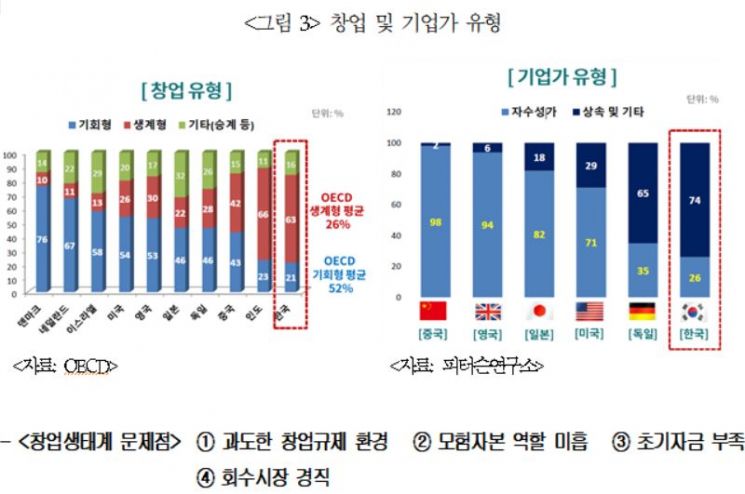
From a qualitative perspective, the survival rate of startup companies was low. KCCI evaluated that the difference in 1- to 5-year survival rates between Korea and OECD countries is about 15 percentage points, indicating that Korea's survival rate is relatively lower compared to OECD countries.
The 5-year survival rate of Korean startups is 29.2%, meaning that more than two-thirds of companies close within five years of establishment. The survival rates of 'subsistence startups' with low entry barriers, such as culture, sports, leisure industries, and accommodation and food services, fall significantly below the OECD average. This year, due to the prolonged impact of COVID-19, survival rates are expected to decline further.
The report identified the problems in Korea's startup ecosystem as ① excessive startup regulations, ② insufficient role of venture capital, ③ lack of initial funding, and ④ rigidity in the exit market.
◆ Excessive startup regulations and insufficient roles of venture capital = First, KCCI pointed out, "In Korea, starting a business often faces obstacles from the very beginning due to various paperwork and licensing requirements," adding, "Moreover, the inefficient, supplier-centered support system makes it difficult for companies to efficiently plan and operate their businesses as policies differ by ministry and change frequently, requiring continuous adaptation."
Secondly, it highlighted the insufficient role of 'venture capital' that invests boldly from the early stages. KCCI noted, "Looking at the trend of venture investment patterns in Korea, the proportion of preferred shares, which are relatively easier to recover, is increasing," explaining, "This is because common shares carry high uncertainty in principal recovery unless IPO or M&A occurs."
Lack of initial funding was also cited as a problem. Securing investment appropriate to the growth stage is crucial for startups, especially seed money (angel investment and venture capital) at the initial stage, which determines the success or failure of startups. Although venture investments in Korea are increasing annually, unlike the US and China, more than half of the investment funds are concentrated in the mid-to-late stages, causing many entrepreneurs to complain about a shortage of initial capital.
Fourth, the report pointed to the rigidity of the exit market as a problem. It stated, "The exit market in Korea is rigid, hindering the inflow and activation of new investments," and evaluated, "In particular, the M&A ratio is about 1% in Korea compared to 45% in the US, making its role in the market almost negligible." This is presumed to stem from social and structural issues such as large corporations' negative perception of M&A with SMEs, uncertain corporate governance regarding ownership and management, and distrust of SMEs' accounting data.
◆ "Top priority for creating a startup ecosystem is legal and institutional innovation" = KCCI proposed four major policy tasks for establishing a dynamic startup ecosystem.
First, it urged 'legal and institutional innovation.' With the advent of the 4th Industrial Revolution and the post-COVID era, where new technologies and industries are expected to emerge and converge, it is necessary to overhaul the legal and institutional environment related to startups on a broad scale. The report especially suggested, "Procedures related to startup laws and institutions should be greatly simplified, and various support channels unified to reduce confusion on the ground," and "The legal and institutional environment should be improved to lower entry barriers for startups and facilitate venture investment."
Secondly, it proposed 'expansion of startup infrastructure.' The report argued that a system providing one-stop services related to startups should be established to nurture Korean-style unicorn companies aiming for global expansion. It emphasized supporting startups by creating innovation hubs where everything from prototype production, financial institution funding, to domestic and international market development can be done in one place from start to finish.
It also advocated for 'improving systems to activate private capital participation.' KCCI suggested, "Incentives such as tax credits and corporate tax reductions are needed for private capital investing in startups," and "Improvements in related laws and systems are also necessary to expand participation from financially strong large corporations and foreign companies."
Lastly, it proposed 'strengthening support for re-challenge after startup failure.' The report emphasized the need to reinforce safety nets that help overcome the fear of re-starting even after failure, requesting various support measures beyond simple financial aid, including re-startup education, expert mentoring, and easing joint guarantee standards.
© The Asia Business Daily(www.asiae.co.kr). All rights reserved.
![Clutching a Stolen Dior Bag, Saying "I Hate Being Poor but Real"... The Grotesque Con of a "Human Knockoff" [Slate]](https://cwcontent.asiae.co.kr/asiaresize/183/2026021902243444107_1771435474.jpg)
















