[Asia Economy Reporter Ji Yeon-jin] After the KOSPI index soared to a historic high earlier this year and underwent a correction period of about two months, there are growing expectations that it will attempt a new rise in March. Some securities firms predict it could reach 3,300 points.
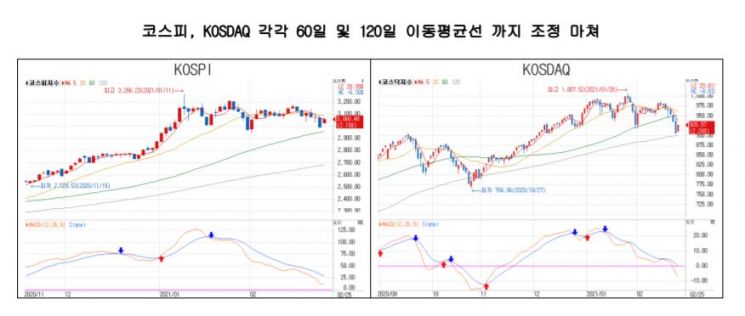
According to the securities industry on the 1st, the KOSPI index rose to 3,266 points in early January, then fluctuated around 3,100 points before closing at 3,012.95 points on the 26th of last month. Foreigners and institutions continued a tug-of-war of selling while individual investors bought, but rising commodity prices and U.S. Treasury yields caused the index to fall below 3,000 points last month.
The liquidity boom driven by large-scale economic stimulus measures worldwide due to COVID-19 had supported the stock market, but concerns over inflation have raised fears of tapering quantitative easing policies.
However, Jerome Powell, Chairman of the U.S. Federal Reserve Board (FRB), stated that employment and inflation levels in the U.S. still remain below target, signaling a continuation of the ultra-low interest rate and large-scale asset purchase quantitative easing stance, thereby calming market anxieties.
As a result, the stock market in March is expected to begin an upward trend that escapes the influence of interest rates. As of the 24th of last month, the 10-year U.S. Treasury yield (1.38%) has risen close to the pre-crisis level of 1.5%, reflecting some expectations of economic recovery. Given the limited room for further rate hikes, market instability is likely to gradually ease.
Moon Nam-jung, strategist at Daishin Securities, said, "The 10-year U.S. Treasury yield could rise to around 1.5%, which was the level before the COVID-19 outbreak in February last year. Since the current rate increase reflects the economic recovery phase excluding crisis situations, there is room for further rise," but added, "The impact is temporary as it is an initial reaction to a newly occurring phenomenon."
Another factor supporting a bullish market outlook is that historically, rising interest rates based on economic recovery did not burden the stock market. Only when rate hikes signaled a tightening shift did they trigger market corrections. Moon, the strategist, said, "The fundamentals are not strong enough to tighten monetary policy less than a year after the COVID-19 crisis began. From the Fed's perspective, tasked with full employment and price stability, the current unemployment rate (6.3% as of January 2021) supports a dovish monetary policy stance. It is time to increase exposure to stocks that are set to rise despite interest rates."
Korea Asset Investment projected the KOSPI index's low point this month at 2,950 points and the high point at 3,300 points. Korea Asset Investment stated, "In the last week of February, the index temporarily fell below 3,000 points amid extreme volatility, which helped clear accumulated sell orders. The rise in commodity prices, interest rates, and inflation concerns have already been reflected in the initial shock, improving the environment for a rebound." However, they noted that a rebound in Samsung Electronics' stock price is necessary to set a new KOSPI record high.
Lee Eun-taek, strategist at KB Securities, said, "The possibility of distant future rate hikes and short-term tightening is low in reality. Such misunderstandings have often occurred in the past, and the market usually rebounds once these misunderstandings are resolved. Although the U.S. S&P 500 has only corrected by a maximum of -2.7% from its peak, meaning the Korean market could see further corrections, I do not believe this is the start of a new problem, and I still maintain the view that the market will rebound after early March."
© The Asia Business Daily(www.asiae.co.kr). All rights reserved.
![Clutching a Stolen Dior Bag, Saying "I Hate Being Poor but Real"... The Grotesque Con of a "Human Knockoff" [Slate]](https://cwcontent.asiae.co.kr/asiaresize/183/2026021902243444107_1771435474.jpg)
















