Assemblyman Song Gap-seok Proposes 'Small Business Protection Act Amendment'
Establishes Legal Basis for Compensation Due to Government Quarantine Measures
Mainly Targets Businesses Restricted by Quarantine Measures
Leaves Room for Specific Targets and Scope to Be Defined in Enforcement Decree
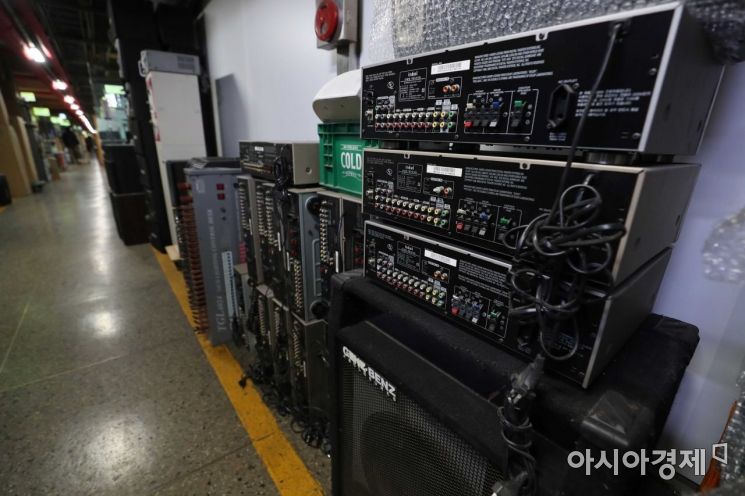 On the 18th, as karaoke rooms closed down due to the prolonged COVID-19 pandemic, various equipment and fixtures used in the establishments have been piling up at a secondhand equipment trading shop for karaoke rooms in Seoul. Photo by Mun Ho-nam munonam@
[Asia Economy Reporter Kim Bo-kyung] The government and the ruling party will pass the Small Business Support Act, which includes the legal basis for loss compensation, next month. Starting as early as July, small business owners who suffered damages due to quarantine measures to prevent the spread of infectious diseases like COVID-19 will receive government support funds.
Under current law, measures such as gathering bans and business restrictions can be imposed to prevent infectious diseases. However, there has been no legal provision for compensating losses caused by these measures.
Until now, the government has provided support funds to small business owners at its discretion based on the scale of damage and budget conditions, but going forward, there will be a legal obligation to provide such support.
However, general businesses that did not face gathering bans or business restrictions but simply experienced a decline in sales will be excluded from the support target.
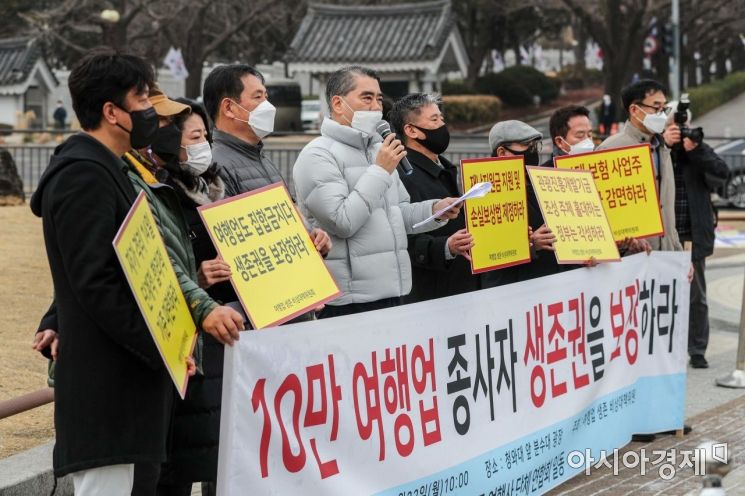 On the 22nd, small business owners belonging to the Emergency Survival Measures Committee for the Travel Industry held a press conference in front of the Blue House Fountain in Jongno-gu, Seoul, urging the guarantee of the right to survival for travel industry workers. Photo by Kang Jin-hyung aymsdream@
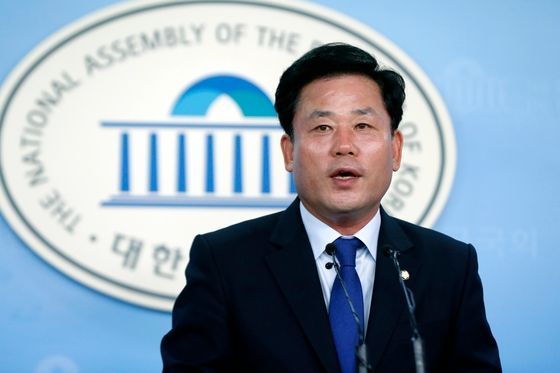
The recently proposed amendment to the Small Business Protection and Support Act (Loss Compensation Act) by Song Gap-seok, a member of the Democratic Party of Korea, includes these loss compensation measures.
Song’s bill was drafted after behind-the-scenes consultations between the ruling party and the government, with the ruling party planning to pass the Loss Compensation Act in the March National Assembly session.
The main points of the bill are ▲ loss compensation for small business owners whose business locations and operating hours are restricted under the Infectious Disease Control and Prevention Act, subject to review by a deliberation committee ▲ compensation possible for small and medium enterprises beyond small business owners based on the committee’s review results ▲ establishment of a dedicated organization to support the deliberation committee and the committee itself.
First, the amendment explicitly mentions the term ‘loss compensation.’ Since the concept of loss compensation is specified, the compensation target is limited to small business owners who have been subject to gathering bans or business restrictions.
This excludes general businesses currently receiving government support funds (small business owners who did not face gathering bans or business restrictions but experienced reduced sales) from the compensation target.
Instead, the bill leaves room to compensate small and medium enterprises and other targets beyond small business owners who suffered damages due to quarantine measures. This allows expanding the compensation target to individual businesses with five or more employees and small enterprises.
Specific support targets and the scope of applicable quarantine measures will be delegated to enforcement ordinances. There is an interpretation that adjustments may be made later, such as recognizing indirect damages to general businesses and including them in the compensation target.
The issue of compensation during the law’s grace period may become problematic later.
The amendment stipulates that the law’s enforcement date will be ‘three months after promulgation.’ Assuming it passes the National Assembly at the end of March, it could be enforced around July.
Since the law applies only to losses incurred after its enforcement date, there will be a roughly three-month gap between the law’s passage and its enforcement. If the COVID-19 spread does not subside easily, there may be a situation where a fifth disaster relief fund needs to be provided.
However, regarding this legislation, Song introduced it as a system to protect small business owners who suffer losses due to quarantine measures in the event of new infectious disease outbreaks beyond COVID-19.
Song said, “Most experts predict that global pandemics like COVID-19 will recur in the future, and the cycle of worldwide infectious disease outbreaks will shorten.”
He added, “A system is needed to systematically compensate small business owners who suffer losses due to quarantine measures such as gathering bans and business restrictions when new infectious diseases spread.”
The amendment stipulates that specific details regarding targets, standards, scale, and procedures will be determined by the deliberation committee. If quarantine obligations are violated, compensation may be reduced or canceled.
Meanwhile, the Democratic Party plans to pass the three laws for mutual growth solidarity to overcome the COVID-19 crisis in March, including the Small Business Loss Compensation Act, the Cooperation Profit Sharing Act, and the Social Solidarity Fund Act.
© The Asia Business Daily(www.asiae.co.kr). All rights reserved.
![Clutching a Stolen Dior Bag, Saying "I Hate Being Poor but Real"... The Grotesque Con of a "Human Knockoff" [Slate]](https://cwcontent.asiae.co.kr/asiaresize/183/2026021902243444107_1771435474.jpg)


















