With Vaccine Rollout in Full Swing, Global Consideration Underway
'Economic and Travel Revitalization vs Another Form of Discrimination' Controversy Continues

[Asia Economy Reporter Kim Bong-su] "Do you have a digital vaccine passport?"
This will soon be a question that international travelers will hear at airports around the world. Since the start of COVID-19 vaccinations on the 26th, interest in digital vaccine passports has been growing domestically as well. Globally, digital certificate issuance, i.e., vaccine passport issuance, is being promoted with the aim of allowing free movement only to those who have been vaccinated to revitalize overseas travel and the economy. However, there is also considerable controversy due to concerns about side effects.
According to the Ministry of Science and ICT on the 28th, major countries such as the United States and Europe, as well as countries where vaccinations have begun like the Philippines and Israel, have already started or are promoting vaccine passport issuance. The UK, which was the first in the world to start vaccinations at the end of December last year, has been piloting vaccine passports for some citizens since January and is conducting trial services until March. The UK Home Office announced on the 22nd that it will officially consider issuing vaccine passports.
Israel, which has the highest vaccination rate (48%) in the world, issues an online "green passport" only to those who have received both the first and second doses of the vaccine. Based on the high vaccination rate, Israel lifted the restriction on going outside within 1 km of one's home on the 7th and partially eased the lockdown from the 21st, reopening some commercial and public facilities. People who test negative for COVID-19 are granted a validity period of 72 hours, and those who have completed vaccination for more than a week are granted a validity period of six months.
In Switzerland, the nonprofit Commons Project and the World Economic Forum (WEF) are developing an app that can be used as a vaccine passport. They are collaborating with airlines such as Cathay Pacific, JetBlue, Lufthansa, Swiss International Air Lines, United Airlines, and numerous medical institutions. The main purpose is to facilitate the entry and exit of international travelers and revitalize the tourism industry.
In the United States, IBM is developing a digital health pass app containing information such as COVID-19 test results, body temperature, and vaccination records, and the Philippines also plans to issue vaccine passports only to vaccinated individuals.
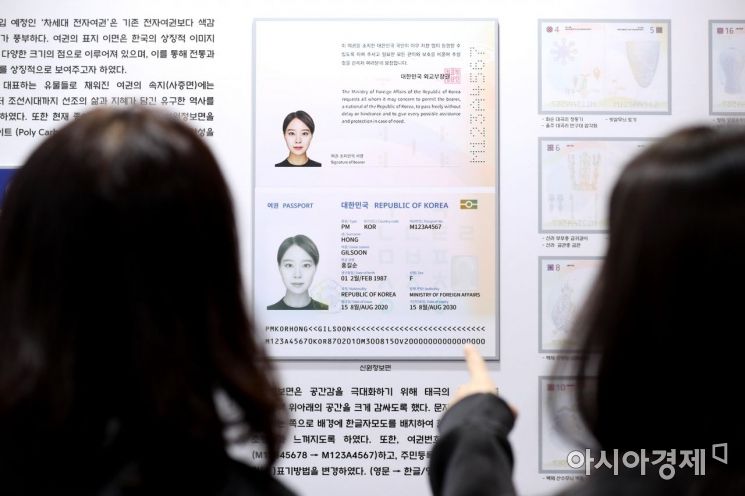 Next-generation electronic passport scheduled for introduction in 2020. Reference photo. Not directly related to the article.
Among European countries, 13 countries, mainly southern European countries with high travel demand such as Italy, Spain, Greece, Poland, Sweden, the Czech Republic, and Denmark, are positive about introducing vaccine passports. Even Germany, which was skeptical, has turned positive, with Chancellor Angela Merkel announcing on the 25th that vaccine passports will be introduced by this summer.
Global IT companies have already started developing digital vaccine certificates using blockchain technology. Microsoft (MS), Oracle, Salesforce, and other global IT companies announced on the 14th of last month that they formed the "Vaccine Credential Initiative (VCI)" together with U.S. nonprofit medical foundations, the Commons Project, and MITRE Corporation to develop a global common digital certificate that can prove vaccination on smartphone apps. They plan to implement technology that stores COVID-19 vaccination history as an encrypted digital copy in a digital wallet. For users without smartphones, it is characterized by allowing the use of printed QR codes on paper. The VCI plans to negotiate with governments worldwide to allow entry if one can prove either a negative COVID-19 test or vaccination status.
Domestically, an IT company is preparing to launch a digital vaccine certificate. The company is developing an app service that provides an official digital certificate in QR code form by updating the certificate issued by the government to COVID-19 vaccine recipients.
The International Air Transport Association (IATA), which has over 120 member airlines worldwide, is also developing the "COVID-19 Travel Pass" app, which is scheduled to be fully used from the end of next month. It was already piloted by Singapore Airlines in December last year, and airlines such as Emirates, Qatar Airways, and Air New Zealand have also participated in the pilot.
However, opposition is also strong. Experts including the World Health Organization (WHO) warn that since variant viruses are still spreading, global vaccination rates are very low, and vaccine effectiveness has not been fully verified, issuing vaccine passports could cause confusion in social distancing measures. Regardless of the type of vaccine passport, the exposure of personal information is inevitable, raising privacy concerns. Above all, restricting or permitting freedom of travel and movement based on vaccination status is pointed out as another form of discrimination, similar to race, nationality, gender, or wealth disparities.
The UK's Guardian stated in a column on the 27th, "Vaccine passports may be one way to enable free travel and economic revitalization," but added, "However, we must not allow this to lead to unfair discrimination. Alternative options that everyone can enjoy should be available after this summer."
© The Asia Business Daily(www.asiae.co.kr). All rights reserved.
![User Who Sold Erroneously Deposited Bitcoins to Repay Debt and Fund Entertainment... What Did the Supreme Court Decide in 2021? [Legal Issue Check]](https://cwcontent.asiae.co.kr/asiaresize/183/2026020910431234020_1770601391.png)

















