[Asia Economy Reporter Kim Eunbyeol] As U.S. Treasury yields surged, causing significant volatility in the financial markets, experts predict that this trend will not last long. Since the rise in Treasury yields is based on expectations of economic recovery and inflation, it is expected to stabilize after some time. Therefore, the consensus is that the negative impact of rising interest rates on the stock market will not continue. Additionally, the fact that central banks around the world, including the U.S., are unlikely to withdraw accommodative monetary policies due to inflation concerns, thereby maintaining liquidity, supports this view.
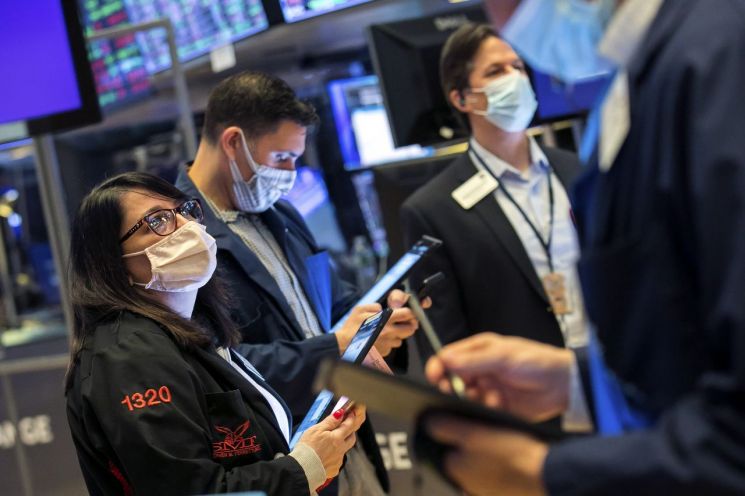
On the 26th (local time), the Dow Jones Industrial Average closed at 39,932.37, down 469.64 points (1.5%) from the previous session in the New York stock market. The S&P 500 index closed at 4,811.15, down 18.19 points (0.48%) from the previous session, while the tech-heavy Nasdaq index ended the day up 72.91 points (0.56%) at 13,192.34. The market closed mixed after showing significant volatility linked to fluctuations in U.S. Treasury yields.
The previous day, the KOSPI index closed at 3,012.95, down 86.74 points (2.80%) from the previous day. It had fallen below the 3,000 mark on the 24th but recovered briefly following Federal Reserve Chairman Jerome Powell's remarks on maintaining accommodative monetary policy, only to plunge again the next day. The won-dollar exchange rate surged more than 15 won to 1,123.5 won per dollar, marking the largest single-day increase since March 23 of last year (20 won rise).
Inflation Expectations Take Time to Materialize... Domestic Demand Recovery Slow and COVID-19 Uncertainty High
First, experts agree that the recent rise in Treasury yields driven by inflation expectations will not last long. Although rising international oil prices have fueled expectations of inflation, it will take time for these expectations to translate into actual price increases. In the U.S., the unemployment rate stood at 6.3% as of January, far from the pre-COVID-19 level of 3.5% (February 2020). South Korea’s unemployment rate is expected to remain at 4.0% this year, following last year, with little recovery in employment numbers. The Bank of Korea lowered its forecast for the number of employed persons this year from 130,000 to 80,000 in its economic outlook released on the 25th.
If the employment shock caused by COVID-19 is not resolved, consumption and domestic demand will struggle to recover, making it difficult for inflation to rise as much as expected. Moon Namjung, an analyst at Daishin Securities, said, "Uncertainty about the progression of COVID-19 could increase savings rates, and it inevitably takes time for expected inflation to lead to actual inflation. This is why the current interest rate rise, which is fueling stock market anxiety, is not expected to last long."
Foreign IBs Highlight Mortgage Convexity Hedge Selling as Cause of Treasury Yield Rise... Bond Tantrum Premature
There is also an argument that the recent rise in long-term U.S. Treasury yields is technical, and without new news that would stimulate inflation, further increases in Treasury yields are unlikely.
According to Bloomberg and other foreign media and the International Finance Center, the recent rise in long-term U.S. Treasury yields has been driven by increased risk aversion among mortgage-backed securities (MBS) investors. As concerns about inflation began to surface, MBS holders, exposed to price decline risks, started selling Treasuries to avoid losses. MBS are securitized assets based on mortgage loans that financial institutions have lent to individuals. Typically, when interest rates rise, mortgage rates also increase, exposing MBS holders to price decline risks. This behavior is called 'convexity hedging.' This phenomenon also occurred in 1999 and 2004.
Bloomberg reported, "Although MBS investors’ Treasury selling has increased significantly, one-third of MBS are held by the Federal Reserve, and another third by banks, so large-scale hedging demand like in 2003 is not expected." Morgan Stanley expects mortgage convexity hedge selling demand to continue until the 10-year U.S. Treasury yield reaches about 1.6%. Currently, 1.6% is seen as a threshold; once yields exceed the 1.7% range, a pause is expected.
Morgan Stanley assessed that the recent rise in long-term yields reflects expectations for economic growth and is not a dangerous situation. Wells Fargo viewed Federal Reserve Chairman Jerome Powell’s recent remarks as effectively allowing the rise in yields, thus expecting liquidity to continue. Wells Fargo stated, "Powell’s remarks gave a 'green light' to rising yields. Although inflation will rise sharply in the short term due to base effects, it is expected to hover around 2% going forward and will not be very high." Goldman Sachs forecasted, "Without new news that would stimulate inflation, it seems unlikely that real interest rates will rise an additional 20 basis points (1bp = 0.01 percentage points) or more."
© The Asia Business Daily(www.asiae.co.kr). All rights reserved.

















