Analysis of 1,108 Bankruptcy Discharge Applicants Visiting Seoul Financial Welfare Counseling Center
59% Have Debt Under 100 Million KRW... Causes of Debt Include 44.5% Living Expenses Shortage, 22.0% Business Failure
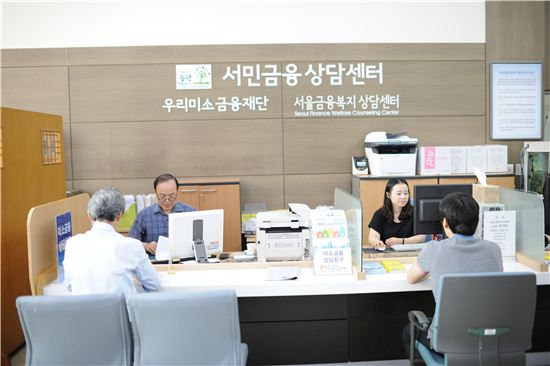 Seoul Financial Welfare Counseling Center
[Asia Economy Reporter Lim Cheol-young] It has been revealed that more than 8 out of 10 debtors who applied for personal bankruptcy and discharge through the Seoul Financial Welfare Counseling Center, managed by the Seoul Welfare Foundation, are aged 50 or older. In particular, more than 7 out of 10 applicants were 'beneficiaries,' indicating that the vast majority of bankruptcy applicants were from vulnerable groups.
On the 1st, the Seoul Financial Welfare Counseling Center announced that an analysis of the living conditions and debt status of debtors who applied for personal bankruptcy and discharge through the center in 2020 showed these results. There were 1,252 personal bankruptcy applications routed through the center, accounting for 11.7% of the 10,683 personal bankruptcy cases filed annually at the Seoul Rehabilitation Court. The center analyzed data from 1,108 applicants among these cases.
According to the statistical analysis, 83.3% of applicants were 'aged 50 or older,' and 75.5% were 'beneficiaries,' indicating that the majority of bankruptcy applicants using the center were from vulnerable groups. Considering that 50.0% were 'single-person households,' it can be inferred that a significant portion of middle-aged and older bankruptcy applicants were maintaining their livelihoods alone without economic or psychological support from family, and some experienced family breakdown due to issues such as malignant debt.
Up to three years before applying for personal bankruptcy, the majority (54.2%) of debtors were engaged in income-generating activities such as wages or self-employment, but at the time of application, 79.2% were unemployed. Considering that 51.4% of applicants had been in a 'potential bankruptcy period' for four years before visiting the center, it is analyzed that debtors endured psychological distress caused by unemployment or business closure until just before bankruptcy.
The center explained, "Considering that 51.4% of debtors were in a potential bankruptcy situation for four years, a significant number of debtors suffered from the pain of unemployment or business closure until just before applying for bankruptcy."
Only a very small number of applicants owned homes, and 81.5% lived in rental housing with low rent. The rates of free residence and living in gosiwon (small, low-cost rooms) were 8.1% and 9.0%, respectively, indicating housing instability. This suggests that welfare service linkage for housing stability is necessary in addition to resolving debt issues.
The causes of debt, identified through multiple responses, were 'lack of living expenses' (44.5%), 'business failure' (22.0%), 'fraud damage' (8.6%), and 'guaranteeing others' debts' (6.8%), in that order. Additionally, the direct causes leading to insolvency were situations where debt (principal and interest) exceeded income at 33.6%, and times when income-generating activities were impossible due to unemployment or business closure at 34.4%.
Among applicants, 59.9% had four or more multiple debts, and 59.0% held debts under 100 million KRW. Considering that 65.2% of applicants had assets under 5 million KRW and 81.2% had monthly incomes under 1 million KRW, it appears that debtors suffered from excessive multiple debts relative to their asset situations until filing for bankruptcy.
The proportion of applicants who had been in a potential bankruptcy period for more than five years was 48.6%, with those in the '20 years or more' and '15 to 19 years' categories accounting for 21.6% combined. Considering that 83.3% of applicants were aged 50 or older, it is analyzed that one in five debtors who applied for bankruptcy through the center had long maintained socio-economic vulnerability due to unresolved debts incurred around the time of the foreign exchange crisis during their youth.
Park Jeong-man, the center director (lawyer), said, "Market economies bloom based on the nutrients of failure. Henry Ford, the king of American automobiles, and Walt Disney, the king of cartoons, all succeeded in making a comeback after bankruptcy," adding, "Although most bankruptcy applicants through the center are from vulnerable groups, the personal bankruptcy system, which serves as a stepping stone for a fresh start, should be more widely recognized and made more accessible so that any citizen who has experienced economic failure can approach it quickly and easily."
© The Asia Business Daily(www.asiae.co.kr). All rights reserved.
![Clutching a Stolen Dior Bag, Saying "I Hate Being Poor but Real"... The Grotesque Con of a "Human Knockoff" [Slate]](https://cwcontent.asiae.co.kr/asiaresize/183/2026021902243444107_1771435474.jpg)















