Next Week's Announcement on Extension and Soft Landing Measures for Small Business and SME Loan Maturities
Support of '6 Months + α' Provided Until Repayment Period, Not Just Until End of September
Financial Sector Reluctant to Unconditional Interest Deferral... "If Interest Can't Be Paid, It's Essentially a Distressed Company"
"Extension End Will Raise Restructuring Issues for Marginal Companies... Financial Insolvency Must Be Considered"
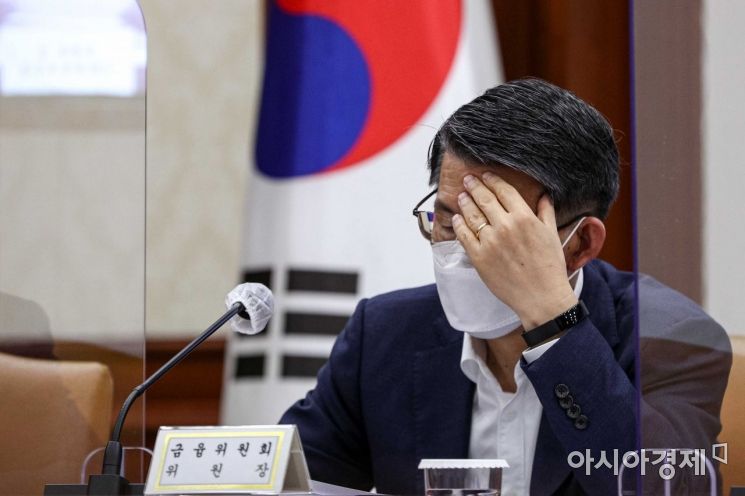
[Asia Economy Reporter Kwangho Lee] The Financial Services Commission will announce next week a plan to extend loan maturities and facilitate a smooth transition for small business owners and SMEs affected by COVID-19. The extension will be for an additional six months until September this year, and after that, borrowers will be allowed to choose repayment methods and periods according to their circumstances. In reality, this is not just a loan maturity ending at the end of September, but a ‘6 months + α’ support that includes the repayment period. The financial sector agrees with the loan maturity extension but holds a negative view, stating that companies unable to pay interest are essentially insolvent. However, they are only silently suffering as they cannot oppose government policy.
Financial Sector: "Unconditional Interest Deferral Not Possible... Companies Unable to Pay Interest Have Slim Survival Chances"
According to financial authorities and the financial sector on the 27th, the loan maturity extension and smooth transition plan to be announced by the Financial Services Commission next week will include the ‘Five Principles of Smooth Transition Support.’ These five principles are: providing optimal repayment consulting to borrowers, granting a repayment period longer than the deferral period, waiving interest on deferred interest, exempting early repayment fees for early repayment, and allowing borrowers to choose the final repayment method and period.
To prevent the burden of principal and interest repayment from concentrating all at once when financial support ends, consulting on the optimal repayment plan will be provided, and based on the consultation, borrowers will be able to choose the final repayment method or period. Also, if loan repayment was deferred for one year but only six months remain after the deferral ends, the repayment period will be guaranteed for more than one year to ease the burden. For example, if the remaining interest at the time of deferral application was 500,000 won, the borrower will only have to pay that 500,000 won in interest even after the deferral period ends.
The financial sector accepts the loan maturity extension considering the COVID-19 situation but expresses reluctance toward unconditional interest deferral. While principal maturity extension allows for the expectation of future loan repayment, companies unable to pay interest are unlikely to survive even after the end of COVID-19. According to the Financial Services Commission’s work report, the amount of loan maturity extensions for SMEs and small business owners is 116 trillion won (350,000 cases), and the amount of deferred installment principal and interest repayment is 8.5 trillion won (55,000 cases). Among these, interest repayment deferrals, whether lump sum or installment, amount to 157 billion won (13,000 cases).
The financial sector recently proposed supplementary measures during meetings with Financial Services Commission Chairman Eun Sung-soo, such as combining overdue interest of interest-deferring companies into the principal for repayment or allowing long-term installment repayment of principal and overdue interest over 5 to 10 years or more, but these have reportedly not been considered. Such programs are methods banks apply to companies undergoing restructuring.
‘6 Months + α’ Support: "Borrowers Will Decide Repayment Methods"
Kim Tae-hyun, Secretary General of the Financial Services Commission, said at a briefing on the results of the Emergency Economic Central Countermeasures Headquarters meeting on the 24th that regarding the detailed smooth transition plan, "When principal is repaid in installments, the repayment period will be sufficiently granted beyond the deferral period, and interest accrued during the deferral period will be maintained in total regardless of repayment method or period," adding, "(Most importantly) the final repayment method will be decided by the borrower."
Regarding concerns about bank soundness, he also mentioned, "The scale of loans with repayment deferral is only about 0.34% of total credit," and "Simulation results show that even assuming all deferred loans become non-performing, the increase in delinquency rates and repayment delinquency rates is not higher than past figures."
He emphasized, "Looking at the non-performing loan ratio fixed as of 2013, it was about 1.19% in 2017, and even after reflecting all, it is only 0.99%, so concerns about non-performance are limited."
He also said, "Financial companies are being guided to build provisions first, and they are accumulating much more provisions than in previous years."
A financial sector official criticized, "The financial authorities are conducting a one-way ‘pre-decided answer’ (the answer is fixed, you just have to respond) approach without considering the opinions of the financial sector at all," and pointed out, "When the support program ends, restructuring issues for marginal companies will be highlighted."
Another official lamented, "While it is also the financial sector’s role to consider the circumstances of struggling businesses, the financial sector is not a bottomless pit," and added, "(The government) must also consider financial insolvency caused by prolonged financial support measures."
© The Asia Business Daily(www.asiae.co.kr). All rights reserved.

















