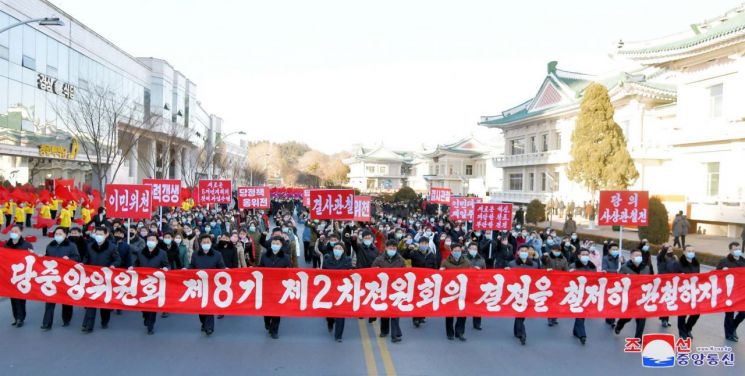
[Asia Economy Reporter Lee Ji-eun] North Korea held an expanded plenary meeting of the Cabinet to discuss ways to economically and legally guarantee enterprises' independent production and management activities.
Korean Central News Agency reported on the 26th, "An expanded plenary meeting of the Cabinet was held via video conference on the 25th to thoroughly implement the programmatic tasks presented at the 8th Congress of the Workers' Party and the 2nd plenary meeting of the Party Central Committee."
The meeting was chaired by Premier Kim Deok-hoon and attended by Deputy Premiers Park Jeong-geun and Jeon Hyeon-cheol, along with other Cabinet members.
In his report, Deputy Premier Park analyzed the causes of passive and conservative tendencies shown by the Cabinet and economic institutions during this year's economic plan formulation process and proposed measures to carry out this year's economic plan. He also raised issues related to establishing business-related systems and order, realistically setting and implementing scientific and technological development goals, and realizing the localization of raw materials and supplies.
Additionally, the Korean Central News Agency stated, "Tasks were raised to more strongly establish measures to guarantee economic conditions and legal environments so that enterprises can independently and proactively carry out production and management activities, maximize creativity, and respond swiftly to environmental changes," adding, "It emphasized the need to intensify the struggle to put an end to unit particularism and self-centeredness that infringe upon the state's laws and the people's interests."
At the meeting, discussions were held by Kim Gwang-nam, manager of Kim Chaek Iron and Steel Complex; Ma Jong-seon, Minister of Chemical Industry; Ri Seong-hak, Deputy Premier; Choe Ryong-gil, Vice Chairman of the State Planning Commission; and Joo Cheol-gyu, Deputy Premier and Minister of Agriculture.
The Korean Central News Agency reported, "Issues discussed included concentrating labor, equipment, materials, and funds needed by factories and enterprises in the metal and chemical industries, solving technical problems for producing steel using domestic fuel, and improving management and enterprise administration in accordance with the requirements of the socialist enterprise responsibility management system."
During the discussion, an annual plan for the localization of raw materials and supplies was finalized, and measures to normalize enterprise production were discussed. Emphasis was placed on recycling idle materials and by-products and utilizing substitute raw materials. Practical issues for improving cooperative farm management and implementing agricultural production plans were also consulted.
Experts interpreted this meeting as a measure to strengthen the Cabinet-centered system. Professor Im Eul-chul of the Far East Institute at Gyeongnam National University said, "It appears that Premier Kim led the meeting, which is an important step to empower the Cabinet," adding, "Considering sanctions and the prolonged COVID-19 situation, efforts to secure labor, equipment, materials, and funds necessary for increased production within North Korea will accelerate."
Professor Yang Moo-jin of the University of North Korean Studies also said, "Although this meeting is a Cabinet-level inspection meeting, it is likely to be held frequently," and added, "Cabinet officials who witnessed the dismissal of Economic Vice Minister Kim Du-il at the recent Party plenary meeting have a sense of crisis that they could face the same fate if they do not perform properly, and it is also judged that there is a purpose to show General Secretary Kim Jong-un that they are 'diligently inspecting'."
© The Asia Business Daily(www.asiae.co.kr). All rights reserved.

















