Conflict between Financial Services Commission and Bank of Korea called "just a power struggle"
Personal Information Committee opposes amendment... controversy likely to continue
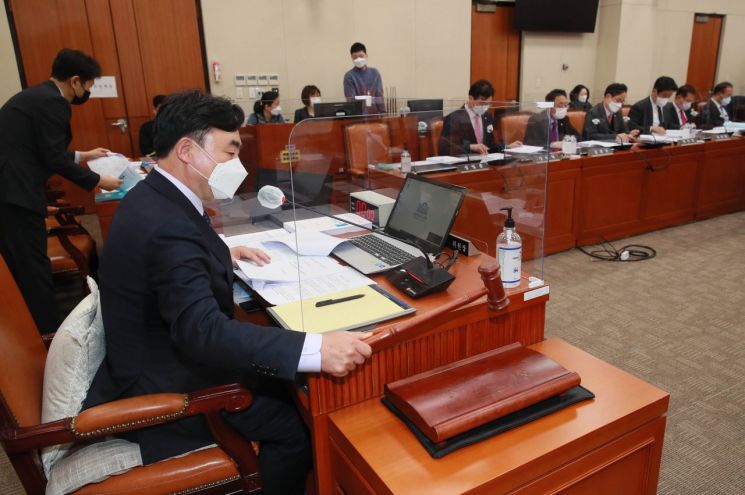
[Asia Economy Reporter Wondara] Amid the clash between the Bank of Korea and the Financial Services Commission over the amendment to the Electronic Financial Transactions Act (EFTA), fierce debates broke out at the public hearing on the EFTA amendment held on the 25th. The opinions sharply opposed each other, with one side arguing that the amendment is necessary for consumer protection, while the other side criticized it as "Big Brother" (social surveillance and control power).
Although public hearings are usually a step toward passing legislation, significant controversy is expected to continue as the National Financial Industry Labor Union (Financial Union) and the Personal Information Protection Commission under the Prime Minister's Office have effectively expressed opposition to the EFTA amendment.
"EFTA Amendment Contradicts Global Standards" VS "Market Rapidly Growing... Consumer Protection Needed"
At the public hearing hosted by the National Assembly's Political Affairs Committee, Professor Yang Gijin of Jeonbuk National University stated, "The EFTA amendment contradicts global standards," and argued, "Since the Bank of Korea operates the large-value payment system closely linked with the small-amount payment network, it should take the lead in decisions, so it is difficult to consider this under the jurisdiction of the Financial Services Commission."
Professor Yang also said, "There is no global precedent, including China, for external clearing of internal transactions," and added, "Transmitting personal information related to internal transactions externally is excessive legislation."
On the other hand, Professor Jeong Sunseop of Seoul National University's Law Department countered with the opinion that supervision should be strengthened from the perspective of consumer protection. Professor Jeong pointed out, "In the event that a fund transfer operator goes bankrupt, the supervisory authority should be able to directly return the user's deposited funds to customers," emphasizing, "It is important to note that this is a field with strong public interest."
According to Professor Jeong, as of the first half of last year, the scale of card-based simple payments among electronic financial transactions reached 214 trillion won. As of the third quarter of last year, more than 14 million simple payments and remittances were made daily, with 66% of these occurring in internal transactions.
Ryu Jaesu, Executive Director of the Korea Financial Telecommunications and Clearings Institute, addressed the recently raised "Big Brother controversy," stating, "The clearing of Big Tech (large information and communication companies) should be seen not as designing a new clearing and settlement system but as an expanded concept of the current open banking." He added, "The KFTC has been responsible for payment and clearing operations such as bill exchange for over 100 years and is designated as an institution subject to the strictest protection, management, and supervision," explaining, "Internally, it operates an information protection department as a headquarters system, thoroughly managing security monitoring and incident response."
"Power Struggle" A Sharp Critique of the Conflict Between FSC and BOK
A sharp critique was also made regarding the recent conflict between the Financial Services Commission (FSC) and the Bank of Korea (BOK). Professor Ahn Donghyun of Seoul National University said, "The recent controversies between the FSC and BOK regarding the clearing system sound nothing but a 'power struggle,'" and criticized, "The grand cause of 'financial consumer protection' is being sidelined, and discussions are delayed over peripheral issues such as information concentration and system stability that can be legally or technically resolved."
Meanwhile, the Personal Information Protection Commission sided with the Bank of Korea in the conflict between the FSC and BOK, which escalated into the Big Brother controversy. The commission stated that it would consult with the FSC to revise the problematic content.
In response to a query from Yoon Jaeok, a member of the People Power Party (Political Affairs Committee), regarding the EFTA amendment, the commission officially replied, "The EFTA amendment promoted by the FSC concerning the collection and management of Big Tech transaction details raises concerns about privacy and personal information infringement." It pointed out, "Some provisions of the amendment do not align with the personal information protection legal framework, may violate the principle of prohibition of broad delegation, and raise concerns about infringement of privacy and the right to self-determination of personal information."
© The Asia Business Daily(www.asiae.co.kr). All rights reserved.

















