Administrative Order Reviewing Semiconductor, Battery, Rare Earth, and Medical Supplies Supply Chains
"Working Hours Reduced Because of This Chip"
Korean Companies Face Dilemma Over US and China Markets
[Asia Economy New York=Correspondent Baek Jong-min, Reporter Kim Heung-soon] "This is a semiconductor. Because of this chip, which is hard for the public to see, automobile production has been delayed and the working hours of Americans have been reduced."
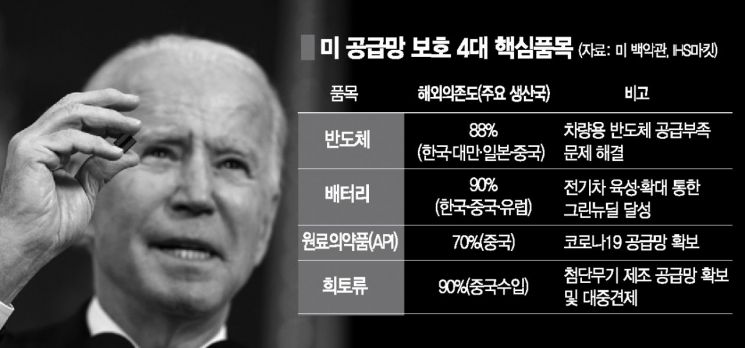
On the 24th (local time), President Joe Biden stood on the podium at the White House just before signing an executive order to review the supply chains of semiconductors, batteries, rare earths, and medical supplies over the next 100 days, and personally held up a semiconductor chip for reporters. This was to emphasize the importance of semiconductors and the necessity of semiconductor production within the United States.
◇Legislation to Support the Semiconductor Industry Also Underway= The executive order issued that day, which mainly focused on reviewing the supply chains of four major items, particularly emphasized semiconductors. Recently, the shortage of semiconductors has caused automobile production lines to come to a halt, which had a significant impact. President Biden stressed, "The executive order does not immediately solve the semiconductor shortage, but we must address supply issues to avoid future crises."
He also mentioned, "We are working with allied semiconductor companies and others to resolve bottlenecks." President Biden emphasized, "We cannot respond after the supply chain is disrupted. We must prevent supply chain crises from the outset."
On the same day, the U.S. government and Congress agreed to provide funding to support the semiconductor industry. Before signing the executive order, President Biden held a meeting at the White House with about ten bipartisan lawmakers and disclosed that he had secured bipartisan cooperation. Senate Majority Leader Chuck Schumer of the Democratic Party also expressed his intention to push for legislation to fund the semiconductor industry. Schumer, whose constituency is New York State, has previously expressed hope for Samsung Electronics' investment in New York State.
U.S. media evaluated this move as an intention to expand the semiconductor production base within the United States. President Biden also emphasized, "We need to conduct research and development (R&D) and establish a production base like in the 1960s." The 1960s was the period when the semiconductor industry first emerged worldwide in the United States.
◇Korean Companies Face Deepening Concerns... What Are the Pros and Cons?= As the Biden administration ordered a review of the supply chains of key items that revealed structural supply and demand problems, domestic related companies are now in a situation where they must carefully weigh the pros and cons. Semiconductor companies, which account for 95% of exports, are particularly sensitive. The relationship with China, which accounts for about 40% of export value, cannot be ignored.
According to the Korea International Trade Association, Korea's semiconductor exports over the past year from January last year amounted to about $107.9 billion (approximately 119 trillion won), with China recording the largest share at about $43.3 billion (approximately 48 trillion won). It is also known that China accounts for half of the semiconductor export share of major domestic companies such as Samsung Electronics and SK Hynix.
An industry insider said, "China is a market that domestic semiconductor companies cannot afford to lose because IT companies have rapidly grown there and it has a significant influence on the global economy." He added, "Currently, the industry is in a difficult position where it cannot act decisively because the U.S.'s future plans are not yet clear." He further noted, "While expanding investment and exchanges with the U.S., companies must skillfully balance so as not to lose the Chinese market."
© The Asia Business Daily(www.asiae.co.kr). All rights reserved.
![Clutching a Stolen Dior Bag, Saying "I Hate Being Poor but Real"... The Grotesque Con of a "Human Knockoff" [Slate]](https://cwcontent.asiae.co.kr/asiaresize/183/2026021902243444107_1771435474.jpg)
















