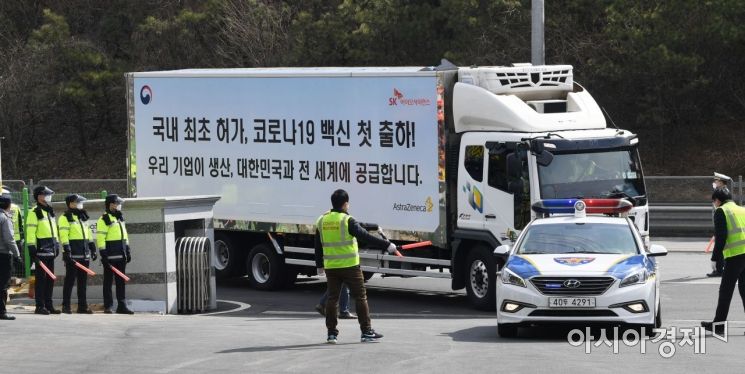
 On the 24th, when the first shipment of the AstraZeneca COVID-19 vaccine was made in Korea, a vaccine transport vehicle that left the SK Bioscience factory in Andong, Gyeongbuk, arrived at the Gtree BNT logistics center in Icheon, Gyeonggi-do.
The vaccines that arrived at the logistics center on this day are part of the 750,000 doses contracted by the government, totaling 150,000 doses, and are scheduled to be sequentially transported to public health centers and nursing hospitals nationwide starting from the 25th, the following day. February 24, 2021 Photo by Joint Press Corps
[Asia Economy Reporter Lee Chun-hee] "Rather than placing significance on the 'first recipient' itself, the emphasis is on the fact that it is the first day that vaccinations begin." (Hong Jeong-ik, Team Leader of the Vaccination Management Division, COVID-19 Vaccine Promotion Task Force)
As the first COVID-19 vaccinations in South Korea begin at 9 a.m. on the 26th for inpatients, residents, and workers under 65 at nursing hospitals and facilities nationwide, attention is focused on who will be the 'first recipient.' However, health authorities maintain that since vaccinations start simultaneously across the country, there will be no separate 'first recipient.'
Hong Jeong-ik, Team Leader of the Vaccination Management Division of the COVID-19 Vaccine Promotion Task Force, appeared on MBC Radio's 'Kim Jong-bae's Focus' on the 25th and said, "Everyone receiving the vaccination at 9 a.m. on the 26th in each region can be called the first recipient." He added, "We place significance not on the first recipient itself but on the first day."
Jung Eun-kyung, Director of the Korea Disease Control and Prevention Agency (KDCA), also mentioned in a briefing the previous day, "The first recipient situation applies to all facility workers and residents as the first vaccination targets."
Regarding the replacement of all 3,900 doses of AstraZeneca vaccines being transported to Jeju the previous day due to temperature deviations during transport, Team Leader Hong explained, "There was no major problem, but since the temperature deviation during sea transport might have lasted longer, we took precautionary measures just in case there could be an issue."
The previous afternoon, the temperature inside the transport container of the vehicle carrying 3,900 doses of AstraZeneca vaccines from the Icheon vaccine logistics center in Gyeonggi Province to Jeju temporarily dropped to 1.5 degrees Celsius. AstraZeneca vaccines must be maintained between 2 to 8 degrees Celsius during transport and storage. Upon detecting the incident through the monitoring system, the KDCA recalled the vehicle and dispatched a new vehicle loaded with fresh vaccines from the logistics center. This vehicle arrived safely in Jeju that morning.
Team Leader Hong emphasized repeatedly, "According to data provided by the manufacturer, the vaccine is safe for up to 72 hours at low temperatures between minus 5 degrees and 2 degrees Celsius," explaining that the vaccine in question is not subject to disposal as the measures were taken proactively.
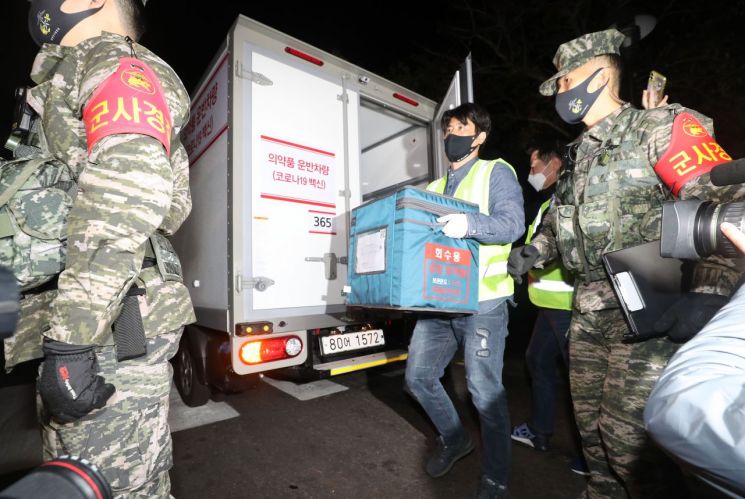 A 1-ton refrigerated truck carrying 3,900 doses of COVID-19 vaccines for Jeju residents arrived at Jeju City Public Health Center on the morning of the 25th, and officials are moving boxes containing the vaccines inside the health center. [Image source=Yonhap News]
© The Asia Business Daily(www.asiae.co.kr). All rights reserved.


















