Domestic Research Team's Next-Generation Solar Cell Studies Featured on Nature Cover for Two Consecutive Months
Following January's 'Gwangsatae' Paper, Perovskite Solar Cell Material Paper Also Featured on Cover on the 25th
[Asia Economy Reporter Kim Bong-su] Research papers on next-generation solar cell materials by Korean researchers have graced the cover of the international journal Nature for two consecutive months. These are all core technologies aimed at increasing the efficiency of converting light into electrical energy and enabling the production of solar cells in various shapes. Amid accelerating international competition to develop renewable energy sources in response to global warming, Korea appears to be leading solar power research and development (R&D).
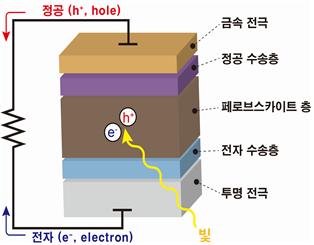
According to the Korea Research Institute of Chemical Technology on the 25th, Nature selected and published a cover paper on the 25th featuring a study by Dr. Seo Jang-won’s team at the institute, which developed key materials (electron transport layer and perovskite layer) for ultra-high-efficiency perovskite solar cells. This recognition was due to their achievement in developing core perovskite solar cell materials that can raise the photoelectric conversion efficiency (the ratio of converting light into electricity), a key performance metric of solar cells, to a record 25.2%.
Perovskite solar cells are attracting attention as third-generation solar cell materials. Compared to conventional silicon materials, they can be easily manufactured using inexpensive chemical materials through low-temperature solution processes. Additionally, they can be processed into rollable solar cells that are flexible or foldable, making them suitable for various applications such as car and airplane roofs. The challenge, however, is that their photoelectric conversion efficiency remains significantly lower than silicon’s (26.7%).
In response, the research team developed new materials and processing methods. To increase voltage and current, they created electron transport layer materials (tin oxide) and perovskite layer materials. The team devised a chemical solution deposition method that synthesizes tin oxide directly on a transparent electrode to form the electron transport layer. This method reduces defects, facilitating smooth electron transport and resulting in increased voltage.
They also developed a new synthesis method for the perovskite layer material that can absorb more light. The perovskite layer material consists of a mixture of black crystals that absorb light well and yellow crystals that do not. To stably secure more of the light-absorbing black crystals, the team identified the optimal bromine (Br) ratio to be incorporated into the perovskite layer and synthesized a new material accordingly. As a result, electrons could absorb more light, increasing the current.
By enhancing current and voltage with these two new materials, the team achieved high efficiencies of 25.2% for 0.1㎠ devices and 23% for 1㎠ devices. Considering that previously reported efficiencies for perovskite solar cells worldwide were in the 10% range, this is a remarkable achievement. The materials developed by the team also demonstrated a high luminous efficiency of 17%, indicating potential applications as light-emitting devices that convert electricity into light. The team had already obtained official certification from the U.S. National Renewable Energy Laboratory (NREL) in September 2019 for these results. Recognizing this, the world’s most prestigious international journal Nature published Dr. Seo’s team’s research as the cover paper on this issue.
Dr. Seo Jang-won, principal researcher at the Korea Research Institute of Chemical Technology, stated, “An efficiency exceeding 25% corresponds to 80% of the theoretical efficiency. If further improvements are made, efficiencies above 26% are possible, potentially approaching the highest efficiency of silicon solar cells at 26.7%.”
Meanwhile, another research team at the Korea Research Institute of Chemical Technology also published outstanding research results related to solar materials last month, which were selected as a cover paper in Nature. The team led by Dr. Seo Young-duk and Dr. Nam Sang-hwan from the Pharmaceutical and Bio Research Division discovered the world’s first “nanoparticle avalanche phenomenon,” published as the cover paper on January 14th in Nature.
Typically, materials have unique energy levels, so the energy of light emitted when amplified is constant. However, this team created a nanomaterial with a unique atomic lattice structure using the element thulium (Tm) and weakly irradiated it with low-energy light. This triggered a chain amplification reaction, producing light up to 40% stronger. The team was the first in the world to observe this phenomenon and named it “avalanche” by analogy to a snow avalanche.
This discovery is expected to have limitless applications, including next-generation solar cells where light absorption efficiency is critical, autonomous vehicle component development, sensors for advanced Internet of Things (IoT) devices such as satellites, optogenetics research using light, optical materials, and display-related industries.
© The Asia Business Daily(www.asiae.co.kr). All rights reserved.
![Clutching a Stolen Dior Bag, Saying "I Hate Being Poor but Real"... The Grotesque Con of a "Human Knockoff" [Slate]](https://cwcontent.asiae.co.kr/asiaresize/183/2026021902243444107_1771435474.jpg)











