Insurance CEOs Declare ESG Management
Expanding ESG Investments for Carbon Neutral Era
[Asia Economy Reporter Oh Hyung-gil] As 'ESG (Environmental, Social, Governance) management' emerges as a key topic in the insurance industry, attention is focused on whether the underperforming alternative investment results can be reversed.
In line with the 'carbon neutrality' era, which shifts from fossil fuels to renewable energy sources such as wind, solar, and hydrogen, insurance companies plan to secure stable investment returns in renewable energy and other sectors.
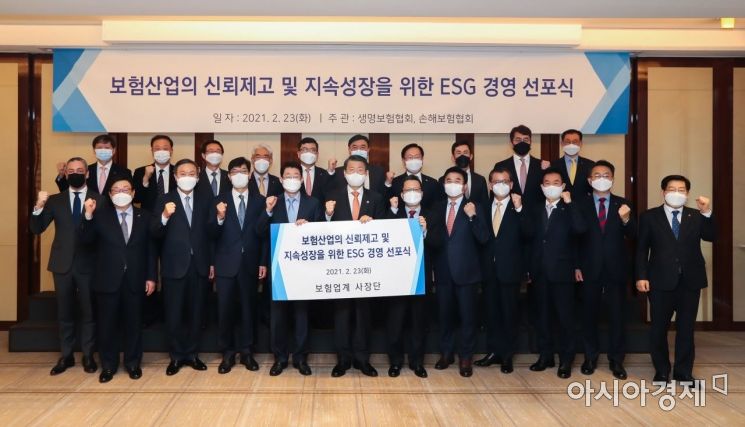
According to the insurance industry on the 24th, executives from life and non-life insurance companies held an ESG management declaration ceremony on the 23rd to enhance trust in the insurance industry and promote sustainable growth, announcing the insurance industry's ESG management declaration.
What stands out in this declaration is the asset management section. Insurance companies expressed their commitment to "consider ESG factors in asset management and participate in efforts to reduce greenhouse gas emissions and transition to a low-carbon economy."
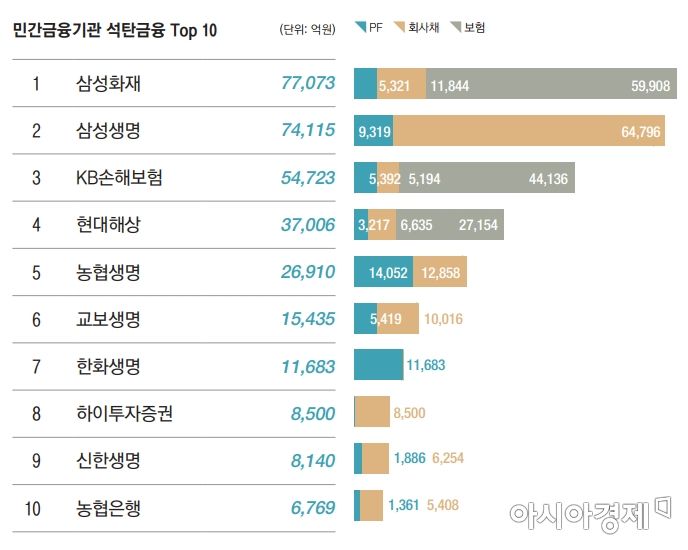
Among private financial institutions, insurance companies have accounted for an overwhelming share of investments in the coal sector. According to the '2020 Korea Coal Finance White Paper' released by the Korea Social Responsibility Investment Forum, eight of the top ten private financial institutions investing in coal power generation were insurance companies.
Samsung Fire & Marine Insurance led with KRW 7.7073 trillion, followed by Samsung Life Insurance with KRW 7.4115 trillion, KB Insurance with KRW 5.4723 trillion, Hyundai Marine & Fire Insurance with KRW 3.7006 trillion, NongHyup Life Insurance with KRW 2.691 trillion, Kyobo Life Insurance with KRW 1.5435 trillion, Hanwha Life Insurance with KRW 1.1683 trillion, and Shinhan Life Insurance with KRW 814 billion. These funds were provided through project financing (PF) loans, corporate bonds, and insurance support.
The problem is that as global environmental concerns increase, opportunities for insurance companies to invest in coal power generation are gradually disappearing. It is pointed out that surviving with existing asset management strategies will be difficult and that the risk of future losses is increasing.
According to the Financial Supervisory Service, as of the end of September last year, the scale of overseas alternative investments by insurance companies reached KRW 70.4 trillion, accounting for 6.5% of total assets (KRW 1,087 trillion). Real estate was the largest at KRW 24.1 trillion (34.2%), followed by social overhead capital (SOC) at KRW 20 trillion (28.4%), and corporate acquisitions and restructuring at KRW 9.3 trillion (13.2%).
In particular, the financial authorities have decided to strengthen soundness management by preparing model guidelines for risk management of alternative investments focused on overseas investments by insurance companies, as the possibility of loss expansion is increasing due to losses of about KRW 19.44 billion in some assets caused by the decline in value of overseas real estate and aircraft investment funds amid the COVID-19 pandemic.
In this situation where new alternative investment destinations are urgently needed, the ESG sector is emerging as an alternative. Several large insurance companies have already started coal phase-out management declarations.
Samsung Life Insurance and Samsung Fire & Marine Insurance have stopped new investments in coal power generation since June 2018 and have decided not to invest in direct loans or financing for coal-fired power plants or corporate bonds issued for the construction of coal-fired power plants. As of 2019, Samsung Life Insurance's share of new investments in renewable energy such as solar and wind power accounted for 29.1% of approximately KRW 1.1 trillion in new investments.
Hanwha Life Insurance and Hanwha General Insurance also declared last month that they, along with Hanwha Financial affiliates, will not participate in financial investments or support for coal-fired power generation in the future.
An insurance industry official said, "Not only coal phase-out but also asset management reflecting ESG factors such as ESG bonds, which are expected to increase in issuance, will become important," adding, "We plan to continuously expand investments in eco-friendly assets such as renewable energy."
© The Asia Business Daily(www.asiae.co.kr). All rights reserved.
![Clutching a Stolen Dior Bag, Saying "I Hate Being Poor but Real"... The Grotesque Con of a "Human Knockoff" [Slate]](https://cwcontent.asiae.co.kr/asiaresize/183/2026021902243444107_1771435474.jpg)

















