New Public Housing Site Development... Judged as Inflow of Speculative Demand
Preemptive Blocking of Instability Factors in Real Estate Market
Establishing a Sound Market Order Centered on Genuine Demand
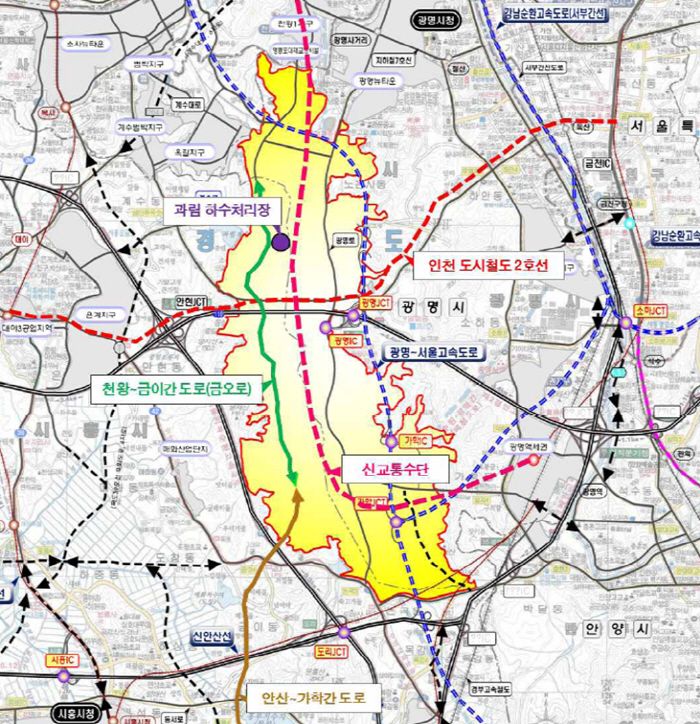
[Asia Economy Reporter Kangwook Cho] The Ministry of Land, Infrastructure and Transport announced on the 24th that three new public housing districts?Gwangmyeong-Siheung (Gyeonggi Province), Gwangju-Sanjeong (Gwangju City), and Busan-Daejeo (Busan City)?along with their surrounding areas, will be designated as land transaction permission zones.
Earlier, on the 4th, the Ministry announced a plan under the "Public-led 3080+, Drastic Expansion of Housing Supply in Metropolitan Areas" to supply approximately 250,000 new public housing units across 15 to 20 locations nationwide. As the first phase, three new public housing districts?Gwangmyeong-Siheung, Gwangju-Sanjeong, and Busan-Daejeo (totaling 101,000 units and 16.8㎢)?were confirmed and announced on this day.
The designation of land transaction permission zones for these newly announced public housing districts was made to preemptively block speculative demand driven by expectations of land price increases, as new public housing sites are being promoted in prime locations in both the metropolitan and provincial areas. This aims to stabilize the real estate market and establish a sound market order centered on actual demand.
The land transaction permission zone designation proposal passed the Central Urban Planning Committee review on the 23rd, was publicly announced on the 25th, and is scheduled to take effect from the 2nd of next month.
The land transaction permission zones cover a total area of 32.4㎢ across Gyeonggi, Gwangju, and Busan, including the Gwangmyeong-Siheung area (22.7㎢), Gwangju-Sanjeong area (3.5㎢), and Busan-Daejeo area (6.2㎢). The designation period is two years, from the 2nd of next month until March 1, 2023. The permission requirement applies to land exceeding the standard area defined in the Enforcement Decree of the Real Estate Transaction Reporting Act (e.g., 100㎡ in green zones).
Land transaction permission zones are designated by the Minister of Land, Infrastructure and Transport or the governors of cities/provinces under Article 10 of the Real Estate Transaction Reporting Act. These zones are established in areas where speculative land transactions are rampant or where land prices are rapidly rising or expected to rise. The designation is made after review by the central (when designated by the Minister) or city/provincial urban planning committee (when designated by the governor). Those intending to acquire land exceeding a certain area in these zones must obtain prior permission from the head of the city, county, or district office by specifying the intended land use. Those granted permission are obligated to use the land according to the approved purpose, such as actual residence or actual business operation, for a specified period.
Kim Hyung-seok, Director of Land Policy at the Ministry of Land, Infrastructure and Transport, stated, "Starting with these 101,000 units, approximately 250,000 new public housing units will be sequentially announced in the first half of this year. To curb speculative land transactions fueled by development expectations, we are implementing land transaction permission zone designations." He emphasized, "Even after this designation, we plan to actively consider additional permission zone designations by comprehensively taking into account the scale and nature of projects and land market trends."
© The Asia Business Daily(www.asiae.co.kr). All rights reserved.
![Clutching a Stolen Dior Bag, Saying "I Hate Being Poor but Real"... The Grotesque Con of a "Human Knockoff" [Slate]](https://cwcontent.asiae.co.kr/asiaresize/183/2026021902243444107_1771435474.jpg)
















