Biden to Sign Plan This Month to Strengthen Global Supply Chain Solidarity
[Asia Economy Reporter Kwon Jae-hee] The Joe Biden administration in the United States is strengthening ties with allied countries to reinforce supply chains for key components and raw materials such as semiconductors and electric vehicle batteries. This is interpreted as a plan to isolate China on the global stage by strengthening alliances in response to competition for global dominance with China.
On the 24th, Nihon Keizai Shimbun reported as its top story that President Joe Biden is expected to sign an executive order containing these details within this month.
President Biden stated, "Cooperation with allied countries will create a strong supply chain," expressing a plan to establish a national strategy for supply chains of key components and raw materials. The key components identified by the U.S. government include semiconductors, electric vehicle batteries, rare earth elements, and medical supplies.
Nihon Keizai Shimbun reported, "The intention is to build a new supply chain with allied countries excluding China to dismantle the current system dependent on China."
According to a draft obtained by Nihon Keizai Shimbun, semiconductors are expected to be linked with Taiwan, which has a friendly relationship with the U.S., as well as South Korea and Japan. Cooperation on rare earth elements is anticipated with Australia and various Asian countries.
Specifically, there is also mention of sharing information about supply chains of major products with allied countries. In addition to mutually complementing production items, a structure for rapid procurement among allied countries in emergencies is reportedly under consideration. There is also a possibility of requesting a reduction in transactions with China.
Nihon Keizai Shimbun reported, "The issuance of an executive order by the U.S. to cooperate with allied countries in building supply chains for key components reflects the judgment that, since 2018, due to confrontation with China, there is a need to build a new supply chain that completely excludes China from a security perspective."
In fact, China has previously regulated exports of rare earth elements to Japan, with which it has a conflict over the Senkaku Islands (called Diaoyu Islands in Chinese). The U.S. imports about 80% of its rare earth elements and 90% of its medical supplies from China.
The U.S. has already been working on building new supply chains since last year. One example is semiconductors, with strengthened relations with Taiwan, a friendly country to the U.S. Last year, Taiwan's TSMC announced plans to invest $12 billion (approximately 13.3 trillion KRW) to establish a 5-nanometer process production line in Arizona, USA.
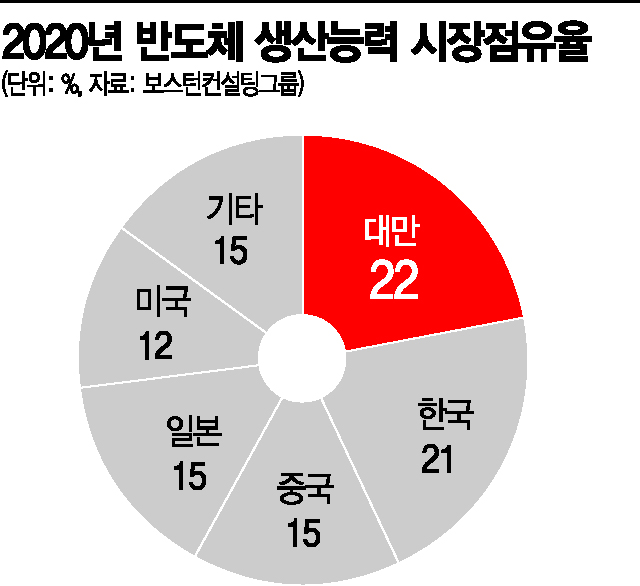
Semiconductors are especially considered representative components that China could weaponize. According to Boston Consulting Group (BCG), as of 2020, Taiwan and South Korea held the top two positions in global semiconductor production capacity market share with 22% and 21%, respectively, while the U.S. and China tied for third place with 15%. The U.S. ranked fifth with 12%. However, China's production capacity is steadily increasing and is expected to account for 24% of the global market by 2030, becoming the largest worldwide. The Biden administration's plan is based on concerns about security risks if dependent on China in the supply chain, allowing pressure to be applied through trade regulations.
The Biden administration believes that by building a semiconductor supply chain linked with South Korea, Japan, Taiwan, and others, it can not only check China but also block China's expanding market share globally. However, there is a possibility that the U.S. may force South Korea, which houses major semiconductor makers such as Samsung Electronics and SK Hynix, to choose between the U.S. and China.
However, it remains uncertain whether countries and companies will respond positively to this plan. Nihon Keizai Shimbun reported, "Major semiconductor makers are among the top globally, and whether they will align with the Biden administration depends on each company's judgment," adding, "Building a new supply chain is likely to take considerable time in the future."
© The Asia Business Daily(www.asiae.co.kr). All rights reserved.


















