Smartphone Ownership Rate Among Children Under 10 at 51%... Increasing Every Year
Reflecting Both Parents' 'Trust' and Children's 'Interest'
[Asia Economy Reporter Eunmo Koo] "Kids phones must have features that engage children’s interest and services that parents can trust at the same time."
An official from a mobile carrier said, "We are trying to improve the platform from the perspective of promises and empathy between parents and children, rather than blocking and controlling." As the age at which children first encounter smartphones continues to decrease, market interest in ‘kids phones’?smartphones designed exclusively for children?is rapidly growing. The three major carriers are competitively strengthening the functions as educational smart devices and expanding related device releases and services.
"Capture the demand for new kids phones"
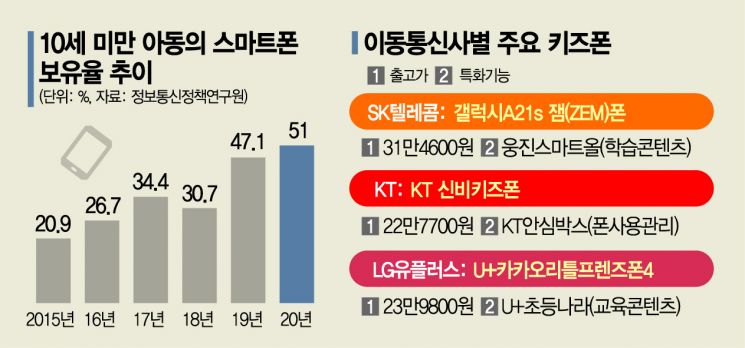
According to the industry on the 23rd, all three major carriers have recently actively expanded kids phone services. KT launched the 'KT Shinbi Kids Phone' on the 8th, featuring characters from the animated series 'Shinbi Apartment.' LG Uplus also released the 'U+ Kakao Little Friends Phone 4' with characters from ‘Kakao Friends’ on the 15th of last month. Earlier, SK Telecom launched the ‘Galaxy A21s ZEM’ phone last year.
First, SK Telecom partnered with Woongjin ThinkBig to launch the ‘Woongjin Smart All’ product last week, which offers monthly subscription access to learning content for all elementary school subjects. Additionally, it comes preloaded with apps such as Naver Language Dictionary, Today’s Conversation, and Word Quiz, providing light snack-type learning content for easy study.
LG Uplus also emphasizes educational content apps by including ‘U+ Elementary Country’ as a mobile version for the first time on the U+ Kakao Little Friends Phone 4. LG Uplus offers a collection of kids-specialized services usable from preschoolers to elementary students, including ‘Kids Country,’ ‘U+ Elementary Country,’ and ‘U+ Kids Vivid Library.’
KT, which most recently launched a new kids phone, introduced a new value-added service called ‘KT Safety Box’ that enhances safety features. Safety Box provides real-time location tracking of children, as well as ‘Study Mode’ and ‘Protection Guide.’ Study Mode controls the child’s phone usage to allow only calls, texts, camera, and gallery, helping manage study time. Protection Guide offers a feature to view the child’s smartphone usage status at a glance.
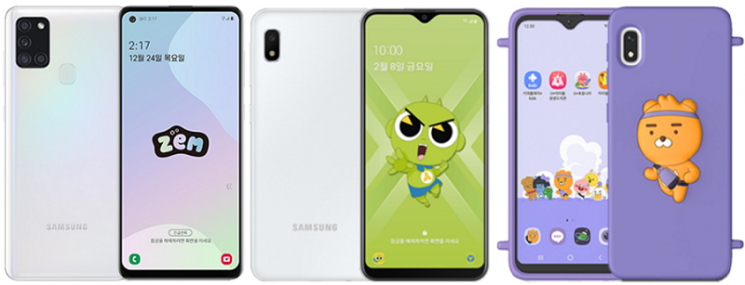 (From left) SKT's 'Galaxy A21s Jam (ZEM)', KT's 'KT Shinbi Kids Phone', LGU+'s 'U+ Kakao Little Friends Phone 4'
Half of children under 10 own smartphones
According to the Korea Information Society Development Institute, the smartphone ownership rate among children under 10 years old was 51.0% last year, an increase of 3.9 percentage points from 47.1% in 2019. The ownership rate for children under 10, which was only 20.9% in 2015, rose annually to 26.7% in 2016 and 34.4% in 2017, more than doubling in five years. Not only ownership but usage is also increasing. According to SK Telecom, the average data usage of elementary school subscribers last year was about 1.8 gigabytes (GB), up approximately 20% from 1.5GB the previous year.
The growth of the kids phone market is interpreted as a result of increased social interest in child safety and the expansion of the online world. In particular, COVID-19 accelerated the growth of the kids phone market. Not only safety but also the educational aspect has been strengthened. Until now, kids phones focused on providing optimized services for safe smartphone use by children through specialized apps such as location tracking, phone usage status checks, and blocking harmful content. However, as in-person schooling was restricted and remote classes expanded due to COVID-19, making non-face-to-face interaction the norm, the role of these devices as providers of educational content has become more emphasized.
"Must satisfy both children’s interest and parents’ trust"
Kids phones are evolving not only with diverse functions but also in ways that satisfy both buyers and users. Early kids phones focused on providing functions and services desired by parents, the buyers, but recently, elements that can stimulate children’s interest, the users, are actively incorporated. Characters preferred by children are applied to smartphone themes and content, and various accessories such as phone cases, sling bags, and stickers are included to enhance children’s satisfaction.
Kids phone manufacturers and carriers plan to focus on creating user interfaces (UI) and user experiences (UX) that are friendly to both parents and children. Kiwi Plus, a kids phone and app developer, stated, "As kids phones have more functions, some parents find it difficult to use all features efficiently," adding, "We are improving products to make them easy and convenient to use from the user’s perspective." LG Uplus also explained, "We received customer feedback that app menus are complicated, so we are making them as simple as possible and focusing on discovering practical points such as providing single-page manuals of key functions that can be attached to refrigerators to help in daily life."
© The Asia Business Daily(www.asiae.co.kr). All rights reserved.
![Clutching a Stolen Dior Bag, Saying "I Hate Being Poor but Real"... The Grotesque Con of a "Human Knockoff" [Slate]](https://cwcontent.asiae.co.kr/asiaresize/183/2026021902243444107_1771435474.jpg)












