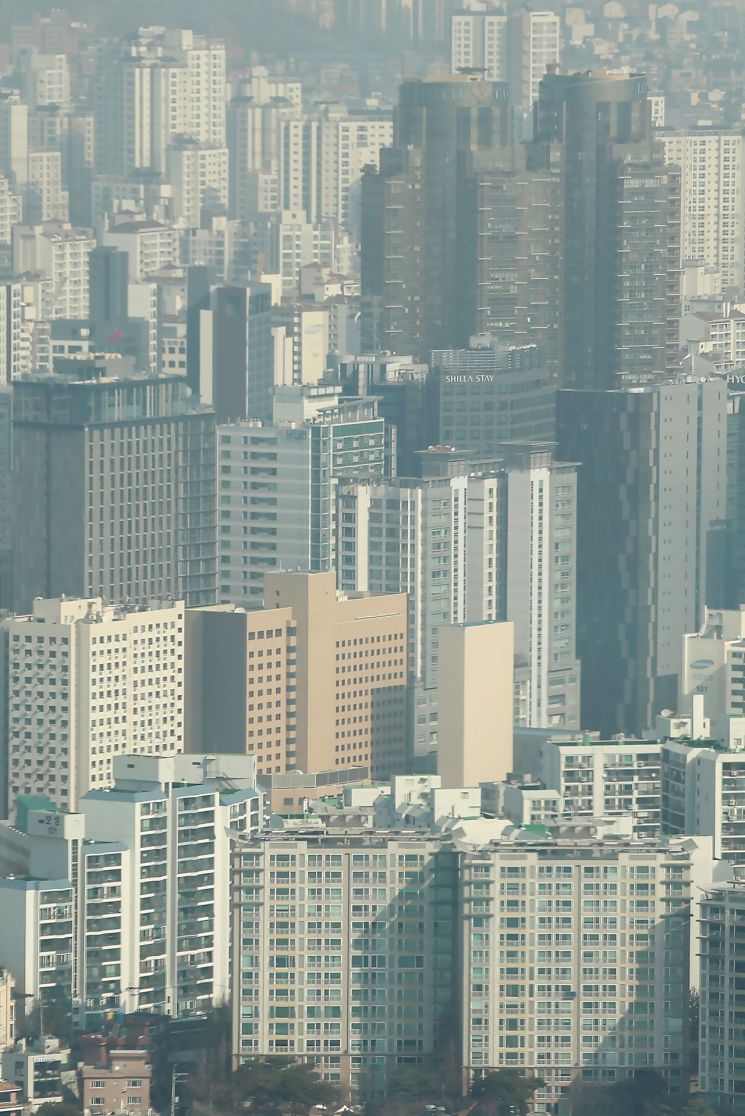
 Since the announcement of the February 4th plan, which focuses on large-scale housing supply, the rate of increase in apartment prices in Seoul has been slowing down. According to Real Estate 114, a private market price research firm, the apartment sale prices in Seoul rose by 0.14% in the third week of February, narrowing from the 0.17% increase recorded in the first week of the same month. Statistics from the Korea Real Estate Board, a government-certified price survey agency, also show a slowdown in the rate of increase in Seoul apartment prices for two consecutive weeks. The photo shows apartment complexes in downtown Seoul as seen from 63 Square in Yeongdeungpo-gu, Seoul, on the same day.
 The capital gains tax rate hike on corporate-owned housing sales that began in January led to a roughly 25% decrease in corporate housing sales compared to the previous month. It appears that corporations had already offloaded a large volume of properties by the end of last year, just before the tax increase. However, the structure where individuals absorb the volume of properties sold by corporations remained unchanged.
According to the Korea Real Estate Board's housing transaction status on the 23rd, the number of houses (including detached houses, multi-family houses, multiplexes, row houses, and apartments) sold by corporations nationwide last month was 37,838, down 24.5% from 50,087 in the previous month.
This decline in corporate housing sales is attributed to the government's real estate regulatory measures. The government strengthened tax policies related to corporate housing transactions through the June 17 and July 10 measures last year. Until the end of last year, capital gains from corporate housing sales were taxed at the basic corporate tax rate (10?25%) plus an additional 10% rate, but from the new year, the additional rate was raised to 20%.
Most of the properties sold by corporations last month were purchased by individuals. Individuals accounted for 91.6% of the purchases of houses sold by corporations, other corporations accounted for 3.9%, and other buyers made up 4.5%.
However, the continuous disposal of properties by corporations does not seem to be affecting housing prices. According to the Real Estate Board, nationwide apartment prices rose by 0.27% in the second week of this month (as of the 8th). In particular, the buying sentiment among the 20s and 30s age groups remains strong. According to the monthly transaction status by buyer age group from the Real Estate Board, the share of 30s in Seoul apartment transactions last month was 39.6%, the highest among all age groups. The combined purchase share of those aged 20 and under and those in their 30s was 44.7%, also a record high.
© The Asia Business Daily(www.asiae.co.kr). All rights reserved.

















