5600 New Move-ins Next Month
66% Decrease Compared to Jan-Feb
April Even Worse with Around 2000 Units
Concerns Over Resurgence of Jeonse Crisis
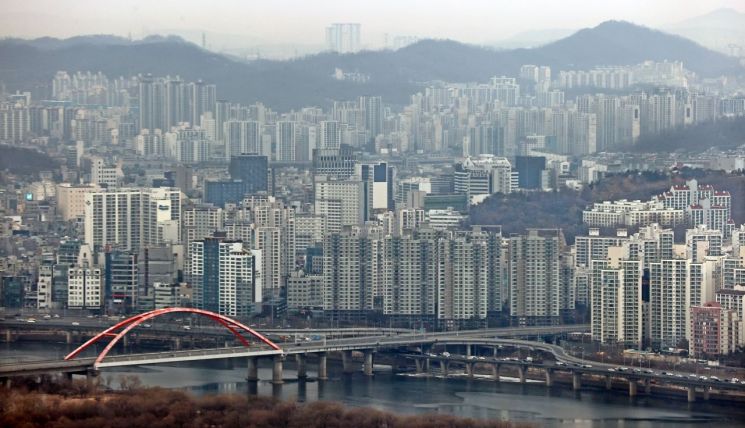 Apartment complexes in downtown Seoul as seen from 63 Square in Yeouido, Seoul [Image source=Yonhap News]
[Asia Economy Reporter Onyu Lim] Concerns are growing over the resurgence of the jeonse (long-term lease) shortage in the Seoul metropolitan area. This is because the supply of apartment move-ins sharply decreases during March to May, when seasonal demand from newlyweds and others increases.
According to Zigbang on the 23rd, the nationwide apartment move-in supply next month is expected to be 14,700 households, a 38% decrease from this month's 23,786 households. In particular, the reduction in supply is prominent in the Seoul metropolitan area, including Seoul, Gyeonggi, and Incheon.
The new apartment move-ins in the metropolitan area in March will be limited to 5,598 households, including Mapo Prestige Xi in Yeomni-dong, Mapo-gu, Seoul (1,694 households), and Byeongjeom Station I-Park Castle in Byeongjeom-dong, Hwaseong, Gyeonggi (2,666 households). This is more than 10,000 fewer units compared to last month's 19,402 households and this month's 16,511 households. In Incheon, there is reportedly no move-in supply at all.
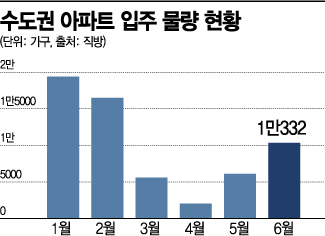
April will be even more severe. The expected move-in supply in the metropolitan area is only 2,041 households, about one-tenth of last month's level. Seoul has 1,050 households, Incheon 991 households, and there is no supply in Gyeonggi. In May, the supply slightly recovers to 6,104 households, but all are in Gyeonggi, with no move-in complexes in Seoul or Incheon. Notable complexes include Wirye Foret Xi in Hakam-dong, Hanam (558 households) and Pangyo The Sharp Forest in Daejang-dong, Seongnam (990 households).
Since the implementation of the new Housing Lease Protection Act, including the contract renewal request system and the rent ceiling system, newly moved-in complexes have played a role in easing the jeonse shortage. In fact, the rise in jeonse prices in January and February, when the move-in supply was relatively high, somewhat slowed down. According to the Korea Real Estate Board, the metropolitan area's jeonse price index rose by 0.18% in the third week of this month compared to the previous week. This is the first time the increase rate has reached the 0.1% range since the second week of October last year.
However, with the decrease in spring move-in supply, key indicators in the jeonse market are showing unstable signs again. The number of jeonse listings in the metropolitan area, which had been increasing, is now stagnant. According to Apartment Real Transaction Data, a real estate big data company, Seoul apartment jeonse listings recovered to about 22,000 units on the 11th, the highest in about six months, but have since remained between 20,000 and 21,000 units.
Ham Young-jin, head of Zigbang Big Data Lab, said, "Since it is the moving season when demand increases, in areas where move-in news is scarce, finding jeonse listings may be relatively limited."
© The Asia Business Daily(www.asiae.co.kr). All rights reserved.


















