Candidate Ahn Proposes 'Outside City Center' Queer Festival in TV Debate
"Erasing Existence Is Also Hate and Discrimination," LGBTQ+ Backlash
Queer Festival Started to Promote LGBTQ+ Visibility
Criticism That Moving Outside City Center Loses Its Meaning
Experts Say "Need to Consider Inclusion of LGBTQ+ in Seoul"
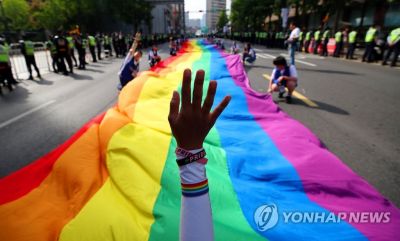 The 'Seoul Queer Culture Festival' and queer parade held at Seoul Plaza on June 1, 2019 / Photo by Yonhap News
[Asia Economy Reporter Lim Juhyung] Conflicts are deepening over the venue for the LGBTQ+ rights festival, the 'Queer Parade.' Ahn Cheol-soo, a preliminary candidate from the People’s Party running for Seoul mayor in the by-election, recently proposed moving the festival outside the city center during a TV debate, stating that "the right to refuse should also be respected." This has sparked criticism from the LGBTQ+ community.
The Queer Parade is an event that affirms the existence of sexual minorities and boosts their confidence. Critics argue that if it is pushed outside the city center, its significance will be lost. However, some counter that "public spaces used by many citizens cannot cater exclusively to sexual minorities," intensifying the controversy.
◆ Candidate Ahn: "Moving the Queer Festival outside the city center is appropriate"
Earlier, on the 18th, during the 'Ahn Cheol-soo - Geum Tae-seop Seoul Mayor Candidate Unification Debate' hosted by Channel A, independent candidate Geum Tae-seop asked Ahn, "Are you willing to attend the Queer Festival?"
In response, Ahn said, "Opposing discrimination is natural. Individual human rights must be respected," but added, "Not only one’s own rights but also others’ rights are important."
 Ahn Cheol-soo, the preliminary candidate of the People’s Party running for the Seoul mayoral by-election (left), and independent preliminary candidate Geum Tae-seop shake hands before a debate for unification held at the Channel A headquarters in Sangam-dong on the 18th. / Photo by Yonhap News
He then referred to the San Francisco Queer Festival in California, USA, saying, "This festival is held in the southern part of the city, a bit away from the downtown area," and emphasized, "If the Queer Festival is held in Gwanghwamun, some people voluntarily come to watch, but there are also those who come with children for various reasons. The right to refuse such things must also be respected."
On the following day (19th), Ahn reiterated, "It is appropriate to move the Queer Festival outside the city center."
In an interview with CBS Radio’s 'Kim Hyun-jung’s News Show,' Ahn said, "Freedom of assembly must naturally be guaranteed, but looking at past Queer Festivals, there have been cases of high levels of nudity and sexual expression," adding, "There are citizens concerned about children and adolescents being exposed without protection."
◆ "Erasing minority existence is also discrimination" vs. "Public squares are public spaces"
Public reactions sharply diverged. Some citizens criticized Ahn’s proposal to hold the festival outside the city as violence against sexual minorities. They argued that asking them to move to places where they are not visible is also discrimination and hatred. On the other hand, some voices supported Ahn’s claim, saying that festivals with a certain level of sexual content should be avoided in public spaces.
Yoo Mo (29), a sexual minority living in Seoul, said, "We are not criminals, so what’s the difference from being forced not to be visible? Deliberately erasing the existence of sexual minorities is also hatred," expressing disbelief that someone with such insensitivity to LGBTQ+ rights is a candidate for Seoul mayor.
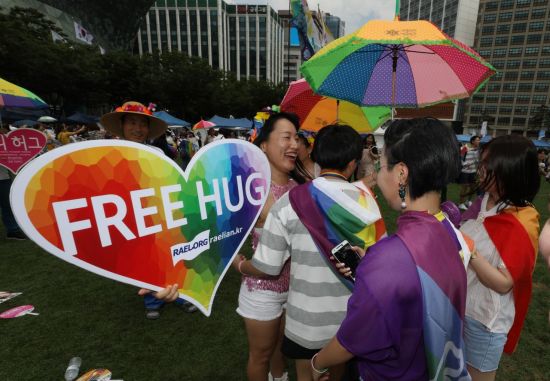 The scene of the queer parade held at Seoul Plaza in 2018. / Photo by Yonhap News
Another office worker in their 20s living in Seoul, A, said, "The Queer Festival has been held in Seoul for several years, and I have never heard of any problems caused by it," adding, "Respecting sexual minority rights and moving toward an inclusive society is a global trend. Should Seoul be left behind?"
Conversely, some argued that due to the often provocative performances at the Queer Festival, it should be held away from downtown Seoul. Office worker B (31) said, "This is not about discriminating against sexual minorities or banning the Queer Parade. However, it is true that the level of expression is somewhat high for a public place," and questioned, "Downtown and public squares are places where everyone from children to adults gather, so respecting only the Queer Parade might actually be reverse discrimination."
◆ The Queer Parade began to promote LGBTQ+ 'visibility'
The strong opposition from sexual minorities to holding the festival outside the city center stems from 'invisibility.' Invisibility refers to the phenomenon where sexual minorities cannot express their presence or voice in society. For example, hiding one’s sexual identity within organizations such as schools or workplaces.
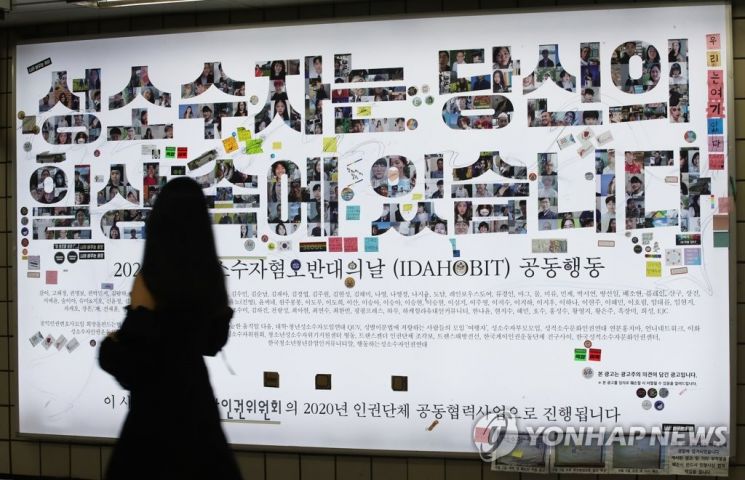 Last year, a subway advertisement opposing discrimination against sexual minorities installed at Sinchon Station on Seoul Subway Line 2. / Photo by Yonhap News
A society rife with invisibility risks creating a hostile environment for sexual minorities. Since sexual minorities are not 'recognized,' organizational cultures may develop without accommodating them. Especially in schools, this can prevent appropriate psychological counseling for adolescents struggling with their sexual identity and make it difficult to provide optimized services in health and social welfare sectors.
According to the 'Survey on Discrimination Based on Sexual Orientation and Gender Identity' report released by the National Human Rights Commission, invisibility and discrimination against sexual minorities are closely correlated.
The commission surveyed 948 adult sexual minorities and found that among those working in generally supportive workplaces, 55.8% disclosed their sexual identity to colleagues and supervisors, whereas only 7.3% did so in unsupportive workplaces.
Meanwhile, the Queer Parade was initiated to promote the visibility of sexual minorities. The world’s first queer festival was the 'Pride Parade' held in New York, USA, in 1970, organized to protest against the hostile American society at the time and to honor LGBTQ+ rights and dignity. Therefore, the Queer Parade holds significance when it is visible to all citizens in the city center. This is why sexual minorities find it difficult to accept festivals held outside the city center.
◆ "Minorities must be embraced in Seoul society"
Experts suggest that since sexual minorities have existed in every era, society should strive to integrate rather than exclude or push them away.
Kim Ji-hak, director of the Korea Diversity Research Institute, said, "The Queer Parade is not only a form of resistance, protest, and demonstration by sexual minorities but also a movement to reveal and affirm their existence in everyday life," adding, "Telling them to 'go somewhere invisible' contradicts the purpose of the festival."
He continued, "Sexual minorities have existed everywhere and at all times, including Korea; they are just becoming visible now," and advised, "Candidates for Seoul mayor, who will run the city, need to consider how to embrace these individuals within the vast society of Seoul, rather than simply hiding or excluding them."
© The Asia Business Daily(www.asiae.co.kr). All rights reserved.



















