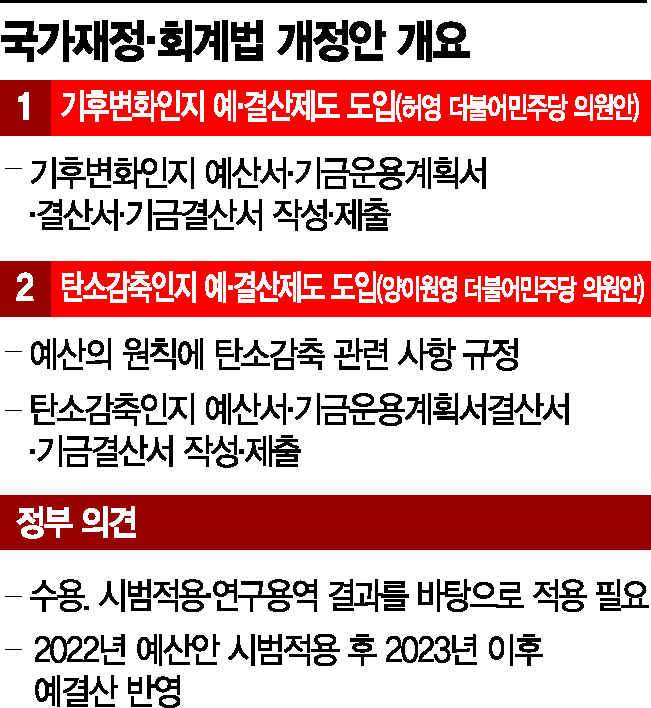
[Sejong=Asia Economy reporters Kim Hyunjung and Moon Chaeseok] Reviewing how government fiscal projects impact carbon reduction during the budget proposal and settlement process is a system already actively implemented in Europe. As the Moon Jae-in administration has positioned ‘2050 Carbon Neutrality’ as a major national agenda, it is expected that legislative promotion and implementation will proceed rapidly. However, experts suggest that establishing concrete carbon neutrality indicators should precede this, and caution that speed control is necessary to avoid balloon effects in the energy sector or excessive regulation.
According to the National Assembly’s Planning and Finance Committee on the 22nd, some European countries such as France, Italy, and Ireland currently operate climate change-aware or carbon reduction-aware budget proposal and settlement systems or similar frameworks. A representative example is France. At the end of 2019, France announced the methodology for Green Budgeting and piloted its application in the 2020 budget proposal. Among the 2020 budget proposal of 390.8 billion euros (approximately 523.3 trillion KRW), projects with significant environmental impact totaling 337 billion euros were classified by environmental goals such as air, soil, and marine environments, rating each project’s environmental impact on a scale from 1 (environmentally harmful) to 3 (very environmentally friendly).
France also published a ‘Green Budget’ as an annex to the 2021 budget proposal, evaluating that out of 547.2 billion euros in budget and tax expenditures, 528 billion euros had environmental impacts. Notably, France’s Green Budget is distinguished by ▲measuring environmental impacts across the entire national budget rather than just some ministries or projects ▲including tax expenditures comprehensively ▲addressing environmental issues beyond climate change such as biodiversity and pollution reduction ▲evaluating not only environmentally friendly actions but also harmful ones.
Italy has been aggregating and publishing the scale of environment-related budgets in expenditure settlements since the 2009 fiscal year and disclosing settlement annexes to the National Assembly. However, it only identifies budget projects with positive environmental impacts, with approximately 0.8% of government expenditures classified as environment-related spending as of 2019.
Additionally, Ireland prepares reports assessing low-carbon and climate resilience impacts as annexes to supplementary budget proposals. Applying this to the 2020 budget proposal, 2 billion euros of the national budget were counted as expenditures aimed at environmental improvement. Domestically, Seoul City and Gyeonggi Province have just begun research projects to introduce climate budgets and carbon-aware budget systems, respectively.
However, some express concerns that premature regulations without a concrete 2050 carbon neutrality scenario from the government could lead to balloon effects. Professor Choi Seung-il of Korea University’s Department of Environmental Systems Engineering explained, “Aligning national finances with the global carbon neutrality trend is the right direction, but it is necessary to carefully review the degree of enforceability in budget reflection and whether the carbon neutrality indicators are appropriate. Ultimately, this is an energy issue, and since balloon effects where one side suffers disadvantages are a concern, it is important to start applying this in small scopes and consider prioritization.” Professor Jung Dong-wook of Chung-Ang University’s Department of Energy Systems Engineering said, “While research can be conducted assuming project characteristics, it is very difficult to judge the effectiveness of developing indicators and reflecting them in the budget. Gradual research is necessary, but it is questionable whether this is an urgent policy to be pursued as a legislative task.” He added, “It would just mean adding another regulation.” An expert who requested anonymity said, “Carbon neutrality is one of the agendas that cannot be fully introduced within the current government’s term. Since budgets strongly reflect government policy directions, it is doubtful how effectively this can be implemented.”
Criticism also arises regarding the realism of the system, citing the current inadequate operation of the gender-responsive budget proposal and settlement system introduced through a similar process. Inside the Planning and Finance Committee, opinions were raised that “even the Ministry of Economy and Finance’s gender-responsive budget proposal and settlement system is not being operated effectively” and that “additional consideration should be given to directions that allow for more quantification.”
© The Asia Business Daily(www.asiae.co.kr). All rights reserved.
![From Bar Hostess to Organ Seller to High Society... The Grotesque Con of a "Human Counterfeit" [Slate]](https://cwcontent.asiae.co.kr/asiaresize/183/2026021902243444107_1771435474.jpg)
















