Yeo, Advocates 'Payments to Low-Income Groups'... Fiscal Authorities Face Challenges of 'Selective Targeting, Overlapping Support'
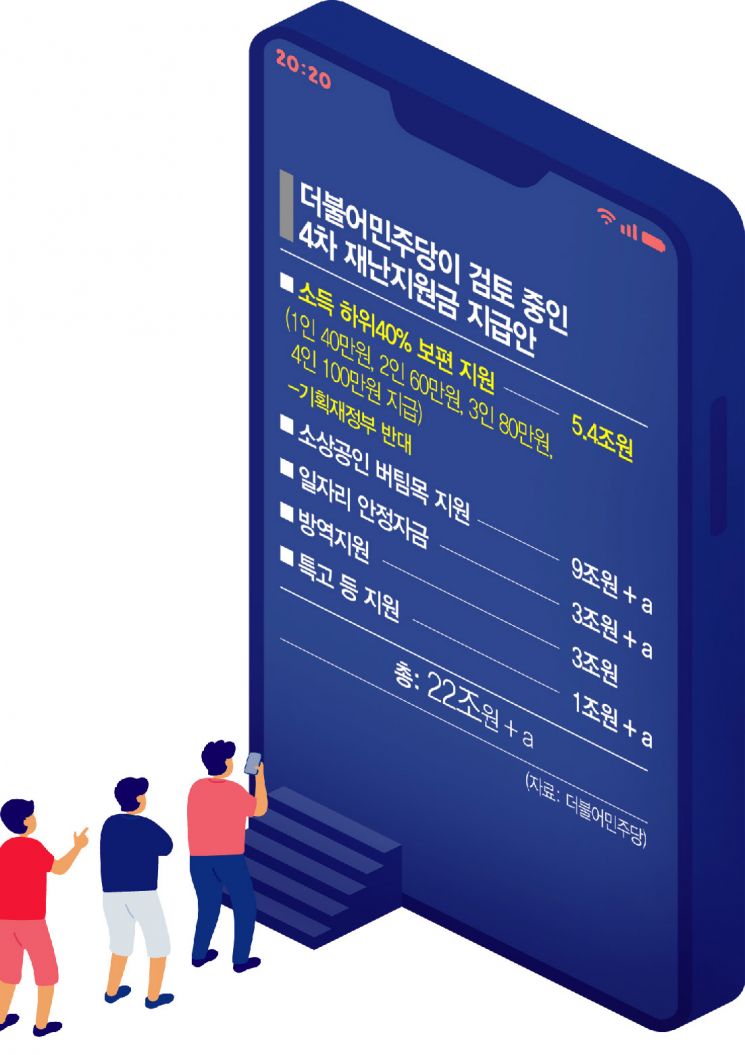
[Sejong=Asia Economy Reporters Son Seon-hee and Jang Se-hee] The Democratic Party of Korea and the government have reached a consensus on the size of the supplementary budget (supplementary budget) at "20 trillion won." The government, which had been resisting the ruling party's pressure, ended up being pulled along at the last minute. The ruling party fixed the funding size and presented multiple plans to the government side, including a plan to provide a uniform payment to the bottom 40% income group and to support self-employed and small business owners much more generously than before (up to 6 million won). The party and government will discuss these two plans and finalize the target recipients and support amounts within this week, with the key issue likely being whether to accept all of them.
According to the Democratic Party on the 22nd, the total number of households corresponding to the "bottom 40% income" standard for low-income households proposed by the party was estimated at 8.2 million households. If payments of "400,000 won for single-person households, 600,000 won for two-person households, 800,000 won for three-person households, and 1 million won for four-person households" are made to these households, the required budget is estimated to be about 5.4 trillion won.
The Democratic Party argues that to minimize blind spots, relatively vulnerable groups should be included. Lee Nak-yeon, leader of the Democratic Party, emphasized at the morning Supreme Council meeting that the deadline for party-government consultations is set for the 28th, stating, "Broad and substantial support is a sure policy tool to prevent the expansion of livelihood damage and accelerate economic recovery." To prevent blind spots, disaster relief funds should be uniformly provided to low-income groups corresponding to the bottom 40% income bracket.
Choi In-ho, chief spokesperson for the Democratic Party, told reporters after the Supreme Council meeting, "Under the goal of 'providing disaster relief funds within March,' intensive discussions will be held through various channels among the party, government, and Blue House this week," adding, "Compared to the 2nd and 3rd rounds, the scale will be much larger, and consultations will be conducted under the principle of 'broader, thicker, and sufficient support without blind spots.'"
The government's position is different. The Ministry of Economy and Finance, responsible for fiscal matters, says it is not easy to accurately distinguish the bottom 40% based on income, and it is difficult to exclude households already receiving various social benefits one by one to select recipients. A government official lamented, "When setting the ratio for the whole, we need to comprehensively consider earned income, capital income, and assets (real estate), but it is difficult to grasp all earned income itself." For example, there is currently no system to fully track income of regular workers who have so-called "two jobs," such as working as substitute drivers, or special-type workers (special employment types) who do not have labor contracts.
Also, cases such as profits from stock investments or households living with parents but registered separately must be considered when selecting recipients, but this inevitably faces administrative limitations. Ultimately, it is clear that fairness controversies will arise among recipient households.
Overlap with various government support programs such as livelihood benefits, housing benefits, and emergency employment retention subsidies is also a problem. In fact, livelihood benefits (30% of median income), medical benefits (40% of median income), housing benefits (45% of median income), and education benefits (50% of median income) are already provided to low-income groups. Emergency employment retention subsidies also target those with income reductions below 100% of median income.
Professor Hong Woo-hyung of Hansung University’s Department of Economics said regarding the issue of providing disaster relief funds to the bottom 40% income group, "There is a high possibility of overlap with other government support measures such as livelihood and housing benefits," adding, "With worsening fiscal conditions, it is appropriate to select only those severely affected."
© The Asia Business Daily(www.asiae.co.kr). All rights reserved.
![Clutching a Stolen Dior Bag, Saying "I Hate Being Poor but Real"... The Grotesque Con of a "Human Knockoff" [Slate]](https://cwcontent.asiae.co.kr/asiaresize/183/2026021902243444107_1771435474.jpg)











