[Asia Economy Reporters Inho Yoo and Jieun Lee] As U.S. President Joe Biden officially declared a stance to check China, analyses suggest that our government needs to seek a cautious diplomatic strategy toward China. Since President Biden has demanded a choice between the U.S. and China, the ball is effectively in our court.

On the 19th (local time), President Biden proposed restoring alliances during his virtual speech at the Munich Security Conference (MSC). He based the identity of alliances on shared democratic values and promised not to view alliances from a transactional perspective.
President Biden said, “Progress in democracy is under attack in many places, including Europe and the United States,” and added, “We are at a turning point where the claim that authoritarianism is the best solution and the claim that democracy is essential are in conflict.”
He emphasized, “Democracy does not happen by chance. We must defend it, fight for it, strengthen it, and renew it.” He further added, “If we cooperate with democratic partners based on strength and trust, we can meet every challenge and outpace every challenger.”
In his speech, Biden identified China and Russia as authoritarian regimes. He stated, “We must prepare together for a long-term and strategic competition with China,” and warned, “The competition with China will be fierce.”
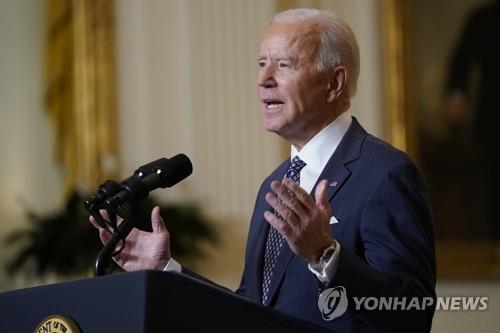
President Biden urged allies in Europe and Asia to stand with the U.S. in the anti-China front. He said, “Because the U.S. and Europe trust the global system that has been diligently built over the past 70 years together with allies in the Indo-Pacific.”
China responded by opposing the U.S. claims. Wang Yi (王毅), China’s State Councilor and Foreign Minister, asserted on the 22nd that the U.S. should not interfere in China’s internal affairs and must respect China’s core interests.
In a speech at the Lanting Forum held at the Ministry of Foreign Affairs’ Lanting, hosted by the China Public Diplomacy Association, Peking University, and Renmin University, Wang mentioned issues such as Taiwan, Hong Kong, Tibet, and the Xinjiang Uygur Autonomous Region, demanding that the U.S. refrain from interfering in China’s internal affairs. He also called for the removal of retaliatory tariffs on Chinese products and the cessation of sanctions against Chinese companies.
Diplomatic experts point out that since President Biden has asked to stand with the U.S. camp, our government must make a choice.
Among the Indo-Pacific allies mentioned as partners to check China are South Korea, Japan, and Australia. The choice is between authoritarian regimes and the democratic camp.
As the Biden administration is expected to demand allied participation in the Quad?a four-party security dialogue among the U.S., Japan, India, and Australia aimed at checking China?and restrictions on the use of Chinese advanced technology products including Huawei’s 5G communication equipment, the burden on our government is increasing.
Shin Beom-chul, head of the Diplomatic Security Center at the Korea Institute for Industrial Economics and Trade, said, “As the government’s diplomatic decision is delayed, the time for ‘choice’ is approaching,” and added, “It is desirable to accept some of the U.S. demands such as joining the Quad while considering China’s position within that framework.”
Some advise that our government need not make an immediate choice but can wait to see the U.S.’s specific responses to China before deciding.
Professor Hwang Jae-ho of Hankuk University of Foreign Studies said, “Unlike the previous Trump administration, the Biden administration’s stance is to cooperate where possible with China and compete where necessary,” and added, “The government should also observe the situation and respond rather than hastily taking sides.”
© The Asia Business Daily(www.asiae.co.kr). All rights reserved.
![Clutching a Stolen Dior Bag, Saying "I Hate Being Poor but Real"... The Grotesque Con of a "Human Knockoff" [Slate]](https://cwcontent.asiae.co.kr/asiaresize/183/2026021902243444107_1771435474.jpg)












