Significant Price Drops in Seoul, Busan, Daegu with High Housing Price Increases
Last Year’s 40-Unit Gap Investment Sparks 'Foreign Speculation' Controversy
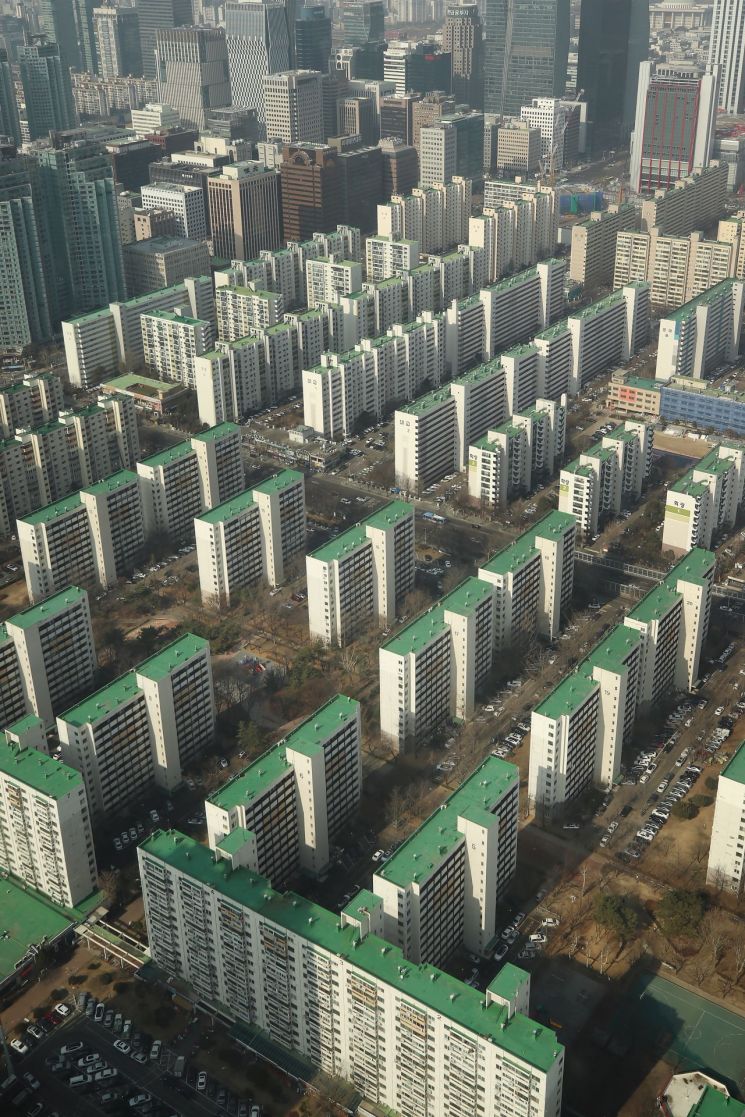 Since the announcement of the February 4th plan, which focuses on large-scale housing supply, the rate of increase in apartment prices in Seoul has been slowing down. According to Real Estate 114, a private market survey firm, the apartment sale prices in Seoul rose by 0.14% in the third week of February, narrowing from the 0.17% increase recorded in the first week of the same month. Statistics from the Korea Real Estate Board, a government-certified market survey agency, also show a slowdown in the rate of increase in Seoul apartment prices for two consecutive weeks. The photo shows apartment complexes in downtown Seoul as seen from 63 Square in Yeongdeungpo-gu, Seoul, on the same day.
 Amid a significant decline in housing transactions at the start of the new year, foreign nationals' transactions of domestic buildings also decreased by 18% compared to the previous month.
According to the Korea Real Estate Board on the 22nd, foreign nationals' transactions of buildings (including detached houses, multi-family houses, apartments, and commercial officetels) in Korea totaled 1,564 cases in January, down 17.7% from 1,901 cases in the previous month. Foreign transactions include cases where either the buyer or seller is a foreign national.
The areas where foreign transaction volumes sharply dropped were the Seoul metropolitan area and major provincial cities such as Busan and Daegu, where housing prices surged last year. In January, foreign transactions in Seoul were 360 cases, down 18.5% from the previous month. Busan decreased from 80 to 31 cases, a 61.3% drop, and Daegu fell from 40 to 14 cases, a 65% decrease. Gyeonggi Province also declined by 12%, from 663 to 582 cases.
Last year, foreign nationals' transactions of domestic buildings reached an all-time high. The surge in housing prices brought the issue of 'foreign speculation' into the spotlight.
In August last year, during an investigation by the National Tax Service, a case was revealed where an American in his 40s purchased 42 apartments in Korea through gap investment (transaction amount of 6.7 billion KRW).
According to the National Tax Service, from 2017 to May last year, foreign nationals acquired 23,167 apartments, with transaction amounts totaling approximately 7.6 trillion KRW. Among these, 7,569 units, or 32%, were found to be purchased by buyers who did not reside in them.
During this period, the regions where foreign nationals purchased properties were led by Gyeonggi Province with 10,093 cases (43.6%), followed by Seoul with 4,473 cases (19.3%), and Incheon with 2,674 cases (11.5%), with Seoul and the metropolitan area accounting for nearly 75%.
When foreign nationals purchase domestic housing, acquisition tax rates of 1-4% apply, and holding tax rates are not significantly different from those for domestic residents. However, foreign nationals are exempt from regulations such as loan-to-value (LTV) ratios on mortgage loans and funding plan submissions. This has led to criticisms of 'reverse discrimination.'
With over 2 million foreign residents in Korea, who have become an influential group in housing policy, there is a growing call to consider their trends when creating or implementing related measures.
Countries such as Singapore, New Zealand, and Canada prohibit foreign nationals from housing transactions or impose heavy taxes to curb speculation. Last year, some amendments to the Local Tax Act and Income Tax Act were proposed in the National Assembly to impose additional acquisition and capital gains taxes on foreign nationals' housing transactions.
For example, the proposal by independent lawmaker Lee Yong-ho included ▲applying an additional tax rate of up to 26% on top of the standard acquisition tax rate (1-4%) for foreign nationals, resulting in acquisition tax up to 30%, and ▲applying an additional 5% capital gains tax rate when foreign nationals transfer land or buildings.
However, these proposals were discarded during the National Assembly discussions. Although concerns about speculative real estate purchases by foreign nationals exist, imposing additional acquisition taxes on foreigners was criticized as potentially violating the principle of reciprocity. Additionally, it was argued that it is difficult to determine whether an acquisition is speculative at the time of purchase, necessitating careful review.
© The Asia Business Daily(www.asiae.co.kr). All rights reserved.
![Clutching a Stolen Dior Bag, Saying "I Hate Being Poor but Real"... The Grotesque Con of a "Human Knockoff" [Slate]](https://cwcontent.asiae.co.kr/asiaresize/183/2026021902243444107_1771435474.jpg)
















