Goyang-si, "Forest Creation Comes Before Luxury Apartment Development"
Seoul-si, "Expanding Sangam-Susaek as a Metropolitan Center Connection Axis"
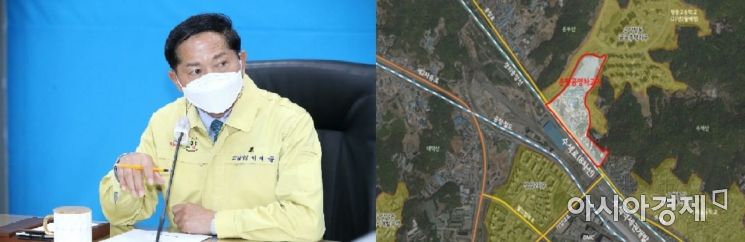 (Photo left) Lee Jae-jun, mayor of Goyang City, is strongly opposing Seoul City's development plan for the Eunpyeong public garage. [Provided by Goyang City and Seoul City]
[Asia Economy Reporter La Young-cheol] Amid escalating conflicts between Goyang City and Seoul City following Seoul's announcement of the 'Eunpyeong Garage Development Plan,' Goyang City has proposed measures to Seoul City to prevent 'urban agglomeration.'
'Urban agglomeration' refers to the phenomenon where the expansion of a central city and the spread of urbanization cause the boundaries between surrounding small and medium-sized cities to blur, resulting in the formation of a mega-city.
To prevent this, Goyang City argues that "development should be restrained in urban boundary areas and green spaces should be created."
On the 17th, Lee Jae-jun, Mayor of Goyang City, presented a measure to prevent 'agglomeration' related to the Eunpyeong Garage development plan, stating, "Rather than simple residential development, designating the area as a citizen forest park would be an alternative."
If Seoul City reviews and accepts Goyang City's 'agglomeration' prevention proposal, it could provide a clue to restoring the previously rigid cooperative relationship between the two cities.
However, at present, the prospect that Seoul City, which has been planning the Eunpyeong Garage development for several years, will accept Goyang City's proposal is considered unlikely.
This outlook is supported by the case where Seoul City, operating under a 'mayoral authority acting' system, began construction just over two months after announcing the 'Gwanghwamun Square Reconstruction Plan' last year despite opposition from political circles and civil society.
Moreover, it remains uncertain how Seoul City's development policies will proceed following the Seoul mayoral by-election in April. The two sides have also clashed over the reactivation of the food waste processing facility at the Nanji Water Reclamation Center.
Subsequently, the conflict deepens as the two sides confront each other again over the Eunpyeong Garage development plan.
According to our investigation, there were no specific prior consultation procedures between the two parties regarding the Eunpyeong Garage development plan.
A Goyang City official stated, "Just before the Lunar New Year holiday, we only received a brief notice that 'a feasibility study will be conducted,' but there were no concrete discussions, nor was there time to express any opinions."
Earlier, on the 14th, Seoul City announced, "We will proceed with a basic conceptual study for the development of a 165,000㎡ site around the Eunpyeong Public Garage."
Seoul City's plan is to develop industrial support spaces linked with Sangam DMC, Susaek Station area, and Goyang Hyangdong District around the public garage area, expanding it as a connection axis between the Sangam and Susaek metropolitan centers.
In response, Mayor Lee strongly criticized, saying, "Seoul City must immediately stop breaking the hearts of Goyang citizens."
He warned, "If deceptive acts continue, Seoul City should remember that the use of Seoul's undesirable facilities could be changed to parks or other purposes, and restrictions on usage period extensions or even demolition could be ordered."
At the end of last month, he had already declared to the prospective Seoul mayoral candidates, "No more new or expanded undesirable facilities from Seoul City will be allowed in Goyang, and necessary facilities should be resolved by Seoul City itself."
Judging by the level of response shown by Mayor Lee, the message sent to the prospective Seoul mayoral candidates was a 'warning shot,' and this time it is close to a 'final ultimatum.'
Furthermore, Mayor Lee expressed suspicion, saying, "I hope that the hasty promotion of business plans that could cause conflicts between boundary areas is not an administrative disorder colluding with construction capital."
Seoul City is also pushing ahead with the reactivation of the underground food waste processing facility in Seodaemun-gu, one of the undesirable facilities, despite Goyang City's opposition.
On the other hand, Seoul City shows a lukewarm attitude toward Goyang City's continuous demands for direct connection of the Goyang Line-West Line and the construction of BRT toward Hapjeong via the 2nd Jayuro.
On the 9th, Seoul City announced, "From now on, the principle for extending urban and metropolitan railways outside the city will be through flat transfers rather than direct connections," indicating that there will be no further direct railway extensions to Gyeonggi and Incheon.
Currently, about half of Goyang City's area, 119.26㎢, is designated as a development-restricted zone due to Seoul City's air quality and environmental issues.
The two sides are expected to continue experiencing various conflicts and clashes in the future, as the Eunpyeong Garage development and the Seodaemun-gu food waste processing facility are linked with several other development projects by Seoul City.
© The Asia Business Daily(www.asiae.co.kr). All rights reserved.
![User Who Sold Erroneously Deposited Bitcoins to Repay Debt and Fund Entertainment... What Did the Supreme Court Decide in 2021? [Legal Issue Check]](https://cwcontent.asiae.co.kr/asiaresize/183/2026020910431234020_1770601391.png)















