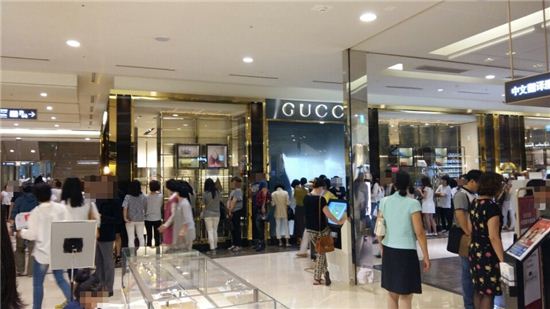
 On the morning of the 29th, a long line of customers was waiting at the Gucci store in the main branch of Lotte Department Store in Sogong-dong, Seoul. Gucci started offering a 50% discount on selected items from this day.
[Asia Economy Reporter Minji Lee] Concerns are growing that Kering's prolonged poor performance may continue due to sluggish sales of its core brand Gucci. Compared to top competitors, the sales growth trend falls short of expectations, leading to a forecast of reduced investment appeal for the time being.
According to the financial investment industry on the 20th, Kering's stock price fell 7% to 528,000 euros as of the 19th (local time) following the earnings announcement on the 17th. The stock price has continued to decline after the fourth-quarter results fell short of market expectations.
Kering recorded 4 billion euros in sales for the fourth quarter of last year, down 8.25% compared to the previous year. Excluding foreign exchange effects, the decrease was about 5%. By channel, despite strong growth in the e-commerce sector, retail sales in the fourth quarter were 3% lower than the previous year. The wholesale sector also declined by approximately 12% year-on-year.
By region, sales in Western Europe decreased by about 40%, and sales in Japan also dropped by 10%. However, sales increased year-on-year in North America (13%), Asia-Pacific (17%), and other regions (8%).
Looking at performance by core brand, Gucci recorded 2.3 billion euros and Saint Laurent 550 million euros, down 13.5% and 3% respectively compared to the previous year. Bottega Veneta recorded 380 million euros, showing a 12.1% growth year-on-year. Eunhye Lim, a researcher at Samsung Securities, explained, “Despite the advances of Bottega Veneta and Saint Laurent, the continued sluggish sales of Gucci, which contributes the most to sales, is a sign that consumer preference centered on China and millennials has weakened compared to competing brands during the year-end shopping season.”
The company's strength in the e-commerce sector grew 72% in the fourth quarter compared to the same period last year. Centered on Saint Laurent and Balenciaga, growth accelerated, and by the end of last year, the proportion of online sales in total sales rose to 13%, up from 6% the previous year.
The polarization trend among luxury brand companies is expected to deepen further after COVID-19. Researcher Eunhye Lim stated, “The company's sales recovery, which falls short of the solid sales growth of LVMH and Herm?s, is already reflected in the stock price. It is trading at a valuation discount of 20-30% compared to competitors, and brand reinvestment and consumption recovery will be key factors determining the stock price direction in the future.”
© The Asia Business Daily(www.asiae.co.kr). All rights reserved.

![User Who Sold Erroneously Deposited Bitcoins to Repay Debt and Fund Entertainment... What Did the Supreme Court Decide in 2021? [Legal Issue Check]](https://cwcontent.asiae.co.kr/asiaresize/183/2026020910431234020_1770601391.png)