"Lacking Motivation and Feeling Helpless"... Both Office Workers and Job Seekers Experience 'Burnout'
Experts Say "Ability to Manage Stress is Necessary"
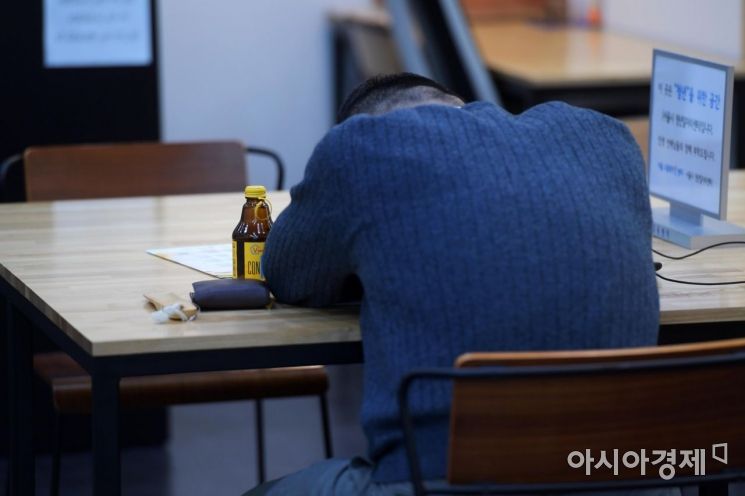 On the 24th, amid ongoing employment difficulties, a job seeker is taking a break at the Youth Job Center in Jung-gu, Seoul. Photo by Moon Honam munonam@
[Asia Economy Reporter Kang Juhee] #Kim, a 20-something office worker with 5 years of experience, has recently felt tired and irritable even after sleeping, with increasing stress. Although she used to be active enough to meet friends or enjoy leisure activities on weekends, she has cut back on these recently. Kim said, "Because I experience a lot of stress at work, I don't feel like having fun even on weekends," adding, "I have no appetite and just don't want to do anything." She especially complained that since mobile messengers became widespread, she has been contacted by her company even after work hours, making it impossible to rest peacefully even after finishing her tasks.
Recently, the number of people experiencing 'burnout' like Kim has been increasing. Burnout syndrome refers to a condition where a person who was fully immersed in work falls into lethargy caused by physical and mental fatigue, self-loathing, sleep disorders, nervousness, and job refusal.
An anonymous office worker community, 'Blind,' conducted a survey in July last year targeting 72,109 office workers, and 71% of respondents said they had experienced burnout. It was found that women (76%) experienced burnout more than men (67%).
The World Health Organization (WHO) defined burnout syndrome in May 2019 as a syndrome caused by chronic stress. Although it is not a medical disease, it is recognized as a work-related condition that needs to be properly understood and managed.
Recently, some office workers have complained of fatigue due to working from home, which some companies have implemented as a result of COVID-19.
Kang, a 30-something office worker, said, "At first, working from home was good, but it feels like work and household chores are not separated," adding, "Working from home has many inconveniences compared to being at the office, so efficiency seems to drop. Since work doesn't go well, I have become more easily irritated and often angry these days."
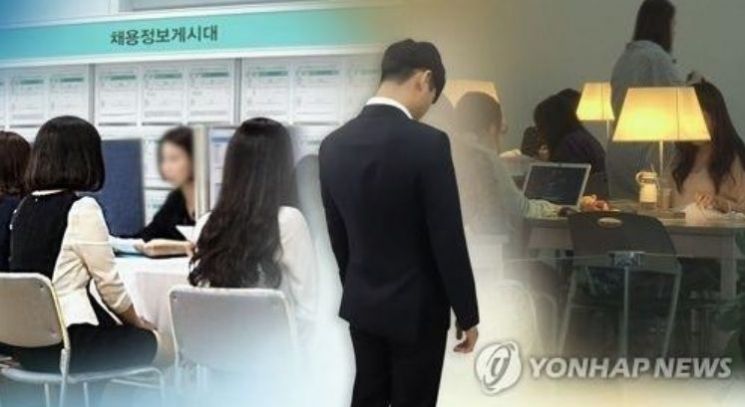 According to a survey, 87.7% of job seekers answered that they have experienced burnout symptoms while preparing for employment. Photo by Yonhap News
Burnout syndrome has been confirmed to affect not only office workers but also job seekers. A job portal, 'JobKorea,' surveyed 1,858 job seekers in June last year about 'job preparation fatigue,' and 87.7% of respondents said they had experienced burnout symptoms during their job search.
Lee, a 24-year-old preparing for employment in Seoul, said, "I worked hard to build my qualifications and prepare with hope of getting a job, but after repeatedly failing interviews, I have become lethargic, thinking that no matter how hard I try, it won't work out."
The biggest reason job seekers experienced burnout was 'economic difficulties such as job preparation costs and living expenses,' at 69.0%. This was followed by 'uncertain hiring environment due to COVID-19, such as cancellation/postponement of public recruitment and irregular hiring (60.8%),' 'interest and expectations from parents and acquaintances (47.6%),' 'anxiety about an uncertain future (42.6%),' and 'insufficient qualifications despite efforts (42.1%).'
Burnout symptoms felt by job seekers included 'feeling tired even after sleeping and feeling fatigued from the morning (62.3%),' 'lowered self-esteem and feelings of depression (57.6%),' 'emotional exhaustion leading to numbness (46.1%),' and 'complete exhaustion and feelings of helplessness and burnout in job preparation (45.7%).' It is analyzed that job seekers are also suffering from anxiety about the future as the economic downturn and employment shocks caused by COVID-19 continue.
Experts suggest that appropriate rest and leisure activities are necessary to relieve stress experienced in daily life.
Professor Lee Dong-gwi of Yonsei University's Department of Psychology explained, "When you work hard and run but the results do not meet expectations, you become disappointed and emotionally helpless. Also, the prolonged COVID-19 pandemic and economic recession have made the job market outlook uncertain. Economic pressure accumulates, leading to anxiety symptoms, and if anxiety persists, people become depressed."
He added, "Achieving goals is important, but managing oneself is even more crucial. Setting short-term goals to live day by day rather than long-term goals can also help. Regular exercise, meals, and sufficient sleep are necessary to recover from stress. Especially when feeling depressed, it is important not to be isolated by meeting people with whom you can share emotional difficulties."
© The Asia Business Daily(www.asiae.co.kr). All rights reserved.


















