GTX Transportation Boom Expectations Remain
High Price Increase Despite Supply Measures
Ansan Overheated Due to Rumors of Line C
D Line Announcement in June... Potential New Trigger for House Price Rise
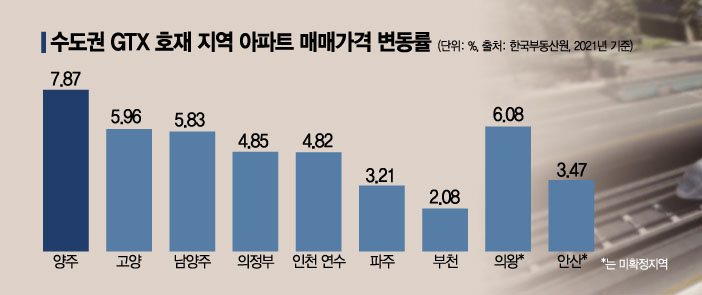
[Asia Economy Reporter Kim Hye-min] The positive impact of the Metropolitan Area Express Train (GTX) is overshadowing the government's housing supply plan for 830,000 households. While the soaring housing prices have temporarily paused, key areas in Gyeonggi Province along the GTX lines continue to maintain high growth rates. In some areas, prices surged sharply based solely on rumors without any concrete confirmation of the routes. Although the government announced an unprecedented supply plan to calm buying sentiment, it seems ineffective against the major transportation developments.
According to the Korea Real Estate Board on the 19th, Uiwang City recorded the highest weekly apartment price increase in Gyeonggi Province at 1.05% as of the 15th. This was followed by Ansan (0.83%), Yangju (0.82%), Namyangju (0.82%), Uijeongbu (0.81%), and Goyang (0.56%). These areas share the commonality of either having planned GTX stops or rumors of the lines passing through. Many of these regions are driving the price surge, with apartment price increases nearly double the Gyeonggi Province average of 0.42%.
The changes are even more pronounced compared to the end of December last year. Among the GTX-A line, Goyang City, which includes Kintex, Daegok Station, and Changneung Station, saw housing prices surge by 5.83% from the end of last December to the present this year. In Deogyang-gu, Donae-dong, the 84㎡ unit of Wonheung Dongil Suite jumped by over 200 million KRW in a single day after news of the new Changneung Station was announced at the end of last year. Yangju City, the terminus of the GTX-C line, also rose by 7.87% during the same period following progress reports on the project. In Ansan City, overheated investment demand is pouring in merely based on rumors that the related line might stop there.
The D line, scheduled to be finalized in June, is becoming a new core driver of housing prices. Major local governments such as Gangdong, Gangseo, and Songpa districts in Seoul are showing strong enthusiasm to attract stations, and this expectation is directly reflected in housing prices.
This rapid price increase is further fueled by expanding demand for mid- to low-priced apartments. Buyers, finding it difficult to purchase homes in Seoul, are flocking to GTX stations expected to improve transportation convenience. Although the government's supply plan has somewhat reduced the rate of increase, experts warn that as long as the projects remain unclear, overheating centered on transportation developments may continue.
Yeo Kyung-hee, Senior Specialist at Real Estate 114, said, "The expectation that one can reach Seoul in a very short time is more attractive to buyers," adding, "When a metropolitan transportation network is established, development potential increases especially around station areas and places with increased foot traffic."
However, she cautioned against 'blind investment' without considering project progress. Yeo advised, "For areas where visibility is low, one must assess the realistic possibilities," and added, "Since the B and C lines, unlike the GTX-A line which has already started construction, still have a long way to go before completion, entering the market aiming for short-term profits is risky."
© The Asia Business Daily(www.asiae.co.kr). All rights reserved.
![Clutching a Stolen Dior Bag, Saying "I Hate Being Poor but Real"... The Grotesque Con of a "Human Knockoff" [Slate]](https://cwcontent.asiae.co.kr/asiaresize/183/2026021902243444107_1771435474.jpg)
















