[Asia Economy Reporter Ji Yeon-jin] The 'inflation fear' has overshadowed the stock market. Recently, oil and raw material prices have surged sharply, and U.S. Treasury yields have risen, shifting expectations for economic recovery to fears of inflation. With the increased likelihood of the U.S. implementing an additional $1.9 trillion stimulus package and the full-scale rollout of COVID-19 vaccinations, signs of economic recovery are being detected in various places, raising concerns that the liquidity-driven rally supporting the recent stock market may be coming to an end.
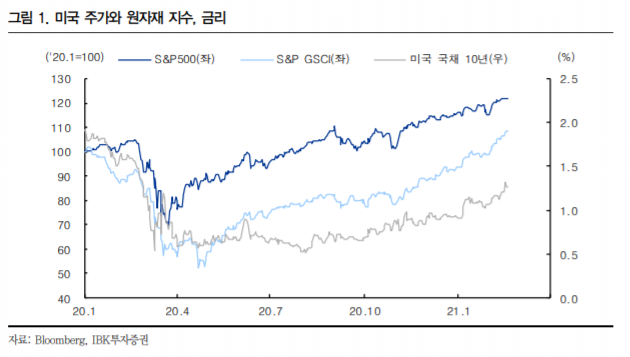
West Texas Intermediate (WTI) crude oil rose 1.8% from the previous day to $61.14 per barrel on the 17th (local time). Brent crude also increased by 1.8% to $64.43 per barrel. Both WTI and Brent crude reached their highest levels in 13 months. Although oil prices for next month have undergone some correction, the cold wave continuing mainly in the U.S. Northeast and Midwest regions means the pressure for a sharp rise remains. There is a view that demand pressure will be significant this year due to economic recovery and the effects of stimulus measures. In fact, prices of raw materials such as iron ore are also surging.
However,
concerns about inflation and monetary tightening due to economic recovery have increased, leading the stock market into a correction phase. The domestic KOSPI has been fluctuating around the 3100 level since the beginning of this month, and the U.S. market shows a similar pattern. Nevertheless, the concerns about inflation and monetary tightening are considered premature.
For inflation fears to materialize, the intensity of price increases must be high enough to burden the economy and corporate profits, but it has not reached that level yet. So-eun Ahn, an analyst at IBK Investment & Securities, said, "Looking at the U.S. case from 1999 to 2000, stock prices continued to rise until cumulative inflation caused economic and profit indicators to decline." She added, "Considering additional stimulus packages from various countries and the effects of COVID-19 vaccines at this point, the upward trend in the economy and profits is expected to continue, and despite inflation concerns, the current trend in the stock market will not change." She explained that during past reflation phases (when prices and stock prices rise), sectors such as energy and industrials took the lead during the full-scale economic recovery and inflation periods.
However, there are also opinions that the rise in raw material prices should be approached with caution. So-yeon Park, an analyst at Korea Investment & Securities, said, "The minutes of the U.S. FOMC (Federal Open Market Committee) showed consensus on continuing bond purchases, but concerns about financial stability and valuation were also revealed." She added, "It is worrisome that a certain portion of inflationary pressure is being driven by the rise in raw material prices."
© The Asia Business Daily(www.asiae.co.kr). All rights reserved.
![Clutching a Stolen Dior Bag, Saying "I Hate Being Poor but Real"... The Grotesque Con of a "Human Knockoff" [Slate]](https://cwcontent.asiae.co.kr/asiaresize/183/2026021902243444107_1771435474.jpg)











