'Passed the Terrifying 7 Minutes,' Landing in a Delta Region from 3 to 4 Billion Years Ago
Goal to Collect Soil Samples and Bring Them to Earth by 2031
Biden: "Showing That There Are No Limits to Our American Science and Technology"
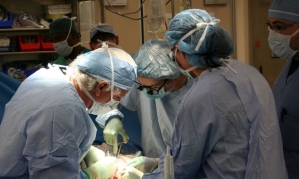
 On the 18th (local time), immediately after the successful landing of the Mars rover 'Perseverance' on Mars, researchers at NASA's Jet Propulsion Laboratory located in Pasadena, California, USA, cheered loudly. Pasadena, USA = EPA Yonhap Photo
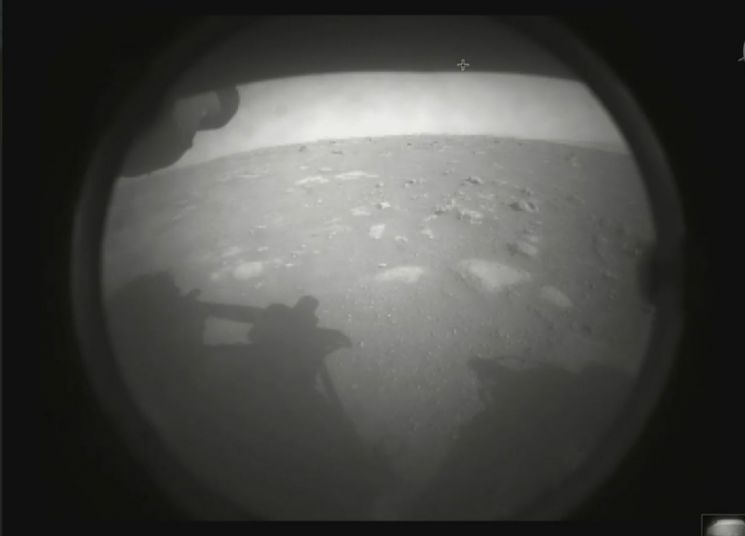
[Asia Economy Reporter Kim Suhwan] The United States' fifth Mars rover, 'Perseverance,' has successfully landed on Mars and transmitted its first photo.
On the 18th (local time), according to NASA, Perseverance landed on the 'Jezero Crater,' an ancient delta on Mars. It immediately began its mission to search for signs of life on Mars. Rob Manning, chief engineer at NASA's Jet Propulsion Laboratory, appeared on NASA's own broadcast, NASA TV, stating, "Today's achievement shows that if we all work together, we can accomplish anything," and added, "We must continue these efforts not only for scientific achievements but also for our nation and humanity."
NASA researchers started working from 2 p.m. local Mars time to communicate with Perseverance and will guide its Mars exploration until late at night.
Perseverance was launched on July 30 last year and traveled 471 million kilometers to reach Mars. The rover safely passed through the landing process known as the "seven minutes of terror," considered the most dangerous phase during Mars flight.
The Jezero Crater, where Perseverance landed, is estimated to be a delta where water flowed 3 to 4 billion years ago, making it a promising site to discover microbial traces.
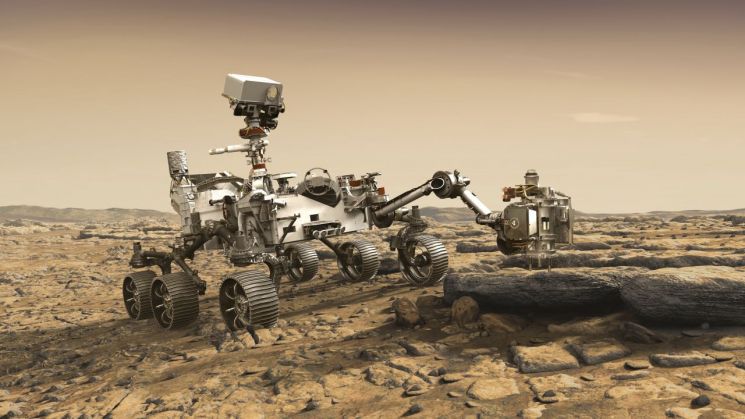
The greatest significance of this mission is that it marks the first step in the journey to collect rock samples from Mars and bring them back to Earth. Until now, all Mars exploration missions involved rovers landing on Mars to analyze rocks directly and send data back to Earth. However, if rock samples can be brought directly to Earth, analysis can be conducted without constraints of time and space.
Equipped with instruments capable of analyzing soil components, Perseverance will search for organics in the Jezero Crater, collect soil samples, and store them at designated locations. These samples will later be retrieved by another rover to be launched, transferred to another spacecraft, and sent back to Earth in 2031.
Louis Friedman, director of the Planetary Society, an astronomical research organization, said, "This mission is one of the most important in the history of human space exploration," adding, "If successful, sending manned spacecraft to Mars will soon become possible."
Another feature of Perseverance is that it carries a flying drone called 'Ingenuity.' If Ingenuity flies on Mars, it will become the first powered aircraft to fly on another planet in human history. Ingenuity will fly overhead and guide Perseverance's navigation path.
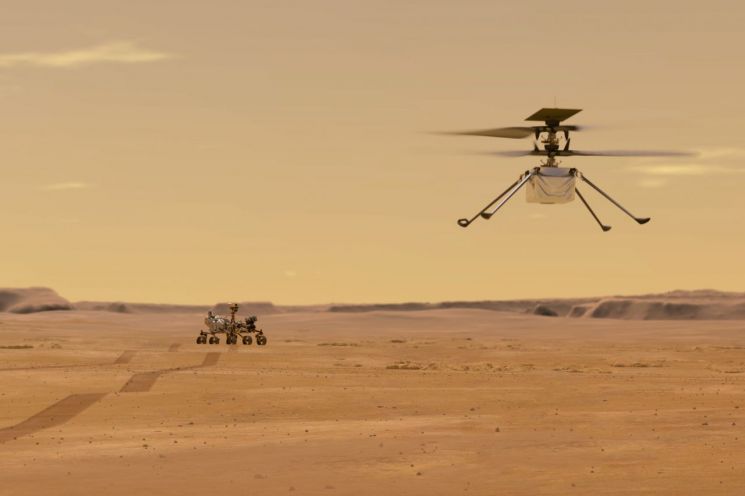 An image of the small helicopter Ingenuity, mounted on the Mars rover Perseverance, taking off.
 [Image source=AP Yonhap News]
Former NASA astronaut Ron Garan said in an interview with CNN, "This mission is a very important event in humanity's exploration of the solar system," and added, "If Perseverance finds signs of life, it will greatly help us understand Earth's weather and environment." He also said, "We will also learn why life disappeared from Mars."
U.S. President Joe Biden tweeted immediately after Perseverance's successful Mars landing, "Today is a historic day," and said, "It shows that with American science and technology, nothing is impossible."
Reactions on social media have been explosive. When NASA posted images of Mars taken by Perseverance on Twitter, it recorded 110,000 retweets and 270,000 likes within 30 minutes.
© The Asia Business Daily(www.asiae.co.kr). All rights reserved.