'MBTI' Test Popular Among People in Their 20s
Boosting Energy in the Lethargic Daily Life Due to COVID-19
Experts Warn to Be Cautious of the 'Barnum Effect' Where Psychological Traits Are Seen as Unique Characteristics
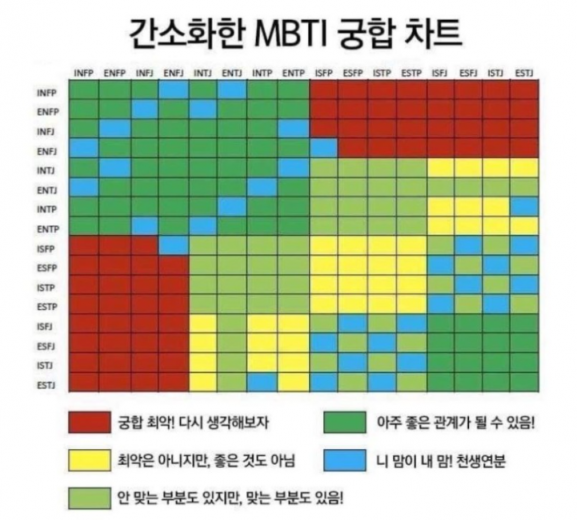 A table summarizing the most compatible personality traits based on the results of the 'MBTI,' a type of personality test. Photo by Online Community Capture
[Asia Economy Reporter Han Seung-gon, Intern Reporter Kim So-young] "Are you ISFP? They say we're the best combination," "They say meeting someone like me leads to disaster?"
With the increase in time spent at home due to the COVID-19 pandemic, new play cultures such as 'making Dalgona coffee,' 'various personality tests,' 'Among Us (game),' and 'Zoom meetings (video chats)' have been spreading.
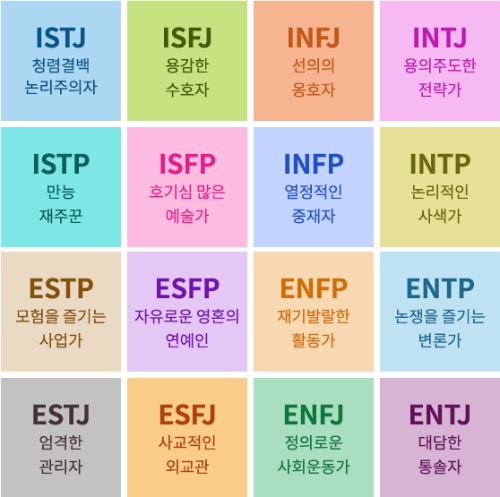
Among them, the 'MBTI' (Myers-Briggs Type Indicator) test is trending mainly among the MZ generation. MBTI is a type of personality test. Through a simple test, one can guess their own tendencies. The results vary, including types that are proactive in everything or those who are cautious but introverted.
The MZ generation is a term combining 'M' from Millennials and 'Z' from Generation Z. The M generation refers to those born from the early 1980s to the early 2000s, characterized by proficiency in information technology (IT) and a high university enrollment rate. The Z generation refers to those born from the mid-1990s to the early 2000s, characterized as digital natives who grew up in a digital environment.
Summarizing the characteristics of these generations, they are curious and experimental, so the MBTI, which allows checking various tendencies through a simple test, fits perfectly as a pastime for the MZ generation. However, experts caution that while this test may be popular as a form of entertainment during the COVID-19 situation, blind faith in it should be avoided.
Recently, university student Yoo (24), who revealed having taken the MBTI, said, "I was always curious about what kind of person I am and how others see me," adding, "Through the test, I was able to see myself objectively and satisfy my curiosity."
Another university student Kim (24) said, "I took the MBTI to find my aptitude and to see what kind of people I get along with."
There are also reactions like being surprised that the test results matched better than expected. Lee (24) said, "It was really similar to my personality, so it was fun, and I learned what kind of work suits me and what kind of synergy I can get by meeting certain people, so it was good to see it just for fun," showing satisfaction with the test results.
On the other hand, some criticize that the results lack objective evidence and are not rational. Park (22) said, "There were similarities, but definitely differences too," adding, "I strongly agreed with some parts, but it was uncomfortable to generalize and define 'me' in other parts."
Some point out that one of the fun reasons for these tests is sharing the results with others. In fact, friends often ask each other, "What did you get?" and send links saying, "If you haven't done it yet, try it quickly."
Moreover, people post their results on social networking services (SNS) like Facebook or Twitter, showing "This is the kind of person I am" by sharing their MBTI results on their SNS.

Similar results lead to forming empathy and strengthening friendships. University student Yoo in his 20s said, "Since I was curious about myself, I unconsciously judged the results as accurate." Choi (24) emphasized, "I don't know if I felt similar because of the results or if it was really similar, but the detailed descriptions for each type were very similar and surprising." Another person, Ahn, said, "The results are mostly general, so they usually feel accurate," adding, "Especially when it says who fits well, I strangely feel why they are my friends."
Experts point out that while such tests are popular for reasons like mood change during the COVID-19 situation, categorizing human types uniformly is problematic.
Professor Kwak Geum-joo of Seoul National University's Department of Psychology analyzed the popularity of personality tests by saying, "Many people are curious about their own psychology. Especially nowadays, with more people feeling depressed due to COVID-19, the use of such psychological tests has increased."
However, Professor Kwak warns against the 'Barnum effect,' where people regard general personality or psychological traits as their unique characteristics when taking personality tests.
Professor Kwak said, "Sometimes the divided types are somewhat accurate, and even if one or two differ, people tend to ignore those and focus on the matching parts or adjust themselves to the results to some extent," adding, "MBTI is definitely not a wrong test. However, it is necessary to fully understand these aspects and not to be overly obsessed with them."
© The Asia Business Daily(www.asiae.co.kr). All rights reserved.



















