Price Reduction and Expansion of Charging Infrastructure... Focus on Removing the Biggest Obstacles to Widespread Adoption
Encouraging Production Cost Reduction through Tax Benefits and Support for Dedicated Platform Development
Mandatory Electric Vehicle Charging Installation Expanded to 10 Chargers per 200 Parking Spaces
Hyundai Motor Declares the First Year of Electrification, Boosting Eco-Friendly Cars like Ioniq 5
[Sejong=Asia Economy Reporters Haeyoung Kwon, Jehun Yoo] The government’s newly announced “4th Basic Plan for Eco-friendly Vehicles” focuses on practical measures to drive the expansion of eco-friendly vehicle adoption. While the 3rd Basic Plan announced in 2015 emphasized achieving 1 million eco-friendly vehicles by 2020, this time the plan includes measures to reduce the price of eco-friendly vehicles and expand charging infrastructure, which had been obstacles to wider adoption. Hyundai Motor Group, defining this year as the “first year of electrification,” has secured a strong drive to foster eco-friendly vehicles, supported by the government’s plan.
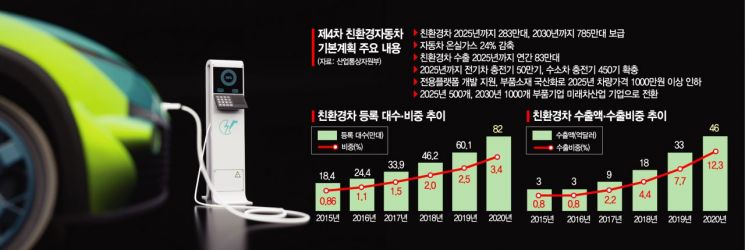
◆Eco-friendly vehicle adoption fell short of initial targets... Government aims for price reduction and charging station expansion=According to the government, eco-friendly vehicle adoption increased more than threefold from 240,000 units in 2016 to 820,000 units in 2020. Exports also rose from 78,000 units to 280,000 units during the same period. However, this falls short of the government’s domestic adoption target of 1 million eco-friendly vehicles set in 2015. An official from the Ministry of Trade, Industry and Energy explained, “Charging difficulties, short driving range, lack of medium and large vehicles, and high vehicle prices have continued to act as obstacles to the spread of eco-friendly vehicles.”
The government has set goals to expand adoption to 2.83 million units by 2025 and 7.85 million units by 2030 by significantly increasing electric and hydrogen vehicle charging stations and reducing eco-friendly vehicle prices by more than 10 million KRW. Viewing price as a major barrier, the government plans to induce production cost reductions through support for technology development aimed at performance improvements, in addition to tax benefits. First, it will support the development of dedicated platforms for electric trucks and buses and invest 113.9 billion KRW in domestic production of key materials such as batteries and fuel cells. This year, a battery leasing program will be introduced for electric taxis and trucks, and next year for hydrogen buses, cutting the initial purchase price by half. The plan also includes measures to dramatically improve energy efficiency, durability, and driving range to ensure eco-friendly vehicle performance matches that of internal combustion engine vehicles.
There is also keen interest in the extent of price reductions for eco-friendly vehicles under this policy. Although the price of the Ioniq 5 is not yet finalized, industry insiders expect it to be set in the mid-50 million KRW range. When purchasing an Ioniq 5 in Seoul, after deducting the government’s electric vehicle subsidy (8 million KRW) and local government subsidy (4 million KRW based on Seoul’s standard), the vehicle price could drop to the low to mid-40 million KRW range. Additionally, with a battery lease discount of about 10 million KRW, the actual purchase price could fall to the low to mid-30 million KRW range.
Furthermore, the government plans to expand charging infrastructure so that electric and hydrogen vehicles can be charged anytime and anywhere. To this end, the mandatory installation of electric vehicle chargers will be increased from the current one charger per 200 parking spaces to 10 chargers by 2022. Public charging facilities will also be required to be open to users who find it difficult to install chargers in multi-family or row houses.
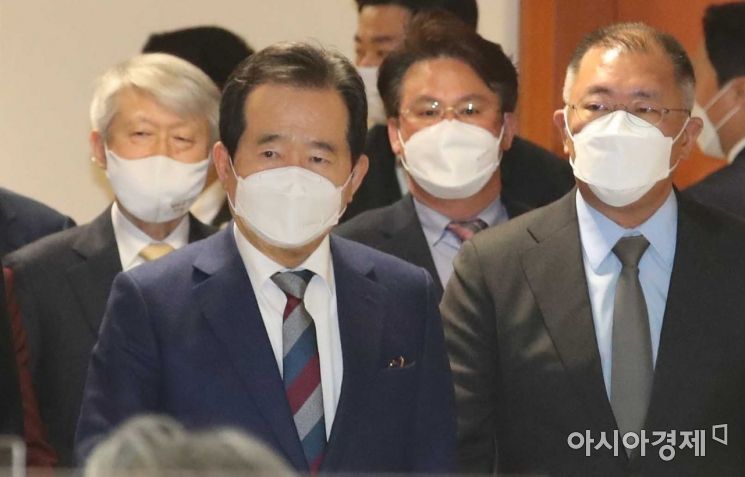 Prime Minister Chung Sye-kyun and Hyundai Motor Group Chairman Chung Eui-sun are attending the Government Policy Coordination Meeting held on the 18th at Hyundai Motor Namyang Technology Research Center in Hwaseong, Gyeonggi Province. Photo by Kang Jin-hyung, Hwaseong.
◆Hyundai Motor takes flight in the ‘first year of electrification’=Hyundai Motor Group, which has defined this year as the “first year of electrification,” has gained momentum in fostering eco-friendly vehicles through this plan. Hyundai previously announced a “2025 Strategy” blueprint to launch a total of 12 electric vehicle models and sell 560,000 electric vehicles annually by 2025.
The first step is the crossover utility vehicle (CUV) Ioniq 5, which will be unveiled on the 23rd. The Ioniq 5 is a strategic model that applies Hyundai Motor Group’s dedicated electric vehicle platform, E-GMP, for the first time. Additionally, Hyundai’s premium brand Genesis plans to release an electric vehicle-only model JW (project name) this year. Hyundai also plans to transition its lineup to electric vehicles in major markets such as Europe, China, and the United States starting in 2030, aiming to achieve an 8-10% global electric vehicle market share by 2040.
The hydrogen fuel cell vehicle business will also be expanded. Hyundai aims to sell 700,000 hydrogen fuel cells by 2030, focusing on four major hubs: Korea, Europe, the United States, and China, by expanding its hydrogen fuel cell system brand “H2” launched last year.
To this end, Hyundai plans to invest 14.9 trillion KRW in hydrogen and electric vehicle businesses by 2025.
Kia will also accelerate electrification starting with the dedicated electric vehicle CV (project name) applying the E-GMP platform, scheduled for release in the second half of this year. Through Plan S, Kia plans to launch a total of 11 models, including 7 dedicated electric vehicles and 4 derivative electric vehicles, and expand electric vehicle sales to 880,000 units by 2026. The overall eco-friendly vehicle sales target, including electric vehicles, is 1.6 million units (40% of total sales).
© The Asia Business Daily(www.asiae.co.kr). All rights reserved.
![Clutching a Stolen Dior Bag, Saying "I Hate Being Poor but Real"... The Grotesque Con of a "Human Knockoff" [Slate]](https://cwcontent.asiae.co.kr/asiaresize/183/2026021902243444107_1771435474.jpg)

















