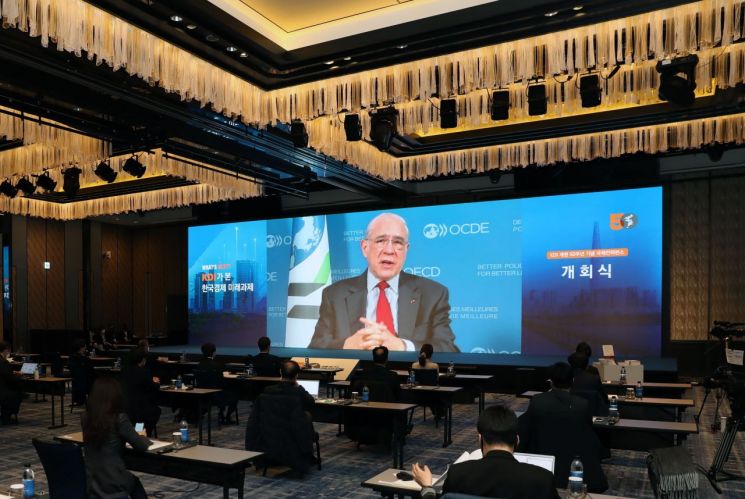
 The 'Korea Development Institute (KDI) 50th Anniversary International Conference' held on the 17th at the Four Seasons Hotel in Seoul.
'Korea Development Institute (KDI) 50th Anniversary International Conference'
Need to Resolve the Dual Structure of the Korean Labor Market
40% of Women's Jobs Are Non-Regular... Korea Ranks First in Gender Wage Gap Among OECD Countries
Over 100 Support Measures for SMEs... Simplification Needed After Reassessment
Reducing Gaps Between Companies is Key to Solving Wage Disparities
[Asia Economy Reporter Kim Eunbyeol] The large wage gap between Korean men and women, and the fact that jobs differ by gender, were identified as major future challenges for the Korean economy. Although overall income has increased significantly, the gap between regular and non-regular workers remains large, and the lack of jobs for the elderly amid aging has led to a higher poverty rate, which was also pointed out as a problem.
While there are many government policies to support small and medium-sized enterprises (SMEs), inefficiency was cited as an issue. Although startups are emerging actively, the environment for their sustainable growth is not yet established, which is another challenge to be addressed in the future.
"Korea Has the Highest Gender Wage Gap Among OECD Members... Need to Resolve Dual Structure of Labor Market"
The Organisation for Economic Co-operation and Development (OECD) pointed out on the 17th at the 'Korea Development Institute (KDI) 50th Anniversary International Conference' that the gender job gap is a future challenge for Korea. Angel Gurr?a, OECD Secretary-General; Ulrik Nissen, OECD Deputy Secretary-General; and Romina Boarini, Director of the OECD WISE Center, all voiced the same concern.
Deputy Secretary-General Nissen said in a special session, "Korea's income sector has seen remarkable growth, but it has not led to a high level of well-being," adding, "By involving women, immigrants, and youth in the labor market, Korea can create wealth and increase inclusiveness." He noted, "Young Korean women have high educational attainment, yet the income gap is excessively large. Recent government policies such as childcare systems, expanded maternity leave, and education for women with career interruptions have partially addressed some gender gaps, but the culture of gender equality itself must be established within companies and households."
Secretary-General Angel Gurr?a also stated in an interview with Korean media, "As of 2019, Korea's gender wage gap was 32.5%, the highest among OECD member countries." The male labor participation rate is 74%, while the female labor participation rate is only 53%. Gurr?a said, "Specific policies for marginalized vulnerable groups are needed, such as promoting the return of women with career interruptions to the labor market and expanding vocational training opportunities for more youth and low-skilled elderly workers."
Romina Boarini, Director of the OECD WISE Center, cited the fact that women mainly work in non-regular jobs as a reason for the large gender wage gap. She explained that Korea's labor market is dualized into regular and non-regular employment, which has led to this outcome. Currently, more than 40% of jobs held by women are non-regular.
She said, "In Korea, wage gaps between workers and industries are large," adding, "The Korean labor market tends to be strongly dualized between regular and non-regular workers, with a particularly high proportion of women in non-regular positions." Furthermore, she emphasized, "Because the elderly poverty rate is also high, the government needs to strengthen capabilities focusing on low-skilled and non-regular workers," and "It is necessary to understand why workers physically cannot receive education and to enhance their capabilities accordingly."
Randal Jones, a senior research fellow at the Japan Economic Research Institute at Columbia University who participated in the discussion, stated that the larger the gender wage gap, the less incentive women have to work. Therefore, Jones argued that the 'dual structure' of Korea's labor market, divided into regular and non-regular employment, must be eliminated. He also advised, "Government policies should shift from merely preserving jobs to protecting the people who work."
"Simplify Complex SME Support System, Create Environment for Startups to Grow"
There was also a call to review whether the SME support system is operating efficiently and to simplify the complex support structure to provide proper support for SMEs. Boarini said, "Currently, there are about 100 support measures related to SMEs in Korea, but after evaluating resources and effectiveness, simplification is necessary."
She added, "Having many SME support measures indicates strong government interest, but it can also cause problems because SMEs may not know what support is available or whether the support is being delivered efficiently."
She also recommended establishing a 'one-stop' integrated support window for SME assistance.
Researcher Jones also pointed out the declining competitiveness of Korean SMEs as a problem. He said, "Although the proportion of startups in Korea is large, cases where they have grown in size and competitiveness are limited," adding, "There are difficulties in securing funding and issues with the investment recovery system, which have reduced the potential for growth into innovative startups." He also viewed this environment as a factor widening the income gap between 'chaebol conglomerates' and other companies.
To solve these problems, he advised making it easier for startups to secure funding and easing regulations to reduce the cost burden on small companies. Additionally, Jones pointed out, "There are many government supports based on company size, which leads to a tendency among SMEs to avoid being classified as mid-sized companies." Because the government mainly supports smaller companies, an ironic phenomenon occurs where SMEs try to stay below the threshold to continue receiving support.
© The Asia Business Daily(www.asiae.co.kr). All rights reserved.
![Clutching a Stolen Dior Bag, Saying "I Hate Being Poor but Real"... The Grotesque Con of a "Human Knockoff" [Slate]](https://cwcontent.asiae.co.kr/asiaresize/183/2026021902243444107_1771435474.jpg)
















