Closed SNS 'Clubhouse' Popularity
Invitation Required to Join, Voice-Based Communication
"Feeling Left Out if Unable to Join" Criticism
Experts Say "Closed Nature Fosters Group Identity"
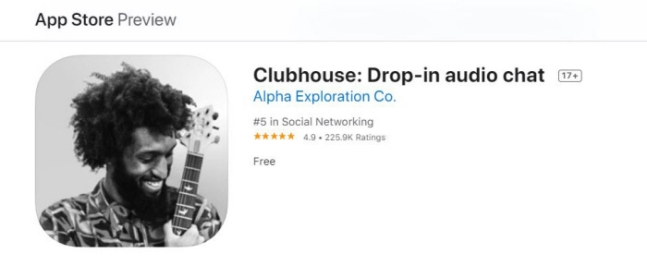 Screen of 'Clubhouse' available for download on Apple iPhone App Store. Photo by Internet homepage capture
[Asia Economy Reporter Kim Young-eun] #A, a 25-year-old university student living in Seodaemun-gu, Seoul, recently joined 'Clubhouse.' A said, "I usually enjoy SNS activities, and lately, it seems many people are using this, so I became interested," adding, "I liked that it allows active communication in a non-face-to-face situation due to COVID-19, and since it's a type of SNS that never existed before with a new way of use, it's attractive." A mentioned that because Clubhouse's system does not allow just anyone to join, it attracted a lot of attention from those around them. They added, "When I say I joined Clubhouse, people around me ask for invitations," and said, "The method of joining by invitation feels special and fun."
Recently, the closed social networking service (SNS) 'Clubhouse' has been gaining attention. It became more popular as it was reported that world-famous figures such as Mark Zuckerberg, founder of Facebook, and Elon Musk, CEO of Tesla, joined. Park Young-sun, a preliminary candidate for Seoul mayor from the Democratic Party, and Cho Jung-hoon, a preliminary candidate from the Transition Korea party, also opened chat rooms on Clubhouse to talk with citizens.
Clubhouse saw a surge in users during the Lunar New Year holiday. According to market research firm Sensor Tower and others on the 14th, about 1.1 million people newly joined Clubhouse in the past six days.
It differentiates itself from existing SNS by features such as real-time conversations, voice-based communication, and closed nature. Especially, it is characterized by communication solely through voice. Users simply create a room and invite people to talk.
Inside the room, speakers can participate in the conversation through speaking rights given by the moderator, who acts as the room owner and host. Other members can listen to the conversation and can also participate if they express their intention to join.

There are various types of chat rooms on Clubhouse, such as book clubs, rooms for impersonations, and rooms where users can communicate with celebrities. Users can choose rooms that match their interests or preferences and engage in interactive communication with other users. Until now, SNS evolved from text-centered platforms like Twitter to photo-focused ones like Instagram, then to video platforms like TikTok, and now 'Clubhouse' has emerged as a voice-based medium.
Additionally, the closed nature is one of Clubhouse's major features. Clubhouse is not open to everyone; users must receive an 'invitation' from existing users to join. This is the most distinctive point compared to existing SNS, which anyone can use once they sign up.
Users feel special because not just anyone can enter, and they say this closed nature is satisfying. On the other hand, some criticize that this characteristic may dichotomize users and non-users and lead to vertical communication. One netizen expressed concern, saying, "Since you need an invitation to join, it is easy to feel excluded, and the gap between social classes may deepen."
Broadcaster DinDin also said on his radio show on the 9th, "Clubhouse is a more empowered communication among like-minded people. It feels like an effort to enter a noble party in the Middle Ages," and broadcaster Kim Ji-hoon evaluated on his Instagram on the 13th, "It reveals the most vulnerable part of modern people's psychological state, such as anxiety when feeling excluded from the trending group."
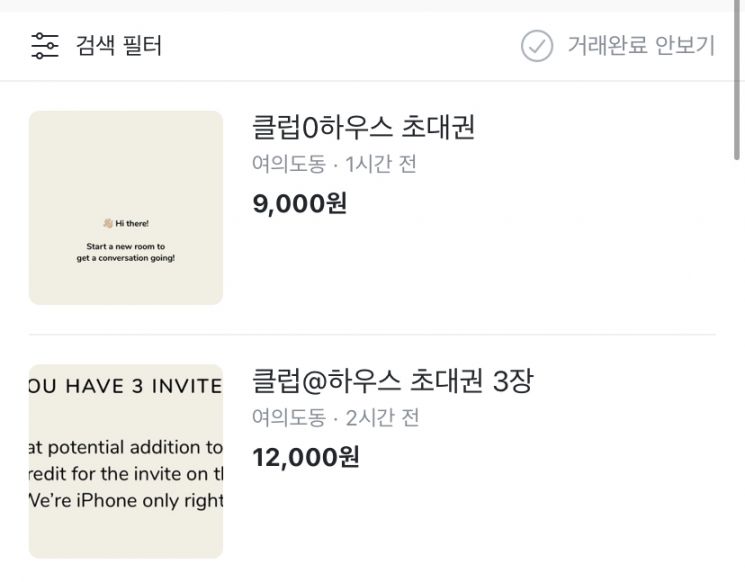 A post offering to sell 'Clubhouse' invitations. Photo by Junggo Trading Application 'Danggeun Market' capture
Meanwhile, due to this rarity, some even sell Clubhouse invitations on secondhand trading sites. On the secondhand trading app 'Danggeun Market,' Clubhouse invitations were listed for sale at prices ranging from 10,000 to 20,000 KRW.
Regarding the popular closed SNS, experts explained that it is a phenomenon caused by humans' desire to belong to a group.
Professor Kwak Geum-joo of the Department of Psychology at Seoul National University said, "Humans have a group identity to belong to groups or organizations, and in the case of Clubhouse, since there are restrictions so that not just anyone can belong, it will attract more interest," adding, "Just like brands or mobile membership services where more expensive memberships are more popular, people prefer things that not everyone can use, and those users feel satisfied belonging to them."
She continued, "Also, because society is rife with harm and fear from openness, a tendency to protect oneself has emerged, and for this reason, closed services also gain great popularity," adding, "Especially since many famous overseas figures have joined, the credibility increases."
She added, "However, those who cannot join will feel excluded, which can cause another conflict or division," and predicted, "Perhaps a modern form of class stratification may emerge."
© The Asia Business Daily(www.asiae.co.kr). All rights reserved.

![Clutching a Stolen Dior Bag, Saying "I Hate Being Poor but Real"... The Grotesque Con of a "Human Knockoff" [Slate]](https://cwcontent.asiae.co.kr/asiaresize/183/2026021902243444107_1771435474.jpg)

















