Meeting on Administrative Lawsuit Against Music Copyright Fee Amendment
OTT Music Association: "Insufficient Industry Feedback, Unclear Rate Basis"
Ministry of Culture, Sports and Tourism: "No Procedural Defects"
[Asia Economy Reporter Koo Eun-mo] "There is a problem with the procedure itself." "At least tell us the basis for the music copyright royalty rates."
Wave, Watcha, Tving, and other newly launched domestic online video service (OTT) providers have finally taken legal action against the Ministry of Culture, Sports and Tourism, with which they have been in conflict over music copyright royalty rates, and are making a direct breakthrough. The OTT industry claims that the criteria for determining the rates are unclear, as the music copyright royalty rates vary several times depending on the platform when watching the same terrestrial drama, and that the minimum mechanical neutrality among stakeholders was not maintained. The OTT Music Copyright Countermeasure Council (OTT Music Council), which includes Wave, Tving, and Watcha, filed a lawsuit on the 5th at the Seoul Administrative Court requesting the cancellation of the Ministry of Culture, Sports and Tourism’s approval of the amendment to the music copyright usage fee collection regulations.
◆ OTT: "Procedurally Illegal"
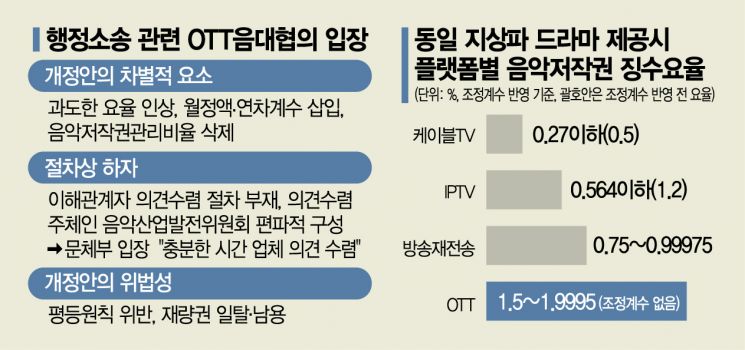
At a press conference held on the 17th at the Central Veterans Hall in Yeouido, Seoul, Hwang Kyung-il, chairman of the OTT Music Council, pointed out the ‘illegality of the approval procedure for the amendment’ as the background of the administrative lawsuit. He said that not only was the industry consultation process insufficient, but the decision was made based on the opinions of a committee that was composed in a way highly unfavorable to OTT companies. Looking at the composition of the Music Industry Development Committee (MIDC) under the Ministry of Culture, Sports and Tourism, 7 out of 10 members are heavily skewed toward music copyright right holders. This could be considered a case of ‘invalidity due to a serious procedural defect,’ according to Supreme Court precedents.
The background for the rate determination is also unclear. The amendment mainly raises the rate from 1.5% this year to 1.9995% by 2026. Although the Ministry of Culture, Sports and Tourism cited overseas cases, the industry is skeptical. Even within the MIDC, members have complained that there is no global standard to refer to because the copyright trust structure, rights acquisition procedures, and settlement methods all differ. For example, the U.S. ASCAP’s basic streaming license rate is 1.08%. In France, the rate is based on subscription fees rather than sales, and both reproduction and performance rights are permitted, making direct comparison difficult.
Wave separately requested information disclosure from the Ministry of Culture, Sports and Tourism regarding the MIDC’s opinion documents, final reports, and Copyright Commission review reports related to the OTT music copyright royalty rate decision, but this was also denied. Chairman Hwang said, "We repeatedly requested dialogue, but since there was no movement to communicate with the OTT industry, we had no choice but to file an administrative lawsuit as a last resort." KT, which is not part of the OTT Music Council, is also considering an administrative lawsuit in opposition to the amendment. On the other hand, the Ministry of Culture, Sports and Tourism maintains that there is no procedural defect, having collected opinions from 18 companies from July 27 to August 10 last year.
◆ Different Rates Even for the Same Drama
The controversy over OTT music copyright royalty rates is not limited to one or two issues. Concerns about discrimination between identical services and double charging have been pointed out. For example, the SBS popular drama ‘Penthouse’ has different rates when viewed on cable TV (0.5%), IPTV (1.2%), and OTT (1.5%). Furthermore, when adjustment coefficients are applied, the rates for cable TV and IPTV drop to about 0.27% and 0.564%, respectively, but this does not apply to OTT. Additionally, there is unavoidable controversy over double charging because copyright fees are additionally collected for content whose rights have already been collectively handled through production companies.
Excessive rates inevitably lead to increased OTT subscription fees, which are passed on to consumers. This is the background for criticism that OTTs, which are still in their early growth stage, are being held hostage. Ultimately, the controversy is unavoidable that not only the copyright trust management organization, the Korea Music Copyright Association, but also the Ministry of Culture, Sports and Tourism, the competent authority, have maximized the interests of copyright holders without considering the public interest, such as the users’ position, universal use of works, and contribution to cultural and industrial development.
© The Asia Business Daily(www.asiae.co.kr). All rights reserved.
![Clutching a Stolen Dior Bag, Saying "I Hate Being Poor but Real"... The Grotesque Con of a "Human Knockoff" [Slate]](https://cwcontent.asiae.co.kr/asiaresize/183/2026021902243444107_1771435474.jpg)
















