- Specialized facilities accommodating diverse companies with segmented corporate forms, rapidly rising as competitive offices
- Knowledge industry centers popular for large tax benefits and customized facilities supporting manufacturing to high-tech industries
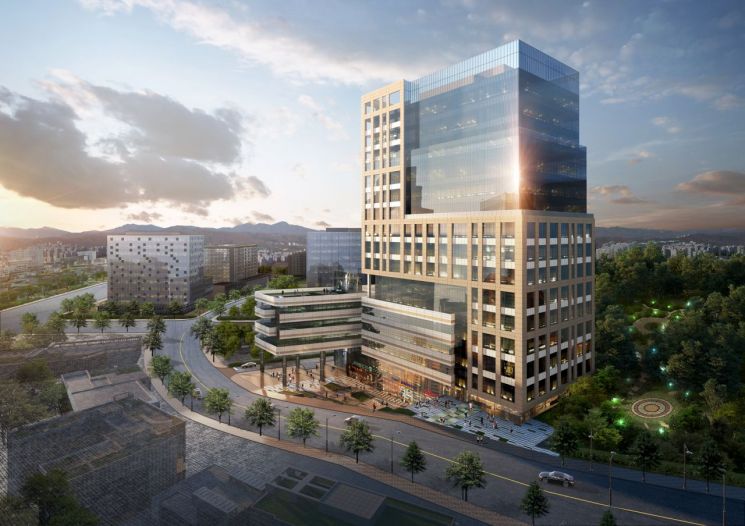
As the types of businesses diversify from large corporations and small and medium-sized enterprises to startups and one-person companies, knowledge industry centers equipped with specialized facilities that can accommodate a wider range of businesses are gaining market attention.
A knowledge industry center refers to a collective building of three or more floors above ground where urban manufacturing, knowledge-based industries, information and communication-related companies, and support facilities can be housed. Due to restrictions on tenant industries, similar industries cluster together to create synergy effects, and since they can be built on self-sufficient facility sites, they feature excellent infrastructure such as transportation and convenience facilities.
Recently, the number of small-scale companies such as one-person creative enterprises and startups has been rapidly increasing, and the second wave of venture startups is intensifying, so the trend of companies moving to knowledge industry centers is expected to accelerate further.
In fact, one-person creative enterprises have been steadily increasing in South Korea. According to Statistics Korea, the number of one-person creative enterprises was 77,009 in 2013, surged to 249,774 in 2015, and reached 277,375 in 2018, showing about a fourfold increase over six years.
Especially as industries diversify and the age range of members becomes younger, the preference for knowledge industry centers equipped with specialized and rest facilities is increasing. From a company's perspective, offices with good working environments become a competitive advantage to attract talented employees.
In the industry, newly supplied knowledge industry centers with the latest facilities are being sold out in a short period, similar to residential real estate. For example, 'Geumgang Penterium IX Tower' supplied by Geumgang Housing in Dongtan 2 New Town and 'GIDC Gwangmyeong Station' supplied in the Gwangmyeong area of Gyeonggi Province were fully sold out within a month after the sales started.
The ‘Gwanggyo Q-Campus’ located in the popular new town of Gwanggyo is also in the early stages of sales, but early sales closure is anticipated due to inquiries from investors wanting to visit the promotional center.
This place is designed with various floor plans per floor to provide an optimal office environment not only for small and medium-sized enterprises but also for one-person companies and startups. It is developed as a specialized product for small-scale companies, and the ‘Live Office’ is a highly preferred product recently as an alternative investment to officetels, providing a space where work and rest can be enjoyed simultaneously. Ancillary facilities such as an in-house cafeteria, coin laundry, shared kitchen, and common storage are also planned.
A sales official said, “Knowledge industry centers have made remarkable progress in design and facilities over the past 10 years, so the difference between old facilities and newly supplied complexes is very large. Gwanggyo Q-Campus is a differentiated product that has been carefully designed in terms of location, design, and rest facilities, so inquiries from various demand groups, from companies intending to move in to investors, are continuing.”
Gwanggyo Q-Campus will be developed with a total floor area of 44,765㎡ from basement level 5 to ground level 15, comprising 303 units and 15 neighborhood living facilities. The neighborhood living facilities account for about 4% of the total floor area, which is very low compared to 10-15% in other knowledge industry centers, allowing for stable investment considering the nearby office workers and residents on upper floors.
The Gwanggyo Techno Valley, where Gwanggyo Q-Campus is located, is a cutting-edge industrial complex housing institutions and companies engaged in bio, pharmaceutical, and IT research such as the Gyeonggi Bio Center, Next-Generation Convergence Technology Institute, Korea Nano Technology Institute, Gyeonggi Small and Medium Business Comprehensive Support Center, Gyeonggi Science and Technology Institute, and Gyeonggi Credit Guarantee Foundation.
Additionally, it is close to the Legal Town, which includes Suwon High Court, Suwon High Prosecutors' Office, Suwon District Court, and Suwon Prosecutors' Office, as well as Gyeonggi Convergence Town, where seven institutions including the Gyeonggi Provincial Government Office, Gyeonggi Provincial Council, and Gyeonggi Provincial Office of Education are scheduled to move in. Furthermore, it is adjacent to the Suwon Convention Center, the only large-scale convention center in the southern Gyeonggi region, a complex MICE complex including exhibition halls, department stores, hotels, and an aquarium, enabling cluster effects with nearby institutions and abundant demand from the surrounding area.
The transportation environment, which determines the value of knowledge industry centers, is also exceptional here. Since Gwanggyo Q-Campus is located in the popular new town of Gwanggyo, Gwanggyo Station on the Shinbundang Line, known as the Gold Line, is within walking distance, and Changryong-daero is adjacent, providing easy access to Yeongdong Expressway Dong Suwon IC, Yongseo Expressway Gwanggyo Sanghyeon IC, and Suwon Northern Ring Road.
Moreover, the extension of the Shinbundang Line (Gwanggyo~Homaesil) is scheduled to open, which will further improve Gwanggyo’s transportation conditions. The Gangnam~Sinsa section of the Shinbundang Line extension is scheduled to open in 2022, allowing travel from Gwanggyo to Sinsa in about 40 minutes, and once the second phase from Yongsan to Sinsa is completed, it will take 47 minutes to Yongsan, dramatically improving access to Seoul.
Gwanggyo Q-Campus is scheduled to be constructed by Taeyoung Construction, and the sales promotional center is located in Suwon City, Gyeonggi Province.
© The Asia Business Daily(www.asiae.co.kr). All rights reserved.
![Clutching a Stolen Dior Bag, Saying "I Hate Being Poor but Real"... The Grotesque Con of a "Human Knockoff" [Slate]](https://cwcontent.asiae.co.kr/asiaresize/183/2026021902243444107_1771435474.jpg)
















