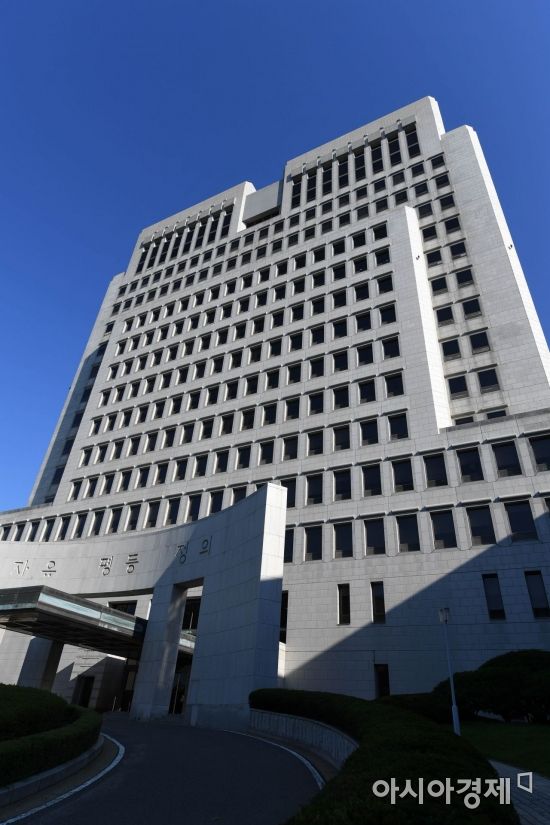
 Supreme Court, Seocho-dong, Seoul / Photo by Honam Moon munonam@
[Asia Economy Reporter Kim Daehyun] The Supreme Court has ruled that when only part of a lower court's judgment is overturned and remanded, the portions confirmed by the appellate court are not subject to review in the remand trial.
On the 17th, the Supreme Court's 2nd Division (Presiding Justice Park Sang-ok) overturned part of the lower court's ruling in the retrial of a wage claim lawsuit filed by 68 bus drivers against their company, confirming the rest of the judgment.
In 2013, the bus drivers filed a lawsuit demanding that allowances such as crew room expenses, driving expenses, and personnel expenses be included as ordinary wages, and that workdays exceeding 15 days per month be considered holidays with additional allowances paid accordingly.
Previously, the first and second trials ruled in favor of the company, judging that there was little basis to pay holiday allowances for overtime work. However, they partially accepted the bus drivers' claims by stating that "crew room expenses and daily allowances should be considered part of ordinary wages."
In 2016, the Supreme Court overturned the lower court's ruling regarding overtime work, holding that work exceeding 15 days qualifies as holiday work. However, the lower court's judgment on other issues such as the scope of ordinary wages was upheld.
Subsequently, the remand trial ruled again, in line with the Supreme Court's decision, that overtime work exceeding 15 days should be regarded as holiday work and ordered the company to pay ordinary wages including crew room expenses and daily allowances. This meant re-examining matters already confirmed by the Supreme Court appellate trial.
In response, the Supreme Court's retrial stated, "The scope of the lower court's judgment after remand is limited to the parts overturned from the plaintiff's losses in the pre-remand judgment and the expanded parts in the post-remand lower court, and it cannot review parts confirmed in the appellate trial," and on its own authority, overturned part of the lower court's judgment.
© The Asia Business Daily(www.asiae.co.kr). All rights reserved.
















