Down to One-Tenth in 5 Months
100,000 in September Last Year, 9,000 Today
Streets Crowded with People... Social Distancing Not Observed
Experts Say "Hard to Analyze"... Various Theories Including Herd Immunity and Statistical Errors
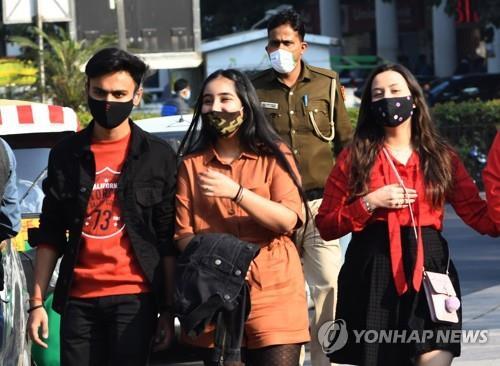
[Asia Economy Reporter Kim Bong-ju] Experts are perplexed in interpreting the situation as an inexplicable phenomenon occurs in India, where the number of new coronavirus disease (COVID-19) infections has drastically decreased.
Despite poor medical infrastructure and streets crowded with people ignoring quarantine rules, the number of infections has significantly dropped.
India’s new confirmed cases drop to one-tenth... Social distancing not observed
According to the Ministry of Health and Family Welfare of India on the 16th, the cumulative number of COVID-19 confirmed cases in India reached 10,925,710, an increase of 9,121 from the previous day.
The number of new confirmed cases, which approached 100,000 around mid-September last year, has sharply decreased to one-tenth in just five months.
Compared to nearly 500,000 to 800,000 daily tests, the positive rate was only 1 to 2 percent.
The daily number of new deaths recently remained around 100. In September last year, over 1,000 people died daily from COVID-19.
The daily life of Indian citizens seems to have already returned to the pre-COVID-19 situation. Especially, the streets of major cities are bustling with people.
In rural areas and slums, 'social distancing' has not been observed for a long time.
Nevertheless, the local situation has dramatically improved. There is even talk that 'COVID-19 has been contained.'
Experts puzzled... Various analyses including herd immunity, young population, statistical errors, and low-income groups refusing tests
In this situation, experts have not been able to present clear evidence.
Some experts argue that herd immunity is forming in India. Herd immunity refers to a state where many local residents have immunity to an infectious disease. When herd immunity is established, rapid spread of the infectious disease becomes difficult.
However, the Indian Council of Medical Research (ICMR), a government agency, surveyed 35,700 residents nationwide from December 17 last year to January 8 this year, and antibodies were found in only 21.5% of the subjects.
Some experts point out that "herd immunity is difficult to form with an antibody formation rate in the 20% range."
There is also an analysis that Indians have superior immunity. It is argued that because Indians have lived exposed to unsanitary environments and various pathogens, they are constitutionally stronger against viral infections.
There are analyses that the virus circulating in India is a less lethal variant than those in other countries, and claims that India’s hot and humid weather lowers infection rates.
There are also claims that low-income groups refuse testing despite showing symptoms, and theories that infection statistics are unclear due to testing errors.
However, considering that there is considerable availability of COVID-19 hospital beds recently and a noticeable decrease in patients visiting hospitals, concluding that the sharp decline in infections is due to statistical errors is unreasonable.
Government: "Because citizens follow quarantine rules well" VS Experts: "Confirmed cases decrease even where rules are not followed" rebuttal
The Indian government explained that citizens have habituated mask-wearing and paid attention to daily quarantine measures.
However, one expert pointed out that "in some areas, confirmed cases decreased uniformly despite improper mask-wearing," criticizing the government’s analysis as insufficient.
Nevertheless, most experts analyze that India’s decline in confirmed cases will not continue, citing various variables such as the spread of variant viruses and the emergence of new cluster infection areas.
© The Asia Business Daily(www.asiae.co.kr). All rights reserved.
![User Who Sold Erroneously Deposited Bitcoins to Repay Debt and Fund Entertainment... What Did the Supreme Court Decide in 2021? [Legal Issue Check]](https://cwcontent.asiae.co.kr/asiaresize/183/2026020910431234020_1770601391.png)
















