Reverse Discrimination Caused by Regulations
Approval Issued After 3 Years and 9 Months Since THAAD
China's 1.2 Trillion KRW Sales Domestically Last Year
Minimal Sanctions Despite Controversies Over Sexualized Ads and Mukti
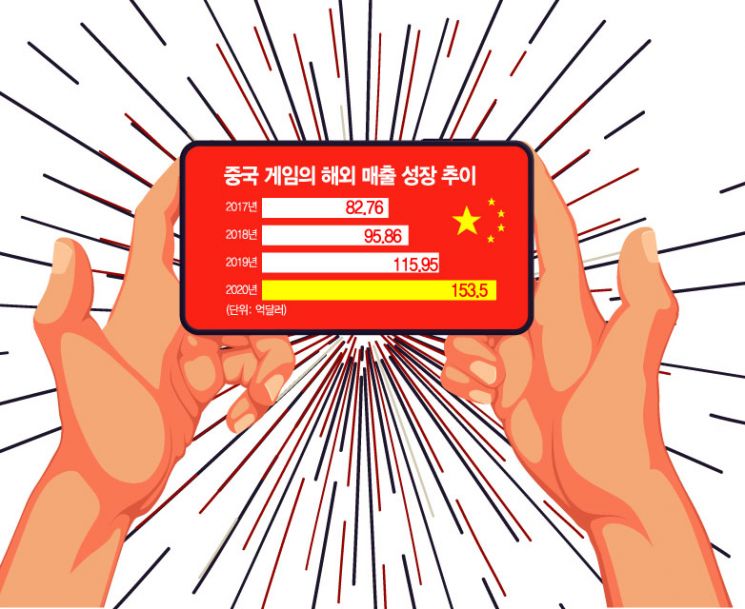
[Asia Economy Reporter Kang Nahum] 1,473 days. This is the time it took for domestic games to receive Chinese foreign game licenses after the THAAD (Terminal High Altitude Area Defense) incident in March 2017. For about 3 years and 9 months, the export route of domestic games to China was blocked, during which Chinese games entered the domestic market without significant regulation, generating substantial profits and increasing their market share. The industry’s calls for active government regulation of Chinese games are growing louder.
According to the ‘Global Game Industry Trends’ report published earlier this month by the Korea Creative Content Agency on the 16th, overseas sales of Chinese games reached $15.45 billion (approximately 17 trillion KRW) last year, a 33% increase compared to the previous year.
Last year, the Korean game industry market size is estimated to have exceeded 17 trillion KRW. In other words, China is generating overseas sales equivalent to the size of the Korean market. Notably, Chinese mobile games earned about 1.26 trillion KRW in sales domestically last year. Korea ranks third in the share of Chinese mobile games’ overseas sales at 8.8%, following the United States and Japan.
Conversely, domestic game companies face difficulties even entering the Chinese market. After the Korean government deployed THAAD in 2017, the Chinese government maintained the ‘ban on Korean content’ policy in retaliation. As a result, Korean games repeatedly failed to enter China. Until Com2uS’s ‘Summoners War: Sky Arena’ received a Chinese license in December last year, no licenses had been issued for Korean games since March 2017. This inevitably raises issues of regulatory discrimination between Chinese and Korean game companies.
For overseas game companies to service mobile games domestically, they essentially only need approval from platform operators. Most are foreign entities, making it difficult to punish them under domestic law unless they commit serious illegal acts. Chinese games, in particular, have faced much criticism for ‘eat-and-run’ behaviors, such as provocative advertising and inducing payments, then unilaterally terminating services within less than a year of launch.
The Chinese game ‘Wangbi-ui Mat (Emperor’s Dream)’ is a representative case of controversy over sexual content. It hired a Japanese AV actress as a model and promoted with slogans like ‘Taste Yuua Mikami,’ while female characters were depicted exposing specific body parts explicitly, drawing much criticism. The Game Rating and Administration Committee issued corrective recommendations to platform operators to block such advertisements, but no further actions were taken.
Regarding ‘eat-and-run’ issues, there is the recent case of the Chinese fashion game ‘Shining Nikki,’ which abruptly terminated service amid the ‘Hanbok Northeast Project’ controversy. Released by Chinese game company Paper Games, the game launched in Korea on November 29 last year. However, when Chinese users claimed that Hanbok originated from the Ming dynasty’s ‘Hanfu,’ sparking controversy mainly in Korean and Chinese internet communities, Paper Games announced service termination within just a week.
Lee Jung-hyun, president of the Korea Game Society, stated, “The government needs to make China aware that banning Korean games through licensing is a violation of World Trade Organization (WTO) agreements and a significant obstacle to Korea-China economic and cultural cooperation.” He added, “Furthermore, based on the principle of reciprocity, the Game Rating and Administration Committee should strengthen its review of Chinese games.”
Regarding this, a Game Rating and Administration Committee official said, “We apply the same standards to all overseas game companies entering the domestic market, so we cannot apply different criteria to games from specific countries.” He added, “In Korea, the classification and related tasks are transitioning from government to private sector, whereas in China, these are managed by the government, so perspectives on the issue of regulatory discrimination may differ.”
© The Asia Business Daily(www.asiae.co.kr). All rights reserved.
!["The Woman Who Threw Herself into the Water Clutching a Stolen Dior Bag"...A Grotesque Success Story That Shakes the Korean Psyche [Slate]](https://cwcontent.asiae.co.kr/asiaresize/183/2026021902243444107_1771435474.jpg)
















