Expected Operating Loss Due to COVID-19
Capital Depletion Crisis Situation
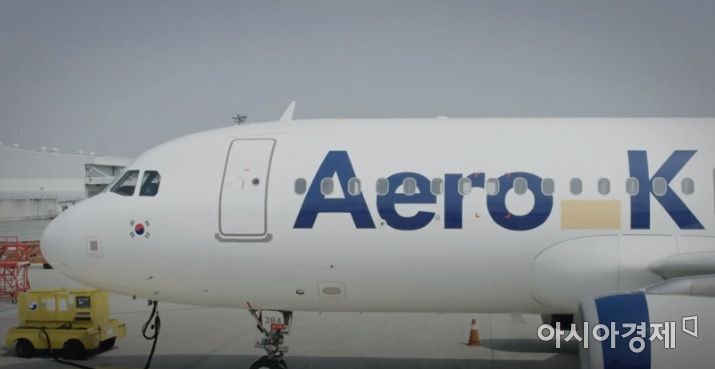
[Asia Economy Reporter Dongwoo Lee] Aero K, a newly established low-cost carrier (LCC) based at Cheongju International Airport, is facing deep concerns ahead of its first flight this week. Due to the impact of COVID-19, operating losses are expected from the start, and with capital funds nearing depletion, the launch of its inaugural flight has become uncertain.
According to the aviation industry on the 15th, Aero K is discussing postponing the launch of the Cheongju-Jeju route scheduled for the 19th. If it takes to the skies as planned, it would be the first flight since the company's establishment in December 2015, after 5 years and 3 months, but the situation is challenging.
As the COVID-19 crisis prolongs, even if the first flight begins, operations may soon have to be halted. Due to delays in issuing the Air Operator Certificate (AOC), the capital of 48 billion KRW has dwindled to about 1 billion KRW, effectively placing the company in a state of capital erosion. The industry expects that Aero K has incurred monthly expenses averaging over 1 billion KRW for aircraft maintenance and operational costs.
Internally, it is also difficult to decide on postponing the launch. The Ministry of Land, Infrastructure and Transport issued Aero K an air transport business license on March 5, 2019, with conditions to obtain the AOC and commence new operations within two years. If the new launch is not achieved by April 5 next year, the business license will be revoked.
Originally, Aero K secured its first Airbus A320 with 180 seats in February last year, but the issuance of the AOC was delayed due to the COVID-19 impact. According to the original plan, operations were to start early this year, with the addition of the second and third aircraft to expand routes from Cheongju International Airport to international destinations.
Aero K is closely monitoring whether the Ministry of Land, Infrastructure and Transport will consider extending the AOC deadline for new LCC companies in light of the COVID-19 impact. An Aero K official stated, "If the AOC extension is confirmed, the company plans to attempt a paid-in capital increase worth about 10 billion KRW to strengthen capital." However, it remains uncertain whether the capital increase can be successfully carried out amid the difficulties of normal operations due to COVID-19.
An aviation industry official said, "Not only Aero K but also the new LCC sector is currently facing a capital crisis and is pushed to the edge, making operations difficult," adding, "The government should include new LCC companies in its support scope to help overcome the COVID-19 crisis."
© The Asia Business Daily(www.asiae.co.kr). All rights reserved.

![Clutching a Stolen Dior Bag, Saying "I Hate Being Poor but Real"... The Grotesque Con of a "Human Knockoff" [Slate]](https://cwcontent.asiae.co.kr/asiaresize/183/2026021902243444107_1771435474.jpg)















