LG-SK 'Battery Lawsuit' New Phase
Key Negotiation Issues Q&A
LG Takes the Initiative
"Depends on SK's Negotiation Attitude"
Possibility of Additional Lawsuits in Europe and Elsewhere
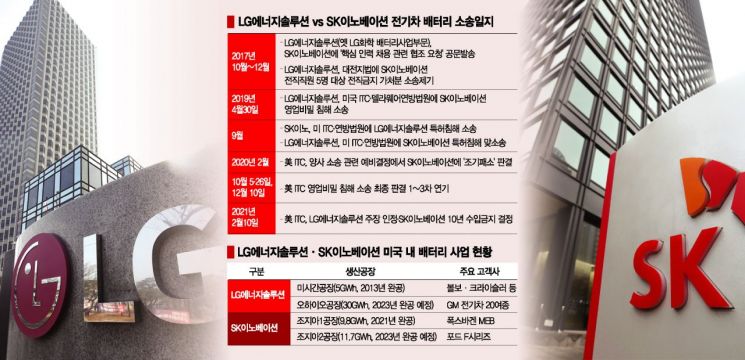
[Asia Economy Reporter Choi Dae-yeol] LG Energy Solution (formerly LG Chem's battery division) and SK Innovation are set to face each other at the negotiation table as early as this week to conclude the battery dispute that has lasted for 3 years and 5 months. Negotiations had been at a standstill due to significant differences in perception between the two companies over trade secret infringement, but with the U.S. International Trade Commission (ITC), a third-party organization, recognizing SK's trade secret infringement and imposing a severe penalty of a 10-year import ban, it is expected that SK will actively pursue a settlement. The key to the negotiations will be how much the two sides can narrow the gap in settlement amounts. We have explored the main issues likely to arise during the negotiation process through questions.
Issue 1. Who Was at Fault?
ITC Recognizes SK's Trade Secret Infringement
LG Claims Intellectual Property Protection
SK Unable to Accept Due to Veto Concerns
The final decision issued by the ITC on the 10th (local time) upheld the early ruling made by a U.S. administrative judge in February last year. At that time, before the two companies proceeded with the trial process, SK was ruled to have lost early due to evidence tampering and violation of forensic orders. The ITC stated that "SK Innovation's efforts to acquire LG Energy Solution's information were carried out on an organizational and company-wide level, and the possibility of legal issues was fully recognizable."
Internal emails from SK submitted as evidence during the lawsuit included LG's battery raw material component specifications, material compositions, and manufacturing secrets. LG has claimed that SK used the research achievements they had accumulated over a long period, such as battery cost structures, to bid at lower prices in domestic and international orders. SK Innovation, considered a latecomer in the electric vehicle battery market, had been increasing its market share by expanding its supply base over the past two to three years.
Before filing the lawsuit with the ITC, LG sent official letters to SK from October 2017, raising concerns about employee turnover. Even after the ITC lawsuit, the two companies engaged in fierce off-court battles. SK argued that the 76 employees who moved from LG in 2017-2018 accounted for less than 10% of total resignations (958 employees) and that they only assessed the employees' work capabilities and expertise during the transition.
The key issue is how the two companies will accept the ITC ruling. LG evaluated the ITC's final decision as "putting a brake on technology and personnel theft" and said it "secured protection for intellectual property (IP) accumulated through investments worth tens of trillions of won." On the other hand, SK expressed regret that the ITC did not properly assess the facts and openly stated its intention to correct the facts in the remaining procedures. This was seen as a tactic to prepare for a presidential veto during the review process, interpreted as an attempt to offset a disadvantageous position in negotiations.
Issue 2. What Is the Appropriate Settlement Amount?
Neither company has officially disclosed the settlement amount so far. According to industry sources, SK has proposed several hundred billion won, while LG's figure is reportedly in the range of 2 to 3 trillion won, showing a significant gap.
The difference stems from how the trade secret infringement, the core of the lawsuit, is viewed. Since the ITC ruled in favor of LG this time, LG holds the negotiation initiative. Unlike the early ruling last year, SK failed to avoid admitting trade secret infringement and to gain an advantageous position in negotiations. LG does not rule out the possibility of filing additional lawsuits in other regions such as Europe or Korea, where damages may also be recognized.
Under U.S. law, damages for trade secret infringement can include punitive damages, allowing up to an additional 200%. Industry insiders say the settlement amount proposed by LG is around 2.5 trillion won. If punitive damages are added, the settlement amount could more than double. For SK, whose battery business is just beginning to grow with annual sales around 1.6 trillion won (2020) and expected to turn a profit only after next year, this is a difficult amount to accept.
Investment bank Credit Suisse estimated that the settlement amount between the two companies could exceed 5 trillion won. Han Woong-jae, head of LG Energy Solution's legal office, said, "Whether punitive damages are reflected in the settlement amount depends on SK's negotiation attitude."
Issue 3. Will Off-Court Battles Affect the Outcome?
Industry Says "Ford and Others' Supply Suspension Grace Period Weakens Veto Justification"
Direct Negotiations Between the Two Companies Are the Best Option
Industry insiders evaluate that the ITC's decision to grant a 4-year and 2-year grace period for SK's customers Ford and Volkswagen to receive supplies has further reduced the possibility of a veto by U.S. President Joe Biden. If the battery import ban on SK were implemented immediately, the supply of electric vehicles in the U.S. would be directly affected, but allowing imports for a certain period weakens the justification for a veto. If the president exercises the veto, it could be criticized as disregarding intellectual property, an issue the U.S. administration has consistently emphasized in trade disputes with China, making the veto a practically unworkable option according to the industry.
The Korean government is also urging the two companies to reach an agreement, but LG believes that direct negotiations between the two companies are the best solution now that the ITC has made its decision. A legal official said, "Entering another arbitration process would require additional time and costs for procedures that have already taken nearly two years, making it difficult. We believe that an agreement is better reached directly between the parties, as third-party involvement could hinder the process."
Im Soo-gil, head of SK Innovation's center, said, "We will ensure that business, customers, the U.S. economy, and local communities are not disrupted in accordance with the remaining procedures," and added, "If reasonable conditions are met, we are ready to negotiate for a settlement at any time."
© The Asia Business Daily(www.asiae.co.kr). All rights reserved.
![Clutching a Stolen Dior Bag, Saying "I Hate Being Poor but Real"... The Grotesque Con of a "Human Knockoff" [Slate]](https://cwcontent.asiae.co.kr/asiaresize/183/2026021902243444107_1771435474.jpg)

















