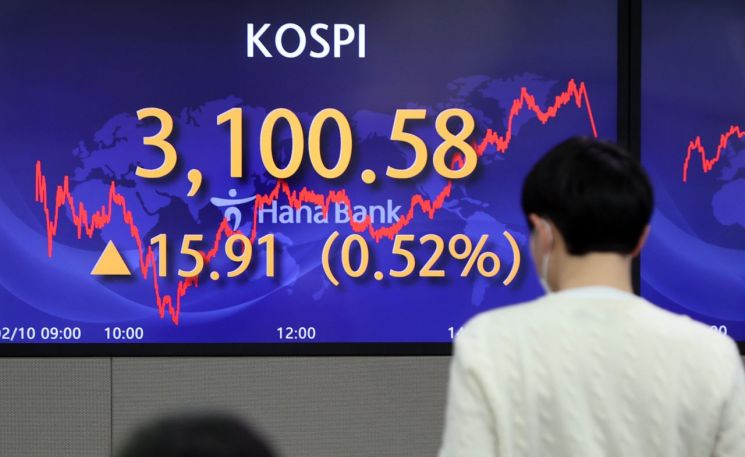
[Asia Economy Reporter Hwang Junho] The Korean stock market, reopening on the 15th after the Lunar New Year holiday, is expected to enter a period of consolidation. During the Lunar New Year holiday (11th-12th), global markets showed strong investor sentiment toward risk assets. While global stock markets such as those in the US and the UK showed upward trends, Korea's KOSPI, which experienced a sharper rise compared to global markets, is expected to need time to alleviate price pressures.
Global Stock Markets Strong During Lunar New Year Holiday... Preference for Risk Assets
In Korea, during the Lunar New Year holiday on the 11th and 12th, the strength of global risk assets continued. The stock markets in Europe and the UK showed notable gains. Over the two days, the US S&P 500 index rose 0.64%, surpassing its all-time high once again. International oil prices increased by more than 1%, with Brent crude exceeding $61 per barrel and WTI surpassing $58. Gold recorded a decline of around 1%, and the dollar showed only slight fluctuations within a strong range.
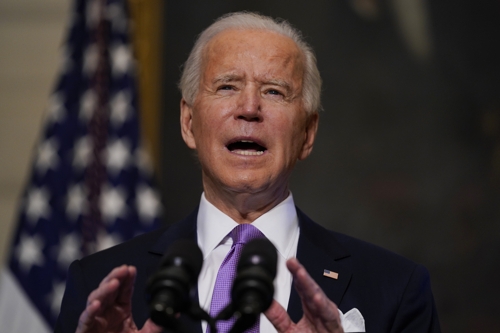
Expectations for US economic stimulus and expanding geopolitical risks fueled the rise. The market reacted sensitively to expectations that US President Joe Biden's $1.9 trillion stimulus package would pass Congress this month and to Treasury Secretary Yellen's calls for additional stimulus measures. Furthermore, strong US corporate earnings and a decrease in COVID-19 cases below 100,000 influenced the stock market's rise.
Economic indicators released during the holiday were disappointing. The University of Michigan's February consumer sentiment index stood at 76.2, significantly below the forecast of 80.8. It also declined compared to the previous month (79.0). This was a variable that disappointed the market, which had initially expected improvement from the previous month.
US bond yields crossed critical thresholds. For the first time since February last year, the 30-year and 10-year US Treasury yields exceeded 2% and 1.2%, respectively. The combination of weak economic indicators and rising bond yields dampened investor sentiment. Despite concerns over oversupply, international oil prices were supported by expanding geopolitical risks in the Middle East and worries about weakening alliances between the US and Saudi Arabia.
KOSPI Expected to Consolidate After Lunar New Year Holiday

Lee Kyung-min, a strategy researcher at Daishin Securities, stated, "Korea's KOSPI showed outstanding strength from November through early January." He added, "The 60-day return difference between global stock markets and the KOSPI expanded to 26 percentage points on January 11, the highest since 2002." He further analyzed, "Although the outperformance margin has recently narrowed to 10 percentage points, it is difficult to say that the short-term price pressure on the KOSPI has been resolved."
He continued, "Amid price and valuation pressures, the weak performance during the fourth-quarter earnings season has led to relative underperformance of the KOSPI compared to global and US stock markets. The KOSPI, having run fast, ahead, and far, is expected to remain in a consolidation phase for the time being."
© The Asia Business Daily(www.asiae.co.kr). All rights reserved.
![Clutching a Stolen Dior Bag, Saying "I Hate Being Poor but Real"... The Grotesque Con of a "Human Knockoff" [Slate]](https://cwcontent.asiae.co.kr/asiaresize/183/2026021902243444107_1771435474.jpg)












