UNIST Research Team Publishes Study Results in Nature Communications on the 5th
[Asia Economy Reporter Kim Bong-su] An additive that can dramatically extend the lifespan of large-capacity electric vehicle batteries has been developed.
On the 14th, according to Ulsan National Institute of Science and Technology (UNIST), a research team composed of Professors Namsoon Choi and Sangkyu Kwak from the Department of Energy and Chemical Engineering and Professor Sungyu Hong from the Department of Chemistry at the school recently developed a battery electrolyte additive that can solve the instability of electrode materials, which has been a major challenge in developing large-capacity lithium-ion batteries.
As demand for large-capacity batteries, including those for electric vehicles, increases, active research is underway to replace the electrodes of commercial lithium-ion batteries with high-capacity materials such as silicon and high-nickel. However, silicon anodes suffer from poor mechanical durability due to volume changes of more than three times during charge and discharge cycles, and high-nickel cathodes also face chemical instability issues.
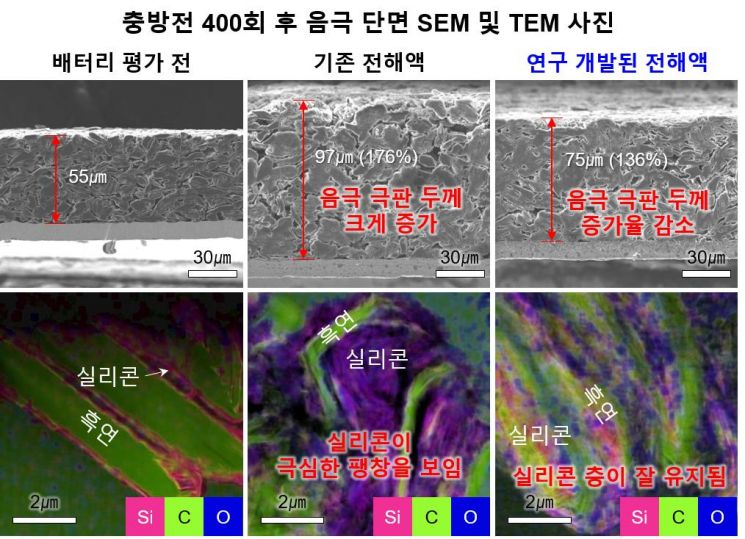
The additive developed by the research team forms a flexible and elastic protective film, similar to a rubber band, on the surface of the silicon composite anode. It also has excellent lithium-ion permeability (mobility), reducing mechanical overload caused by the repetitive volume changes of silicon and enabling fast charging. It removes hydrofluoric acid (HF) in the electrolyte, preventing the leakage of internal metals (nickel) from the high-nickel cathode. The amount of internal metal in the cathode determines the battery capacity.
When this additive was applied to a large-capacity battery composed of a high-nickel cathode and silicon composite anode, it maintained 81.5% of its initial capacity even after 400 charge-discharge cycles, which is 10% to 30% better performance compared to commercial additives such as FEC or VC.
Se-won Park, a doctoral researcher in the Department of Energy and Chemical Engineering at UNIST and co-first author, added, “In experiments involving fast charging the battery within 20 minutes, only a 1.9% capacity loss was observed after 100 cycles.” Professor Sangkyu Kwak explained the protective film formation process clarified through simulation: “The developed additive decomposes in the electrolyte to produce active species (radicals). These active species sequentially react with other additive components to form a flexible polymer protective film on the silicon electrode surface.” Professor Sungyu Hong also added, “The specific structure of the additive that forms the polymer protective film is not easily synthesized through typical chemical reactions, so we solved the problem by employing an intermediate reaction pathway.”
Professor Namsoon Choi stated, “This achievement is the result of collaborative research involving material structure design, experiments, simulations, and synthesis methods to overcome the shortcomings of existing additives (VC). It presents a new direction for developing electrolyte additives for large-capacity lithium-ion batteries,” highlighting the significance of the study.
The research results were published on the 5th in the prestigious international journal Nature Communications. Recognized for its excellence, the paper was also featured as an Editors’ Highlight selected by the journal’s editors. The study was supported by the Energy Technology Development Project of the Korea Energy Technology Evaluation and Planning (KETEP) and the Climate Change Response Technology Development Project of the National Research Foundation of Korea.
© The Asia Business Daily(www.asiae.co.kr). All rights reserved.
![Clutching a Stolen Dior Bag, Saying "I Hate Being Poor but Real"... The Grotesque Con of a "Human Knockoff" [Slate]](https://cwcontent.asiae.co.kr/asiaresize/183/2026021902243444107_1771435474.jpg)
















