Pilot Operation of Wireless Communication Control for Rail Logistics Switching at Daejeon Jochajang Station
Ensuring Worker Safety in Rail Transport Operations... Over 50% Reduction in Accidents
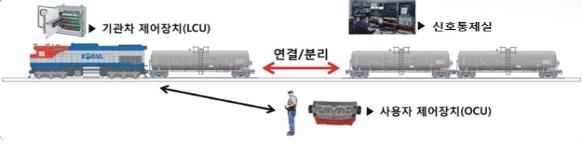 Wireless Control Switching Operation Flowchart / Provided by the Ministry of Land, Infrastructure and Transport.
[Asia Economy Reporter Kangwook Cho] The Ministry of Land, Infrastructure and Transport and Korea Railroad Corporation (KORAIL) announced on the 14th that they will pilot the 'Wireless Control Shunting System' at Daejeon Marshalling Yard Station starting from the 15th by applying wireless communication technology to railroad vehicle shunting operations.
Shunting refers to the operation of connecting, disconnecting, exchanging, or moving vehicles to form a train.
'Wireless control shunting' is a method where, unlike the conventional shunting where the engineer and workers communicate with each other to assemble railroad vehicles, the worker moves the locomotive using a wireless controller (remote control) to perform shunting tasks such as connecting and disconnecting train cars.
The wireless control shunting system is the first to be applied in railroad logistics operations. Since the worker visually confirms the vehicle connection status and controls vehicle movement via wireless communication, it is expected to prevent occupational accidents such as collisions between railroad vehicles and workers caused by communication errors between workers and engineers under the existing system.
Under the conventional shunting method, a total of 36 casualties occurred over the past 10 years, including 4 deaths. However, the Ministry of Land, Infrastructure and Transport and KORAIL stated that by supplementing the shortcomings of overseas cases, the number of accidents is expected to decrease by more than 50% through wireless control shunting.
KORAIL formed a dedicated wireless control task force (T/F) for this pilot operation and deployed two diesel locomotives equipped with wireless control shunting devices. For safety, personnel for the existing shunting method were organized, and personnel responsible for abnormal situation response and vehicle fields were also designated. Through this pilot operation, they plan to supplement the shunting signaling system, operation manual, and emergency response manual.
Kang Hee-eop, Director of Railroad Safety Policy at the Ministry of Land, Infrastructure and Transport, stated, "The wireless control shunting system is expected to contribute to securing worker safety in railroad transportation operations and establishing a people-centered safety culture."
Meanwhile, the Ministry of Land, Infrastructure and Transport plans to prepare support measures such as regulatory revisions and system improvements within this year for the full-scale introduction of wireless control shunting.
© The Asia Business Daily(www.asiae.co.kr). All rights reserved.

















