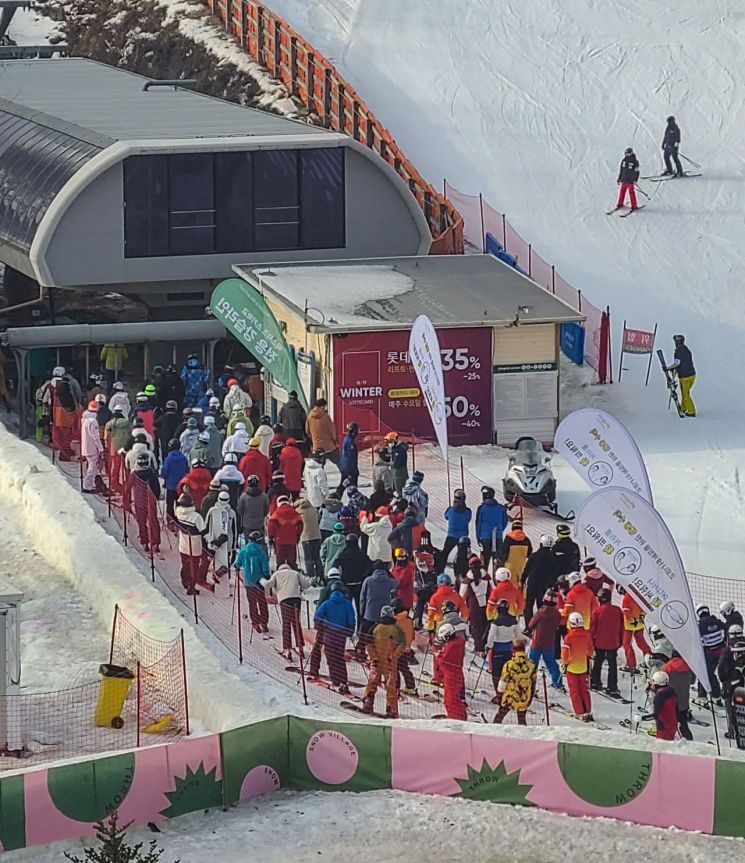
 On the afternoon of the 7th, a holiday, visitors lined up waiting to use the lift at a ski resort in Pyeongchang, Gangwon Province. [Image source=Yonhap News]
[Asia Economy Reporters Donghoon Jeong and Jeongyun Lee] As more people decide not to visit their hometowns due to COVID-19 during the Lunar New Year holiday, ski resorts are expected to be crowded with those wanting to enjoy skiing, a representative winter sport.
On the 12th, Asia Economy inquired at 10 ski resorts in the Seoul metropolitan area and Gangwon Province before the Lunar New Year holiday. Seven of these resorts reported that over 90% of their accommodations (hotels and condos within the ski resorts) were booked during the holiday period (February 11-13).
Although most accommodations such as hotels and condos are relatively expensive, most rooms at popular ski resorts near the metropolitan area were already reserved last month when online and phone reservations began. Ski resort accommodations are required by health authorities to operate at only two-thirds of their total room capacity, but they continue to experience a "sold-out streak."
On the 9th, attempts to make reservation inquiries by phone at several ski resorts were met with difficulty even reaching a representative. Some resorts had as many as 57 people waiting on the phone for consultation. It took tens of minutes to get through. Only a few rooms were available for reservation. For example, Ski Resort A, which has over 400 rooms, had only one 33-pyeong (approximately 109 square meters) room available. On the 1st, health authorities partially allowed night skiing after 9 p.m., which is expected to increase the number of ski resort visitors even further.
Besides ski resorts, many people are visiting tourist attractions. According to Korea Airports Corporation, the number of domestic flight passengers from the 10th to the 14th is expected to reach 840,000. Passenger traffic is expected to concentrate on the day before the holiday, the 10th, and the last day. Although this is a decrease compared to last year's Lunar New Year holiday, concerns remain high due to ongoing COVID-19 spread and the threat of variant viruses. During this period, international flight passengers are also expected to reach 32,147. Jeju Island has even established plans for strong measures, including claiming damages, against tourists who harm quarantine efforts by refusing pre-arrival testing.
When an unspecified large number of people gather simultaneously in multi-use facilities, the risk of infection increases and it becomes difficult to trace infection sources. Professor Eunmi Cheon of the Department of Respiratory Medicine at Ewha Womans University Mokdong Hospital said, "If people go to tourist destinations instead of their hometowns, they inevitably gather and come into contact in facilities used by many people such as hotels and restaurants. On the other hand, visiting one's hometown or parents' home involves fewer contacts. It is actually safer to visit your parents."
© The Asia Business Daily(www.asiae.co.kr). All rights reserved.
![Clutching a Stolen Dior Bag, Saying "I Hate Being Poor but Real"... The Grotesque Con of a "Human Knockoff" [Slate]](https://cwcontent.asiae.co.kr/asiaresize/183/2026021902243444107_1771435474.jpg)
















