Over 14 Million Laying Hens Culled Due to AI Spread
Most Imported Eggs Used for Processing... Domestic Eggs Near 8,000 Won per Carton
 On the 2nd, the government announced plans to supply 20 million imported eggs to the market before the Lunar New Year holiday to stabilize egg prices, which have surged due to the spread of highly pathogenic avian influenza (AI). Citizens are seen shopping at a large supermarket in Seoul. Photo by Jinhyung Kang aymsdream@
[Sejong=Asia Economy Reporter Kim Hyunjung] The government ultimately failed to curb the soaring egg prices ahead of the Seollal holiday. The continuous spread of highly pathogenic avian influenza (AI) and limitations in retail market distribution have rendered the 'duty-free imported eggs' response largely ineffective.
According to the Ministry of Agriculture, Food and Rural Affairs on the 11th, as of 4 p.m. the previous day, the price of eggs (special grade, 10 pieces) was 2,494 won, a 44.3% increase compared to the same period last year. Compared to a month ago, it rose by 15.5%, and compared to the average year, it increased by 41.0%. Based on a carton of 30 eggs, the price is 7,482 won, and some retail stores are already selling them for over 8,000 won.
The farm gate price is already twice the average year’s level. On the same day, the farm gate price for 10 special grade eggs was 1,948 won, up 93.8% from the previous year and 101.0% from the average year.
The main cause of the egg price increase is the shortage of laying hens due to successive culling caused by highly pathogenic AI. As of midnight on the 10th, since the spread of AI at the end of November last year, a total of 14,389,000 laying hens have been culled at 173 domestic farms.
As of 9 a.m. on the 11th, a total of 88 cases of highly pathogenic AI have been confirmed in domestic poultry farms since the end of last year. There have been 172 cases confirmed in wild birds. Notably, highly pathogenic AI has been detected nationwide in wild birds, including Seoul, Incheon, Gyeonggi in the metropolitan area, as well as Busan, Daegu, Gangwon, Chungbuk, Chungnam, Jeonbuk, Jeonnam, Gyeongbuk, Gyeongnam, and Jeju.
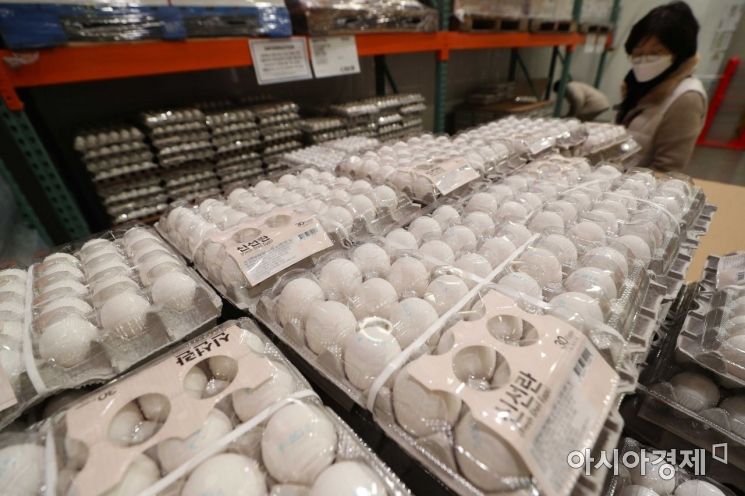 American eggs imported to stabilize the soaring egg prices caused by the spread of highly pathogenic avian influenza (AI) are being sold on the 8th at a warehouse discount store in Seocho-gu, Seoul. Photo by Moon Honam munonam@
It is not only eggs whose prices have risen. Prices of duck meat and chicken meat are also on the rise. As of 4 p.m. on the 10th, the farm gate price of duck meat was 3,271 won per kg, soaring 140% compared to last year. However, by releasing frozen stock, the rise in consumer prices has somewhat eased, recording a 19.6% increase compared to the previous year. For broiler chickens, the farm gate price per kg was 1,439 won, and the consumer price was 5,863 won, up 6.7% and 15.8% respectively from last year.
The government has been supplying duty-free imported eggs domestically since the 28th of last month to stabilize egg prices. However, consumption of imported eggs at home tends to be reluctant, and since they are mainly used for processing in restaurants and bakeries, it is evaluated that this has no effect in lowering retail egg prices.
However, applying the consumption coupon (Let's Farm Discount Korea) promoted by the government ahead of the Seollal holiday can reduce the price burden. As of the 10th, the price of a carton of 30 special grade eggs with the consumption coupon applied is 6,877 won, about 30.6% higher than the average year (5,307 won).
© The Asia Business Daily(www.asiae.co.kr). All rights reserved.

![User Who Sold Erroneously Deposited Bitcoins to Repay Debt and Fund Entertainment... What Did the Supreme Court Decide in 2021? [Legal Issue Check]](https://cwcontent.asiae.co.kr/asiaresize/183/2026020910431234020_1770601391.png)